

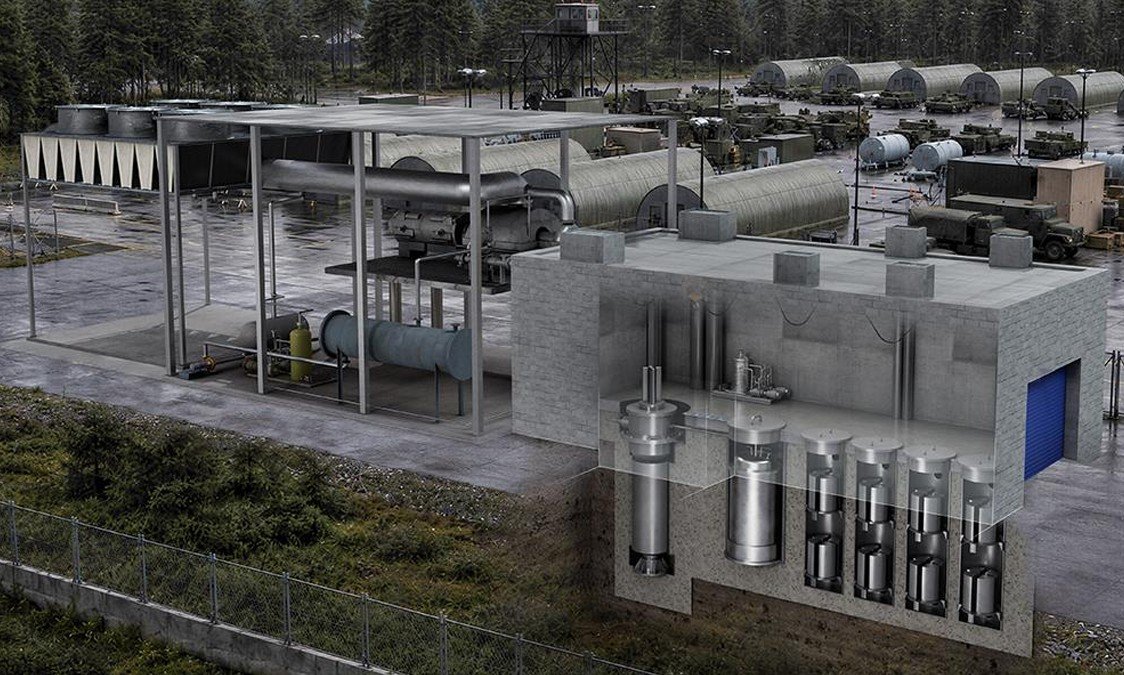
The Army is moving forward with its plan to use nuclear microreactors to power major bases, hoping the technology can safeguard the service from potential threats to U.S. infrastructure.
Five companies will design and build reactors under a set of contracts collectively worth up to $2.2 billion, the service said Wednesday. The initiative, dubbed Project Janus, looks to achieve greater energy independence so critical military missions can continue if the commercial electrical grid fails.
“Everything that we do, from communications to radar, just requires constant energy,” Jeff Waksman, principal deputy assistant secretary of the Army for installations, energy and environment, told reporters Wednesday. “As we start to think about where things are going in the future with drones, with energy weapons, there’s just more and more demand for electricity.”
Nuclear energy is a “natural game-changer” for the Army, he added.
Each firm will work with one of five Army installations to mature and deploy reactor prototypes in the coming years. The pairings include: Antares Nuclear and Fort Bragg, North Carolina; BWXT Advanced Technologies and Fort Campbell, Kentucky; General Atomics Electromagnetic Systems and Fort Hood, Texas; Radiant Industries and Fort Benning, Georgia; and Westinghouse Government Services and Fort Drum, New York.
Selecting bases and vendors
The Army announced last year it would consider several sites to host its first microreactors. The winning locations prevailed on factors ranging from security and mission set to the area’s likelihood of seismic activity.
“It’s really difficult to look across the five and not draw the immediate conclusion that this is a direct link to power projection,” Brandon Cockrell, the Army’s deputy assistant secretary for energy and sustainability, said. “That was a critical aspect that we looked at. … We have to be able to meet the Army’s mission if there are any vulnerabilities in the grid.”
The companies are now on the clock to get at least one reactor up and running by the end of September 2028 — a deadline President Donald Trump set in an executive order last year.
Dozens of officials and experts from across government and academia vetted bids based on their cost, schedule, technical feasibility and benefit to the Army, among other criteria. Waksman argued each company’s timeline is “aggressive but plausible,” and that the bases and reactor designs that were chosen offer the best chance of success.
“This is already very difficult,” he said. “There’s a reason no one has actually built a fully operational commercial nuclear microreactor before.”
Under the other transaction agreements, issued in partnership with the Defense Innovation Unit, the firms will be paid as they hit each of the program’s milestones. Waksman expects “billions of dollars” in private capital will comprise the majority of the program’s funding, but declined to provide specifics.
Though Radiant said Wednesday it had inked an agreement for up to $750 million, the Army declined to answer how much money the other companies may receive as part of the larger pot.
The contracts fund each reactor’s construction and their first year of operations, Waksman said. After that, the Army will begin covering the costs.
But Waksman acknowledged that number is still murky.
“The reality is, nobody knows what these microreactors are going to cost,” he said. “We don’t ever expect that microreactors are going to be quite as cheap as big reactors. … They don’t need to be at natural gas prices for these to have a lot of value to the Army.”
Contract0r-operated reactors
Contractors will own and run their reactors; the Army will supply that workforce with technical knowledge and other support. Officials likened the partnership to the collaboration between NASA and industry on early space programs.
The reactors will first go through an Army-run regulatory process, which Waksman said ideally will align with those used by the Department of Energy and the Nuclear Regulatory Commission. Each system must also comply with federal environmental rules.
Defense officials have a dual goal: They want to create the foundation for a commercial microreactor industry as well. Janus funding subsidizes costs that can make or break a company trying to get a new technology off the ground.
For instance, Radiant said it plans to deploy 15 reactors for the Army by 2030. That’s on top of an earlier agreement to bring its products to Colorado’s Buckley Space Force Base.
“Operating on military installations first gives us the reliability track record to unlock commercial deployments,” Radiant’s Chief Commercial Officer Mike Starrett said in a release. “The resulting, much larger commercial volume drives down costs, letting the government buy at scale for less.”
General Atomics, meanwhile, said it would use the contract at Fort Hood to implement a microreactor design that’s capable of scaling from 5 megawatts to 20 megawatts.
“Our experience designing and deploying 68 reactors worldwide and supporting reactor technologies throughout their lifecycles positions us to deliver assured energy solutions that enhance operational resilience and strengthen mission readiness,” Scott Forney, the company’s president said in a statement.
Risk borne by vendors
Waksman acknowledged the “very real chance that one or more of these companies will fail.”
“We want to ensure that, at all times, we have competition,” he said. “We believe that this will be the spear tip, not just for microreactors, but for all advanced reactors in the United States.”
The project could also spur more growth in nuclear engineering as a technical field in the Army, Waksman said.
“West Point is very excited about trying to get more cadets into nuclear engineering, and I think we are going to see that,” he said. “This is part of the general push that the Army has had to become more technically forward, be more of a technology leader.”
The Army effort joins others across the U.S. military that seek to reap the benefits of nuclear energy. It plans to expand the Janus initiative to other Army sites in the future.
Community outreach and local concerns
But concerns persist about the long-term impact that nuclear energy could have on local communities.
Officials maintained the reactors are safe and will not contaminate local soil. Radiological material must be removed from each site within the first two years of operation, and comply with federal limits on radiation in soil. Waksman added that the service has dug into the physical risks reactors may pose to the workforce and ways to minimize them.
The Army plans to continue engaging with the communities that are slated to receive the microreactors, saying it has met with elected officials and locals and will hold town halls.
“We wouldn’t be putting these on these installations unless we had absolute certainty and comfort in the safety of these systems,” Waksman said. “I’d much rather live near one of these microreactors than live near a fuel farm.”
Copyright
© 2026 Federal News Network. All rights reserved. This website is not intended for users located within the European Economic Area.
