

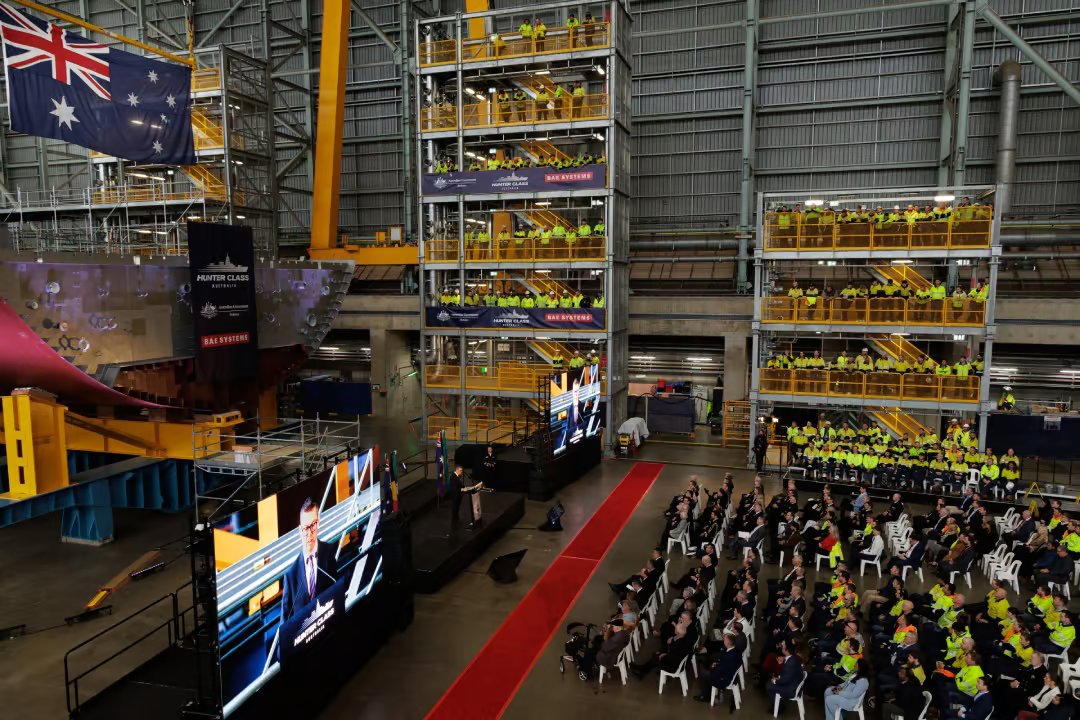

Australia has laid the keel for its first Hunter-class anti-submarine warfare (ASW) frigate. The keel laying took place at Osborne Naval Shipyard, South Australia, on 24 August.
In a statement, the Australian government said the keel laying marked “a significant milestone in delivering Australia’s future surface combatant fleet”. The new frigates will strengthen Australia’s ability to operate with allies and partners, it added.
The keel-laying process involved joining together two of the ship’s 22 building blocks. Passing this latest point in the delivery of what, in Australian naval terminology, is currently called ‘Nuship Hunter’ follows steel cutting on the vessel in June 2024.
Six Hunter-class frigates are being procured under the Royal Australian Navy’s (RAN’s) SEA 5000 Phase 1 programme. The ships are based on BAE Systems’ Global Combat Ship design, from which derivatives are also being procured for the UK Royal Navy (Type 26 City-class frigate) and the Royal Canadian Navy (River-class destroyer).
The RAN’s ships are scheduled to start arriving in service from the early 2030s.
Speaking at the Osborne keel-laying ceremony, Pat Conroy MP – Australia’s defence industry minister – said the RAN’s programme is integrating UK design expertise and Australian shipbuilding prowess.
The Minister added that, with Australia engaged in significant naval construction work including the Hunter class (which, he noted, will run for 20 years of build activity), the country will have a continuous shipbuilding programme.
Such capacity is key to underpinning Australia’s future maritime and wider security needs. These needs include bolstering Australian interests in three oceans (Indian, Pacific, and Southern), and building trade and national security links at sea. All of this is reinforced, the minister said, by the country’s naval power.
The RAN is meeting these objectives while adapting to rapid changes in technology and operating environments, Minister Conroy added.
Such adaptation has included adjusting naval procurement programmes when needed.
The Hunter-class programme brings upgraded capabilities to enhance the RAN’s surface fleet outputs and supports Australia’s aim of building a larger fleet that enhances deterrence impact. However, the originally planned buy of nine vessels was cut to six, under a review into the balance of the RAN’s surface fleet force structure, published in February 2024. Following that review, the navy will be adding at least seven (and maybe 11) general-purpose frigates, based on Japan’s Mogami-class Batch II frigate design, to its fleet. The twin-track frigate programme is designed to enhance both platform numbers and lethality for the RAN.
In its latest National Defence Strategy and supporting Integrated Investment Plan (IIP), both published earlier in 2026, the government said the Hunter-class frigates would enhance the RAN’s underwater, air-defence, and wider strike capabilities. In this context, the IIP noted that Australia is assessing the suitability of a Tomahawk cruise missile fit for the Hunter-class.
by Dr. Lee Willett
