

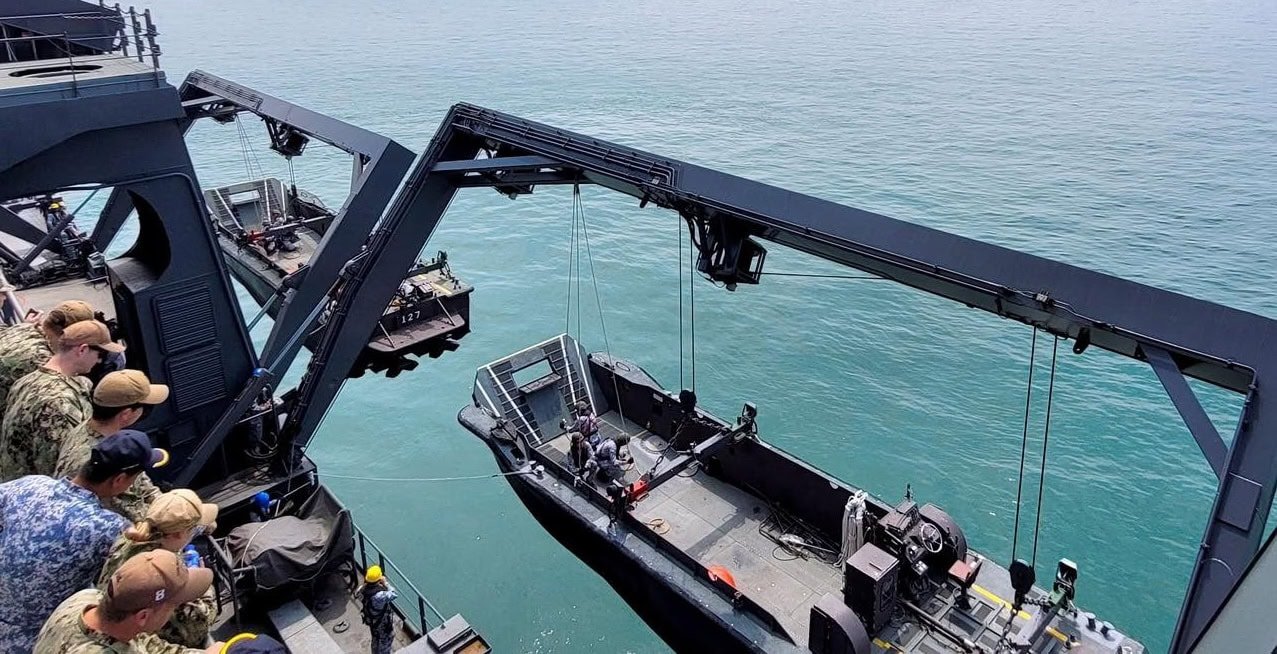
Singapore’s Ministry of Defence has awarded local shipbuilder Penguin International a contract to design and construct two new landing craft for the Republic of Singapore Navy (RSN).
This is part of an evaluation for the eventual replacement of the navy’s existing Fast Craft Equipment and Personnel (FCEP) and Fast Craft Utility (FCU) landing craft platforms.
The two new craft will undergo operational evaluation before any decision is made on a fleet-wide replacement.
“The landing craft will be assessed for its suitability to meet the RSN’s operational requirements before any decision is made on the full replacement of the FCEP and FCU,” the RSN said in a statement.
Singapore’s Defence Science and Technology Agency (DSTA) will also participate in the development programme. Delivery of the first craft is expected from 2029.
The FCU currently in RSN service was built by ST Engineering and introduced in the 1990s. The 22m-long craft has a 7m beam and 600mm draught, with a 77m² deck capable of carrying troops or vehicles weighing up to 18 tonnes.
These craft support ship-to-shore operations, including deployment from the well dock of the RSN’s Endurance-class landing ship tanks (LST).
The existing FCU is operated by a crew of four, but the new design is expected to reduce crew requirements whilst also increasing payload capacity. This is particularly important as the Singapore Army transitions towards heavier platforms.
The smaller FCEP is also used for ship-to-shore movements, and it can be deployed from the side davits of Endurance-class LSTs.
Penguin International said the contract marks its first naval shipbuilding programme as prime contractor. Construction and integration will be carried out entirely in Singapore at the company’s Tuas shipyard.
The company has previous experience supporting RSN shipbuilding programmes, having fabricated carbon-fibre composite superstructures for the new Victory-class Multi-Role Combat Vessels.
This prototype approach to landing craft allows the RSN and DSTA to evaluate the vessels against operational requirements before committing to a larger procurement. It also potentially provides an opportunity to incorporate lessons from the Singapore Army’s evolving requirements for heavier equipment and future ship-to-shore operations.
by Chen Chuanren
