

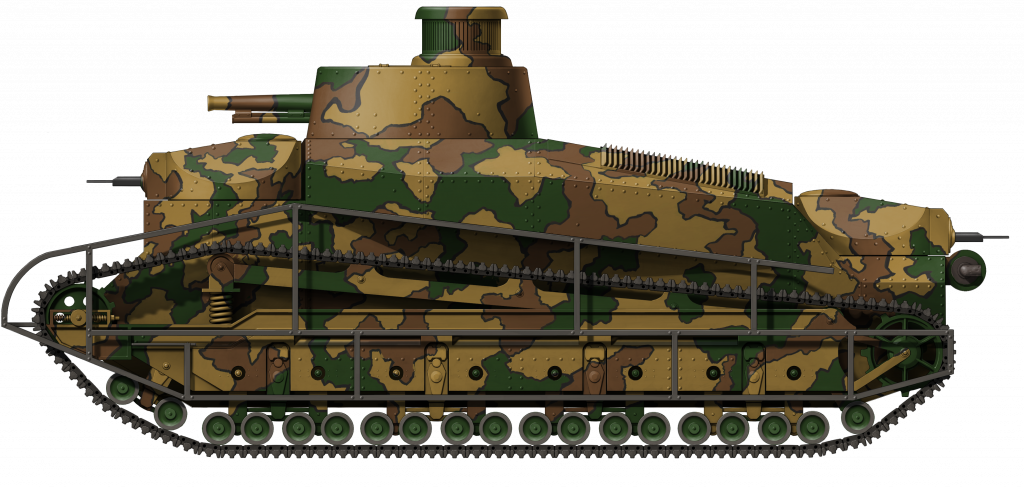
Empire of Japan (1925-1930)
Tank – 2 Built (1 Mk.I And 1 Mk.I-Kai)
During the 1930s, military thinkers from the major military powers widely expected that any future conflict would resemble the First World War. Crucially though, none wished to see a repeat of static trench warfare, prolonged stalemates in swamp-like terrain, or relentless machine gun fire that prevented movement for months at a time. Consequently, many tanks of the period were conceived primarily as breakthrough infantry support vehicles: large, slow-moving machines equipped with numerous anti-personnel weapons. This era also witnessed a widespread enthusiasm for multi-turret tank designs, adopted in one form or another by most leading nations. Imperial Japan was no exception, developing several such vehicles, the first of which was the Osaka Experimental Tank Mark I.
Timestamp for I-Kai trials – 25:18. Source: Imperial Japanese Army Technical Headquarters (陸軍技術本部), Heiki no Genkyō to Sono Sūsei (兵器の現況と其趨勢; “The Current State and Trends of Weapons”) – Produced by Seikō Kinema-sha [精巧キネマ社], 1933 – 56 min., black and white, silent – Digitized and restored by the National Film Archive of Japan; uploaded March 8, 2024 // YouTube, National Film Archive of Japan channel

From Sakoku to Militarism
The Meiji Restoration of 1868 ended over two centuries of Tokugawa shogunate rule, restoring imperial authority under Emperor Meiji and initiating Japan’s transformation into a modern nation-state. This period emphasized rapid industrialization, the adoption of Western technologies, and far-reaching military reforms intended to prevent colonial subjugation.

Source: Polak Christian Philippe, “Contributions of France to Japan’s Industrial Modernization from the End of the Edo Period to the Meiji & Taisho Eras” // Japan Spotlight, May/June 2020. — Japan Economic Foundation
Following the Meiji period, the Taishō era (1912-1926) saw the brief emergence of so-called Taishō democracy, during which parliamentary influence expanded, and Japan fought on the Entente’s side during the First World War, seizing German possessions in Asia and the Pacific. Nevertheless, underlying tensions, including economic inequality, labor unrest, and the devastation caused by the 1923 Great Kantō Earthquake, deepened social and political instability.
Militarism accelerated in the early Shōwa era, beginning with Emperor Hirohito’s accession to the throne in 1926. The Great Depression, which reached Japan in 1929, brought severe unemployment, rural hardship, and growing disillusionment with liberal democracy. Ultra-nationalist organizations and military factions, such as the Kwantung Army, gained influence and advocated autarky and territorial expansion to secure key resources such as coal, iron, and oil.

Political violence, including the assassination of Prime Minister Inukai Tsuyoshi in 1932, shifted power decisively towards the military. Education and the media were increasingly used to promote imperial loyalty and anti-Western sentiment. The early Shōwa years thus presented a paradox; the era’s name, meaning ‘enlightened peace’, contrasted sharply with the militaristic course that led Japan towards war.
Relations with Imperial Russia had formed a central strand of Japan’s imperial policy, marked by rivalry over Northeast Asia. Russian expansion into Siberia and attempts to influence Korea and Manchuria clashed with Japanese ambitions in the same regions. These tensions culminated in the Russo-Japanese War of 1904-1905, triggered by disputes over Port Arthur and dominance in Korea. Japan’s victory, formalized in the Treaty of Portsmouth (1905), made it the first Asian power to defeat a European state and secured southern Sakhalin, railway rights in Manchuria, and international recognition of its position in Korea.

1). Russians (far side of table): Sergey Yulyevich Witte (1849 – 1915), the Prime Minister of the Russian Empire, in the middle. Next to him – diplomats: Ivan Yakovlevich Korostovetz (1862-1933), Konstantin Dmitrievich Nabokov (1872 – 1927), Roman Romanovich Rosen (1847 – 1927), and Georgy Antonovich Plançon (1859 – 1937);
2). Japanese (near side of table): Komura Jutarō (1855 – 1911), the Minister for Foreign Affairs of the Japanese Empire, in the middle. Next to him – diplomats: Adachi Mineichirō (1870 – 1934), Kentarō Ochiai (1870 – 1926), Takahira Kogorō (1854 – 1926), and Aimaro Satō (1857 – 1934).
Source: P. F. Collier & Son. Russo-Japanese War: A Photographic and Descriptive Review of the Great Conflict in the Far East
Hostility nevertheless persisted. Japan intervened against Bolshevik forces during the Russian Civil War (1918-1922), occupying parts of Siberia until 1922 and reinforcing Soviet mistrust. Diplomatic relations were normalized in 1925, but ideological antagonism endured, with Japan’s anti-communism set against Soviet revolutionary aims. Manchuria, rich in natural resources, became a key arena in this rivalry. The South Manchuria Railway Company embodied Japanese economic penetration, while Chinese resistance and Soviet influence further complicated the situation.
Japan’s 1931 invasion of Manchuria crystallized its militarist turn. On September 18th, the Mukden Incident, a staged explosion on the South Manchuria Railway orchestrated by Kwantung Army officers, provided a pretext for full-scale occupation. Despite initial hesitation in Tokyo, the army rapidly seized control of the region, meeting limited resistance from Zhang Xueliang’s forces, who had been ordered to withdraw. In 1932, Japan created the puppet state of Manchukuo, installing Puyi, the last Qing emperor, as a nominal ruler while retaining real authority. This step provoked international condemnation, with the League of Nations’ Lytton Report declaring the new state illegitimate, leading to Japan’s departure from the organization.

Source: ‘League of Nations’ photo (rus. “Лига Наций”) // PHistory.info
The conquest of Manchuria secured vital resources for Japan’s industrial and military sectors during the global economic crisis, but it greatly intensified conflict with China. At the same time, potential adversaries extended beyond the USSR and China: the United States regarded Japanese expansion as a threat to its Open Door Policy, while Britain and France, distracted by European concerns, offered only limited resistance. These developments highlighted Japan’s increasingly isolated yet aggressive stance, in which militarism expanded to fill the space left by diplomatic deadlock.
International Japanese Army
Until the 1920s, the Imperial Japanese Army produced almost no armored vehicles. Seeking to modernize its land forces, the high command ordered a number of complete armored cars from abroad. Having tested this equipment, it then initiated the development of indigenous designs.
Certain details of the early history of Japanese armored vehicles still remain unknown. The data presented in different sources vary noticeably and at times even contradict one another. These discrepancies create certain difficulties, yet it is still possible to form a reasonably detailed and comprehensive picture by comparing and cross‑checking the available evidence.
In the closing weeks of the First World War, Britain sold a Mark IV Female tank to Japan. It was widely demonstrated to the Japanese public, who had never seen a tank before, and served as a study vehicle for Japanese engineers developing their own designs. The vehicle was christened ‘Dai 1 Gou Kinen Sensha’ or ‘First Memorial Tank’.

Source: ‘Japan’s First Tank’ // Sensha-Manual.blogspot.com, 2016
The earliest known indigenous armored vehicle in service of the Imperial Japanese Army seems to have been the Experimental Light Armored Car (試製軽装甲自動車, Shisei Keisōkō Jidōsha). Only several photos of the vehicle remain, supported by limited information. Vehicles of this type were built in 1919 specifically for the Siberian Expedition, the Japanese intervention in the Russian Far East.

Source: “Little Armored Car” (rus. «Броневичек») // seryj221221, LiveJournal, August 30th, 2022;
In 1919, thirteen Renault FTs were purchased from France. The most widely used tank in the world at the time, it became the mainstay of Japan’s early infantry tank force under the designation FT-Kō or Ko-gata sensha. These vehicles saw active service during the Manchurian Incident of 1931 with the 1st Tank Unit of the 12th Division. Ten additional vehicles were ordered from France in 1931, this time the Renault NC27, a modernized and improved variant of the FT, designated ‘Otsu’ by the Japanese. They were deployed with the 1st Tank Unit at Kurume and remained in China for the duration of the Second World War.

Source: @tankmuseum_jp via x.com
In 1921, the Imperial Japanese Army acquired several British Mark A Whippet tanks, its first operational armored vehicles. Around six were tested and employed in maneuvers until 1930, making them the third type of tank to operate on Japanese soil. Their original armament was replaced, apparently with 6.5 mm Type 3 machine guns in place of the standard Hotchkiss weapons.

Another vehicle of the period was a 75 mm Type 88 anti-aircraft gun mounted on a militarised Ishikawajima-built Wolseley truck. Development began in 1923, when the Imperial Japanese Army tasked the Osaka Artillery Arsenal with installing anti-aircraft weapons on motor vehicles, seeking to match contemporary air defense methods employed by other nations. The weapon selected was the 75 mm Type 88 anti-aircraft gun, bolted onto the Wolseley chassis. However, the weight of the gun raised the vehicle’s overall mass to 7.6 tonnes, limiting its top speed to just 16 km/h. Whilst the chassis provided a stable firing platform, the vehicle’s poor mobility proved impractical on Japan’s largely undeveloped road network, and the project was subsequently canceled. The vehicles were retained in Japan until 1940, when they were eventually scrapped. The truck was also capable of mounting the higher-performing 105 mm Type 14 anti-aircraft gun for enhanced firepower.

Last but not least, the Ishi-108 project, which is surrounded by considerable controversy. According to some researchers, Japan acquired basic design drawings of the British A.1E1 Independent heavy tank during the Interwar period, prompting Ishikawajima to construct a comparable prototype of its own. The vehicle was reportedly armed with a 75 mm gun in the central turret, two 37 mm guns in the forward turrets, and machine guns in the two rear turrets, with a flamethrower possibly mounted elsewhere on the hull. Armor protection was relatively light, at only 35 mm. Power was supplied by a 12-cylinder engine producing 350 hp at 2,500 rpm. The tank is said to have carried 750 rounds of ammunition for its guns and 15,000 rounds for the machine guns, with a total weight of 36 tonnes.

Source: WO 208-1320 – Armoured Fighting Vehicles, Characteristics and Performance With Photographs and Drawings
However, serious doubts have been raised about whether the Ishi-108 ever actually existed. The available information is extremely limited and largely speculative, being based on a single archival document whose exact date cannot be confirmed. The Japanese text on the drawing gives a name and putative dimensions for the vehicle, which more likely indicates that it was a Japanese report on the A.1E1 Independent rather than evidence of a separate project. This material is often further conflated with flawed American wartime intelligence reports, possibly derived from the same source.
One of the most striking problems with the original sketch is the side view of the tank. The turret is shown turned to the side, which is unusual for technical drawings of this type, where turrets are almost always depicted facing forward. The commander’s cupola also appears to have shifted forward and to one side compared with the original tank. Although this might at first glance suggest a design change, it is more likely an artifact of the oblique turret position rather than a genuine structural difference.
These mistakes appeared because the sketch was traced from a photograph shot during the Dominion Premiers Display at Farnborough (Hampshire, England, United Kingdom) in November 1926. Therefore, it is more reasonable to regard the document as a Japanese sketch of the A.1E1 Independent, compiled using information from trials and perhaps other reports that had found their way out of British hands.

Source: Tank Museum, Bovington
Claims that Japan purchased design plans for the Independent from Vickers are not supported by production records, which mention only the sale of a 10‑ton tank, likely the Vickers Medium Mark C. Even if Japan did obtain partial documentation, there is no evidence that it designed or built its own derivative vehicle. The incorrect dimensions on the sketch may simply be estimates. While the A.1E1 Independent was indeed influential and studied by several countries, there is no solid evidence that it ever had a Japanese counterpart, the Ishi‑108.
Following unsuccessful attempts to import or license modern foreign designs from the United States, Britain, and France, the Army Technical Department, led by Director Takao Suzuki and with strong advocacy from Captain Tomio Hara, successfully argued for an indigenous development program, which is known as the Dai-ichi Ōsaka Sensha (第一大阪戦車, meaning ‘The First Osaka Tank’), or Osaka Experimental Tank Mk.I (used mostly in English-language sources). It arose directly from lessons learned during the First World War.
The Father of Japan’s Tank Design
Tomio Hara was born on June 12th, 1895, in Fukuoka Prefecture on the island of Kyushu, to Army Captain Horu Hara. The Hara family had a long-standing military tradition in Japan, and from an early age Tomio was enrolled in army schools intended to prepare young men for careers as military officers.
On reaching adulthood, Hara was accepted into the Imperial Japanese Army Academy in Tokyo, Japan’s capital. He graduated with honours in 1918 at the age of 20 and was commissioned into the Imperial Japanese Army as an ensign. In his early years as an ensign, he studied the operation of ballistics and artillery for a short period at Yura Fortress on the Kii Peninsula.
A year after joining the 5th Heavy Artillery Regiment, Hara was sent to Tokyo Imperial University, where he was assigned to the Army Artillery School program. To further his studies in engineering and ballistics, he spent the following two years, from 1920, learning about engineering and automotive design. At some point during his time at university, he developed an interest in armored warfare, coinciding with the arrival of the first tanks at Japanese ports.
In March 1922, Hara graduated from Tokyo Imperial University with honours. He was one of only three officers of his class awarded a gunto, a military sabre signifying officer status, for completing the program with full honors. His graduating thesis addressed the study of tank warfare and design.
With his promotion to lieutenant in March 1923, Hara was sent to join the Army Technical Headquarters in Tokyo, under the Vehicle Research Committee. There he was introduced to a staff of designers and engineers, and was welcomed by colleagues who shared his vision of Japan one day producing its own armored tracked vehicles. Alongside his main work, he pushed for the Army to approve requests for domestic tank research, though these initial efforts did not get far, as Army staff dismissed them as impractical and pointless. In March 1924, the group presented the case for tank development to the government and Army once more.
After further consideration, Hara’s proposal was accepted, though this acceptance came at a cost. The government agreed to fund the project, but required Hara and his staff to complete the design, build a prototype, and finish trials within two years. Should the team fail to meet this deadline, all funds would need to be repaid in full. With domestic tank manufacturing in Japan effectively non-existent at the time, and no supporting infrastructure in place to ease the process, the requirement seemed nearly impossible to satisfy. Despite this, Tomio Hara and sixteen other staff members set to work immediately, and by February 1925 the team had finalized the tank’s specifications.
Experimental Tanks from Osaka
Initial specifications called for a vehicle weighing approximately 12 tonnes with a total length of 6 metres, its proportions constrained to meet rail transport limitations. A crew of five was required, and armament comprised a 57 mm cannon supported by two heavy machine guns, all mounted in independent turrets. Armor was to withstand oblique hits from 37 mm guns at ranges of 500-600 m.
Power was to come from a V8 engine producing at least 120 hp, giving a top speed of up to 25 km/h. The transmission was specified with six forward gears and two reverse gears, using a constant-ratio design fitted with a planetary gearbox. Suspension was to be of parallelogram type, chosen to sustain high speed over rough terrain while remaining protected by armor.
Rather than approach automotive companies to construct the tank, Hara chose to establish a contract with the Osaka Army Arsenal, a government-owned depot for military weapons and equipment. Because existing technical components suitable for tank construction were largely unavailable, hand-drawn blueprints were required for most of the vehicle’s assembly, and Hara and his staff ultimately produced just over 10,000 schematics covering diagrams, parts outlines, and electrical systems. Design work began in June and continued through the remainder of the year.
By May 1926, the team had completed a wooden mock-up, giving the design its first physical form. Armor plates for the tank were supplied by Kobe Steelworks, ranging in thickness from 8 mm to 16 mm. Assembly of the vehicle was contracted to the Kisha Seizo company, known for its production of trains, which supplied workers and assistance in putting the tank together. All of this work took place on a purchased plot of land, where a private factory was built to house the vehicle and the necessary workspace.
Progress remained steady throughout 1926, and cooperation between the groups involved in building the tank was regarded as excellent. Completing the vehicle was the team’s top priority, and Tomio Hara reportedly spent countless sleepless nights perfecting the transmission and drivetrain to ensure the prototype met his standards.
The group ultimately completed the prototype in February 1927, less than a month ahead of the Army’s March deadline. To meet this timeline, the team opted not to design a dedicated engine for the tank, instead adapting the V8 petrol engine originally built years earlier for the group’s 3-tonne tractor. Hara also designed and patented the tank’s planetary gearbox transmission, aiming and ultimately succeeding in preventing significant power loss while turning the vehicle. His transmission design would go on to become a standard feature across later Japanese tanks.

Source: @koderago via x.com
On June 21st, 1927, the tank was transported by rail from Osaka to Gotemba Station and then driven 8 km to the Itatsuma Barracks at the foot of Mount Fuji for its first public demonstration before military observers and civilians. Rigorous operational trials followed at the Fuji Training Ground, where the vehicle successfully negotiated steep gradients, embankments, and trenches, demonstrating superior mobility and firing stability compared with contemporary British and French medium tanks. Captain Hara himself reportedly described the sight of the heavy vehicle advancing at speed as ‘spectacular’, remarking that it instilled renewed confidence in Japan’s defensive capabilities.
Despite these achievements, the trials exposed critical shortcomings. Though the initial requirements for the Osaka Experimental Tank Mk.I are yet publicly unknown, it is said to have far exceeded its original 12-tonne target, reaching 18 tonnes owing to necessary structural reinforcements. This resulted in a top speed of only 20 km/h rather than the required 25 km/h, which the Army deemed insufficient for the vast operational theatres of northern China in the event of conflict with the Soviet Union. The Osaka Experimental Tank Mk.I was consequently rejected for standardization. Nevertheless, the program demonstrated that Japan could design and build its own tanks, and it directly informed subsequent projects. For instance, the first standardized Japanese tank, the Type 89 medium, appeared shortly afterwards. Unfortunately, no further information is available on the ultimate fate of the Osaka Experimental Tank Mk.I prototype beyond its rejection.
To address the identified deficiencies, the Osaka Arsenal undertook a comprehensive modification program that produced the Mk.I-Kai variant. Mk.I-Kai was completed in April 1930, specifically aimed at reducing overall weight, improving handling, and enhancing suitability for adoption; unfortunately, no information about exact changes made is now publicly available. They probably included a new engine, a new commander’s cupola, a new suspension and drivetrain, and some other changes. Although no dedicated trials of the Mk.I-Kai are documented in available records, the modifications proved sufficiently influential that, whilst the vehicle was never standardized, it served as the immediate stepping stone to the next experimental design.

Source: Imperial Japanese Army Technical Headquarters (陸軍技術本部), Heiki no Genkyō to Sono Sūsei (兵器の現況と其趨勢; “The Current State and Trends of Weapons”) – Produced by Seikō Kinema-sha [精巧キネマ社], 1933 – 56 min., black and white, silent – Digitized and restored by the National Film Archive of Japan; uploaded March 8, 2024 // YouTube, National Film Archive of Japan channel
Later, the entire Mk.I and Mk.I-Kai program, though unsuccessful in its own right, provided the essential technical and doctrinal foundation for the Experimental Type 91 heavy tank, marking Japan’s first sustained step towards an independent armored capability.
Name
The tank is usually referred to as ‘Dai-ichi Ōsaka Sensha’ (第一大阪戦車, meaning ‘The First Osaka Tank’) in Japanese sources, while English-language ones usually name it ‘Experimental Tank Mark I’ (試製一号戦車, Shisei Ichigō Sensha, literally ‘Prototype No. 1 Tank’). Its modified variant from 1930 is known as the I-Kai (一改 or 試製一号戦車改, Shisei Ichigō Sensha Kai), where ‘Kai’ (改) translates directly as ‘modified’ or ‘revised’, yielding ‘No. 1 Modified’ or ‘Mark I Kai’.
The designation Chi-I (チ-I) occasionally appears in Western literature, derived from the later Japanese medium-tank naming convention in which ‘Chi’ (チ) abbreviates ‘Chū’ (中, medium) from ‘Chūsensha’ (中戦車, medium tank), and ‘I’ refers to the first entry in the Iroha sequence (一号, Ichigō). However, this designation is not attested in any contemporary Japanese documents or primary sources and is considered retrospective or speculative; it was never employed by the Imperial Japanese Army itself.
During the early Shōwa era (1926-1945), Japan employed a unique national chronological system, which was reflected in the designation of numerous aircraft, guns, and vehicles. This system took the year 660 BCE as its epoch, traditionally regarded as the founding of the Japanese state by Emperor Jimmu. Designations typically followed a ‘Type X’ format, in which X represented the final two digits of the corresponding Imperial year.

Source: Japanese Print ‘Emperor Jinmu (Jinmu Tennô)’ by Adachi Ginko // Museum of Fine Arts, Boston via Ukiyo-e.org
A related question concerns whether the ‘Type 87’ or ‘Type 90’ designations should be applied to the Osaka Experimental Tank Mk.I and Mk.I-Kai, in accordance with the Japanese Imperial calendar. Whilst there is a logical basis for doing so – the I-Gō, for instance, was designated Type 89 under the same system – no Japanese sources employ these designations, and their retrospective application remains of questionable validity.
Henceforth in this article, these tanks will be referred to as ‘Osaka Experimental Tank Mk.I’ (‘Mk.I’ in short) and ‘Osaka Experimental Tank Mk.I-Kai’ (‘Mk.I-Kai’) respectively.
Design
Hull And Superstructure
The hulls of both the Osaka Experimental Tank Mk.I and Mk.I-Kai shared essentially the same layout and could be divided into several compartments. The front section housed the driver and the machine gun operator. The driver was provided with a small observation port, whilst the machine-gunner’s position was set in a slightly raised turret. A large two-part hatch on the glacis plate gave both crew members access. The driver had abysmal vision when buttoned down.
Behind this lay the main fighting compartment, a large, box-shaped, fully-enclosed structure where most of the crew and ammunition were located. It protruded outward on each side, partially covering the tracks, and consisted of metal plates of various sizes bolted to a metal frame. These plates were mostly flat, with only a small number slightly angled, primarily on the front side plates.

Source: ‘Japan’s First Tank’ // Sensha-Manual.blogspot.com, 2016
The rear section housed the engine and sloped gradually downward towards the back of the vehicle. Two large ventilation grilles covered most of the upper portion of this compartment, supplying air to the engine, and a larger exhaust pipe was fitted on the rear right side. At the very rear, a lowered position mounted a second small machine gun turret, just above the transmission.
The entire vehicle was constructed from bolted and riveted plates attached to a metal frame. The Army Technical Bureau’s 1926 specification required protection against rifle bullets and 37 mm infantry gun fire at oblique ranges of 500-600 m, matching contemporary European medium tanks whilst remaining within a planned 12-tonne weight limit. Since Japan possessed neither ballistic armor steel nor welding technology in the mid-1920s, designers at the Osaka Army Arsenal used readily available mild steel plates assembled exclusively by riveting. Armor thickness ranged from 6 mm to 17 mm overall, with major frontal and turret plates of 16 mm and sides of 8–10 mm, which was the only domestically producible solution that met the urgent two-year deadline without foreign imports.

Source: Imperial Japanese Army Technical Headquarters (陸軍技術本部), Heiki no Genkyō to Sono Sūsei (兵器の現況と其趨勢; “The Current State and Trends of Weapons”) – Produced by Seikō Kinema-sha [精巧キネマ社], 1933 – 56 min., black and white, silent – Digitized and restored by the National Film Archive of Japan; uploaded March 8, 2024 // YouTube, National Film Archive of Japan channel
During the 1927 Mount Fuji trials, this mild-steel construction contributed significantly to the prototype’s severe overweight condition of 18 tonnes, limiting mobility and preventing the vehicle from reaching its required speed, despite the protection proving adequate against small-arms fire. To address these deficiencies, the Mk.I-Kai modification of 1930 employed thinner armor plates of around 6-15 mm and removed approximately two tonnes of plating, reducing overall combat weight to 16 tonnes and restoring acceptable maneuverability whilst retaining basic resistance to rifle and light-gun fire.
Propulsion
The Osaka Experimental Tank Mk.I was designed to meet the clear mobility requirement of a maximum road speed of 25 km/h combined with approximately ten hours of operational range. These specifications reflected the Imperial Japanese Army’s need for a domestically produced vehicle capable of supporting infantry operations across the expansive, rugged theatres of northern China.

Source: ‘The First Project or a Continuation?’ (rus. ‘Первый проект или продолжение?’) // seryj221221, LiveJournal, February 27th, 2023
No suitable foreign engine was available within the tight two-year development schedule approved in 1925. Designers at the Army Technical Bureau therefore turned to a four-stroke, V-type, 8-cylinder, liquid-cooled petrol engine producing 140 hp, an existing in-house solution. Some sources mention that the engine was originally designed in 1923 (Taishō 12) by the Osaka Army Arsenal’s artillery section and subsequently left in storage. This unit was repurposed and installed centrally in the new tank chassis, providing the only immediately available domestic powerplant that met the urgent timeline. Other sources mention it was designed from scratch for the Osaka Experimental Tanks only.
During the 1927 trials at the foot of Mount Fuji, the 18-tonne Osaka Experimental Tank Mk.I achieved a top speed of only 20 km/h, well short of the design target, yielding a power-to-weight ratio of approximately 7.8 hp per tonne. Although the vehicle proved surprisingly capable on steep gradients and trench crossings, prompting Captain Hara to describe the sight of an 18-tonne machine moving at speed as ‘spectacular’, the shortfall in velocity and the excessive weight were judged unacceptable.

Source: Imperial Japanese Army Technical Headquarters (陸軍技術本部), Heiki no Genkyō to Sono Sūsei (兵器の現況と其趨勢; “The Current State and Trends of Weapons”) – Produced by Seikō Kinema-sha [精巧キネマ社], 1933 – 56 min., black and white, silent – Digitized and restored by the National Film Archive of Japan; uploaded March 8, 2024 // YouTube, National Film Archive of Japan channel
The I-Kai addressed these deficiencies by uprating the same basic engine to 150 hp whilst reducing overall weight to 16 tonnes through selective armor removal and running-gear simplification. These changes improved the power-to-weight ratio to roughly 9.4 hp per tonne and raised the maximum speed to 21 km/h, producing a decent improvement in overall maneuverability.
Suspension
The Osaka Experimental Tank Mk.I used a parallelogram leaf-spring suspension system featuring large bow-shaped springs connected to the road wheels through independently articulated links at both ends, augmented by substantial shock absorbers that provided double-action damping. Nineteen small road wheels per side, arranged as eight paired lower units plus three individual support wheels, gave the tank decent cross-country stability and slope-climbing capability, while five return rollers, a front idler, and rear drive sprocket completed the track layout.

Source: Hara Tomio, Takeuchi Akira, Nihon no Sensha (jap. «日本の戦車», “Japanese Tanks”) // Shuppan Kyodosha, 1978 – p. 139
The Osaka Experimental Tank Mk.I’s suspension suffered from chronic reliability problems and frequent breakdowns during early trials. The design’s contribution to the vehicle’s severe overweight condition further degraded performance, limiting top speed to just 20 km/h, below the 25 km/h requirement, and impairing obstacle negotiation. These critical disadvantages, mechanical unreliability, insufficient mobility, and poor handling, directly necessitated the Mk.I-Kai modification, in which the entire lower running gear was improved and simplified.

Source: Photos and blueprints of the Type 91 Heavy tank – by @koderago, May 25th, 2022 // X (Twitter)
For the Osaka Experimental Tank Mk.I-Kai modification, the entire running gear was renewed. Road-wheel count per side was reduced from 19 to 17, and the suspension geometry was refined, resulting in markedly better maneuverability without sacrificing the original leaf-spring shock-absorption principle.
Turret
The Osaka Experimental Tanks were fitted with three turrets. The main turret had a simple, almost cylindrical shape. The main armament was positioned at the front, while the rear section housed a small two-part escape hatch and a machine gun ball mount. On top of the turret was another two-part hatch, with the commander’s stroboscopic cupola located on its right side.

Source: ‘Japan’s First Tank’ // Sensha-Manual.blogspot.com, 2016
The two auxiliary turrets, one mounted at the front of the hull and the other at the rear of the engine compartment, were identical in design. Each was armed with a machine gun, and the crew could enter or observe their surroundings through a small hatch located on top of the turret.
Main Armament
The Osaka Experimental Tank Mk.I was armed with a single 57 mm Type 90 tank gun, the first dedicated tank gun designed and issued for use by the Japanese Army. It was a relatively short-barrelled weapon (L/18.4, or 1.46 m long) fitted with a vertical sliding breech. A hydrospring recoil system was employed to manage recoil forces. This gun also served as the primary armament of the later Type 89 I-Gō and Type 91 tanks.
Although classified as a tank gun, it was intended chiefly for infantry support. Consequently, its muzzle velocity was relatively low, at 349-420 m/s, which made it of limited effectiveness against enemy armor, being barely able to penetrate 25 mm of steel at a range of 1 km.

Source: ‘Typ 90 5.7 cm Panzerkanone’ // WW2Technik.de
The 57 mm Type 90 gun fired four main types of ammunition: an armor-piercing high-explosive (APHE) Type 1 shell with a smaller charge of about 30 g of RDX and TNT in a ratio of 15 to 85; a high-explosive anti-tank (HEAT) Type 3 shell with 237 g of RDX and TNT in a ratio of 15 to 85; a standard high-explosive (HE) Type 90 shell containing approximately 250 g of TNT explosive filler; and a semi armor-piercing high-explosive (SAPHE) Type 92 with 103 g of TNT.
| 57 mm L/18.4 Type 90 | ||||
|---|---|---|---|---|
| Shell type | APHE | HEAT | HE | SAPHE |
| Designation | Type 1 | Type 3 | Type 90 | Type 92 |
| Mass | 2.7 kg | 1.8 kg | 2.36 kg | 2.58 kg |
| Muzzle velocity | 420 m/s | 380 m/s | 355 m/s | 349 m/s |
| Charge load & explosive type | 0.03 kg charge (RDX/TNT 15/85, 0.0384 kg TNT eq.) | 0.237 kg charge (RDX/TNT 15/85, 0.30336 kg TNT eq.) | 0.25 kg TNT | 0.103 kg TNT |
| Penetration | 45 mm kinetic + ~9 mm explosive | 55 mm | ~17 mm explosive | 32 mm kinetic + ~13 mm explosive |
| 12-15 rpm | Parameters of penetration are given for 0 m and 0°. | |||
| Source: ZA DB, Pablo Escobar’s gun catalogue | ||||
| N.B. Explosive penetration is the approximate armor thickness that a shell can break using blast effect rather than direct kinetic penetration. It is estimated from field tests with real shells, which typically perforate armor about one third of their calibre, and fail to perforate armor that is around 1.5-2 times less than their calibre in thickness. | ||||
Some sources claim that the I-Kai’s 57 mm Type 90 gun was later replaced with a 70 mm Type 94, the same weapon subsequently mounted on the Type 95 Ro-Gō. However, no reliable sources confirm this modification. The Type 94 was developed in the mid-1930s specifically for the Type 95 heavy tank project, and was not retrofitted to the earlier Osaka Experimental series. Claims of such a modification are likely erroneous or speculative.
Secondary Armament
Secondary armament consisted of three 6.5 mm Type 91 machine guns. Two were positioned in the smaller auxiliary turrets, while one was mounted at the rear section of the main turret.

Source: ‘Type 91 6.5 mm Vehicle-Mounted Light Machine Gun’ // Firearm Central Wiki
The 6.5 mm Type 91 machine gun was a modification of the Type 11 light machine gun, making it possible to be mounted in tanks and other armored vehicles. Modifications included the removal of the bipod and the addition of an angled pistol grip and brackets for mounting a 1.5×30 scope.
| 6.5 mm Type 91 | |
|---|---|
| Shell type | CP |
| Designation | Type 38 |
| Mass | 0.009 kg |
| Muzzle velocity | 743 m/s |
| Penetration | 6 mm |
| 500 rpm (45 shots clip) | Parameters of penetration are given for 0 m and 0°. |
| Source: ZA DB, Pablo Escobar’s gun catalogue | |
Adopted as the Imperial Japanese Army’s first light machine gun, the Type 11 was designed by Kijirō Nambu and showed clear similarities to the Hotchkiss family of machine guns. Its designation is derived from the 11th year of Emperor Taishō’s reign, corresponding to 1922. The Type 11 was the oldest Japanese light machine gun design to see service in the Pacific War of 1941-1945. It was superseded in production by the Type 96 light machine gun in 1936.
Crew
The Osaka Experimental Tank Mk.I was designed for a crew of five: driver, commander, gunner, and two machine-gunners. The driver was positioned in the front of the hull. The commander and gunner occupied the central main turret, operating the primary armament. The two remaining crew members manned the forward hull-mounted and rear turret-mounted 6.5 mm machine guns, providing overlapping fields of fire and close-range protection. The latter Mk.I-Kai retained the identical five-man crew without changes to personnel numbers or roles.
Predecessor?
It is also important to mention a blueprint of a vehicle that, in many respects, shares a strong similarity with the Osaka Experimental Tank Mk.I and lacks some innovations present in the Mk.I-Kai version. All this indicates that it was either some early version of the Mk.I tank or an interim canceled version between the Mk.I and Mk.I-Kai.

Source: ‘The First Project or a Continuation?’ (rus. ‘Первый проект или продолжение?’) // seryj221221, LiveJournal, February 27th, 2023
The most striking difference of this version was the location of both machine gun turrets in front, similar to the later Soviet T-28 medium tank, compared to the Mk.I and Mk.I-Kai, where all three turrets were arranged on the centreline front-to-rear. The inner layout was reworked and simplified. The engine compartment occupied the whole rear of the vehicle, with all the crew now located in the front two-thirds of the vehicle.
It is also interesting that, on the one hand, this vehicle featured a noticeable ‘hump’ on the upper part of the track, and on the other, it had a reduced number of roadwheels to 17, like on the Osaka Experimental Tank Mk.I-Kai.
Type 91 and Type 95 Ro-Go Heavy Tanks
Although the Osaka Experimental Tank Mk.I and Mk.I-Kai prototypes were unsuccessful, they provided the essential foundation for the Type 91 heavy tank, marking Japan’s first sustained step towards an independent armored capability. Produced as a prototype by the Osaka Arsenal in 1931, the Type 91 was an 18-tonne multi-turreted vehicle following the global design trend exemplified by the British A.1E1 Independent and the Soviet T-28.

Source: ‘Type 91 Heavy Tank During Trials, 1932’ // Warthunder, Reddit
The Type 91 featured three turrets arranged on the centreline, with the main turret mounting a 57 mm cannon and a 6.5 mm machine gun, with additional 6.5 mm machine guns in the forward and rear sub-turrets. The tank was powered by a 224 hp BMW IV inline six-cylinder gasoline engine, giving it a top speed of 25 km/h, though its armor ranged from only 8 mm to 17 mm. The Type 91’s suspension, a parallelogram (swing-arm) leaf-spring system inherited from the Osaka Experimental Tank Mk.I-Kai used 17 road wheels per side in paired bogies, a notably complicated arrangement that was later simplified on the successor Type 95 Ro-Go.

Source: ‘The Last Tour of Type 2591’ (rus. ‘Последняя гастроль Тип 2591’) // seryj221221, LiveJournal, September 15th, 2021
Ultimately judged too slow and too thinly armored, the Type 91 was canceled by 1933, but its chassis layout, multi-turret philosophy, and engineering lessons directly informed the heavier and better-armed Type 95 Ro-Go heavy tank completed in 1934.
The Type 95 Ro-Go had thicker armor and heavier armament than its predecessor. Whereas the Type 91 mounted a single 57 mm Type 90 gun and three machine guns, the Type 95 carried a 70 mm Type 94 cannon and a 6.5 mm machine gun in the central turret, a 37 mm Type 94 cannon in the front turret, and a 6.5 mm machine gun in the rear turret.

Source: Kuzhelev Yu, ‘Japanese ‘Mammoths’: Heavy Tank Projects’ (rus. ‘Японские «мамонты». Проекты тяжелых танков’) // October 4th, 2015, Panzer Journal
The suspension system was also redesigned. Instead of the 17 or 18 road wheels per side used on the Type 91, the Type 95 had nine road wheels per side, mounted on a leaf-spring suspension.
Sources disagree on how many Type 95 heavy tanks were built, but the total was very small, with estimates ranging from one to four vehicles. Despite being powered by a more powerful 290 hp engine, the Type 95 had a top speed of just under 22 km/h, and after nearly a decade of development, this series of heavy tanks never progressed to full-scale production. None of the Type 95s survive today, though one was kept at the Chiba as a training vehicle up to 1945.
As limited as production of the Type 95 Ro-Go was, self-propelled gun variants were nevertheless conceived, with two chassis handed over to Mitsubishi Heavy Industries for testing. These chassis were intended to form the basis of the Ji-Ro, with a rear casemate, and the version with an open-topped gun mount at the front, the so-called Hi-Ro (speculative designation). Both tank destroyer variants were to be armed with the powerful 105 mm Type 14 gun. While the Hi-Ro is known to have reached the prototype stage, it is unclear whether the Ji-Ro advanced that far, and no photographs of it are known, only detailed blueprints.

Source: ‘News from the Elves’ (rus. ‘Новости от эльфов’) // seryj221221, December 4th, 2016 – LiveJournal
This would not be the end of the Japanese work on heavy tanks, however. The next generation of such vehicles in Japan would be super-heavy tanks, including the well-known O-I, developed and allegedly built in the early 1940s during WWII.
Conclusion
The Osaka Experimental Tank Mk.I and Mk.I-Kai were attempts to create a new tank design for the military arsenal. While, on paper, they represented impressive vehicles with strong armament for their day, the overall design ultimately proved less than satisfactory. The overall construction was unnecessarily complicated by the addition of two smaller auxiliary turrets, which only provided limited combat effectiveness at best. Mobility would also have been a major issue for this project.

Source: Imperial Japanese Army Technical Headquarters (陸軍技術本部), Heiki no Genkyō to Sono Sūsei (兵器の現況と其趨勢; “The Current State and Trends of Weapons”) – Produced by Seikō Kinema-sha [精巧キネマ社], 1933 – 56 min., black and white, silent – Digitized and restored by the National Film Archive of Japan; uploaded March 8, 2024 // YouTube, National Film Archive of Japan channel
Ultimately, Japanese military officials decided not to proceed with such a design. Instead, they focused on the smaller but somewhat similar Type 89 series, armed with a 57 mm gun, which saw widespread use during the early stages of the war. While the Osaka Experimental Tank Mk.I and Mk.I-Kai can be considered failures, they still provided Japanese engineers with valuable experience in tank design and helped demonstrate what was clearly the wrong approach to tank development in the future.
The authors thank Seon Eun-ae for providing information and sources on Tomio Hara and the development history of the Osaka Experimental Tanks.


| ||
|---|---|---|
| Mk.I | Mk.I-Kai | |
| Dimensions (L-W-H) | Length (without gun): 6,030 mm Width: 2,400 mm Height: 2,780 mm | Length (without gun): 6,220 mm Width: 2,450 mm Height: 2,530 mm |
| Crew | 5 (Commander, driver, gunner, and two machine gunners) | |
| Total weight | ~18-20 tonnes | ~16 tonnes |
| Primary Armament | 57 mm L/18.4 Type 90 | |
| Secondary Armament | 3 x 6.5 mm Type 91 | |
| Max speed | 20 km/h | 21 km/h |
| Propulsion | V-type 8-cyl liquid-cooled petrol engine (140 hp) | V-type 8-cyl liquid-cooled petrol engine (150 hp) |
| Power-to-weight ratio | ~7-7.7 hp/t | 9.3 hp/t |
| Range | 300 km | 270 km |
| Armor | 6 to 17 mm | 6 to 15 mm |
Sources
Archives & Primary Video Sources
- “Power and Speed: Dominion Premiers Attend Tanks’ Demonstration at Old Dean Common”, 1926 – uploaded April 13, 2014 // YouTube – British Pathé channel;
- ConeOfArc, “Independent Fact Checking, the Ishi-108 | Fake Tank Friday”. August 26th, 2022 // YouTube;
- Imperial Japanese Army Technical Headquarters (陸軍技術本部), Heiki no Genkyō to Sono Sūsei (兵器の現況と其趨勢; “The Current State and Trends of Weapons”) – Produced by Seikō Kinema-sha [精巧キネマ社], 1933 – 56 min., black and white, silent – Digitized and restored by the National Film Archive of Japan; uploaded March 8, 2024 // YouTube, National Film Archive of Japan channel;
Books
- Andrzej T. Japanese Armor Vol. 1. AJ Press, 2007;
- Andrzej T. Japanese Armor Vol. 5. AJ Press, 2007;
- Bishop C. Encyclopedia of Weapons of World War II. London: JG (JK) Noble Books, 1998;
- Fedoseev S. Bronetechnika Yaponii 1939–1945 (rus. Бронетехника Японии 1939–1945). Moscow: Tekhnika – Molodyozhi, 2003;
- Hara T. Japanese Medium Tanks. AFV Weapons Profile No. 49;
- Meiji Tennō no Dai Nippon Teikoku (jap. 明治天皇の大日本帝国). Tokyo: Kodansha (講談社). [Available via Wikimedia.]
- McCormack D. Japanese Tanks and Armored Warfare 1932–1945. Fonthill Media, 2021;
- Ness L. Rikugun: Guide to Japanese Ground Forces 1937–1945, Volume 2. Warwick: Helion & Company, 2015;
- Nešić D. Naoružanje Drugog Svetskog rata – Japan. Belgrade: Vojnoizdavački Zavod, 2008;
- Sayama J. Kikō Nyūmon: Introduction to Mechanised Armament (jap. 機甲入門). Kojinsha NF Bunko, 2002;
- Shogun no Fotografii: Shashin ni miru Tokugawa Yoshinobu / Akitake Kyōdai — Tycoon and Photography: Tokugawa Yoshinobu and Akitake (jap. 将軍のフォトグラフィー 写真にみる徳川慶喜・昭武兄弟). Matsudo: Matsudo City Togei Historical Museum (松戸市戸定歴史館).
- Takeuchi A. Shirarezaru Nihon no Heiki: Less Known Army Ordnance of the Rising Sun (jap. 知られざる日本の兵器). Tokyo: Galileo Publishing (ガリレオ出版), 2005;
- Zaloga S. J. Japanese Tanks 1939–45. Oxford: Osprey Publishing, 2007;
Forums & Discussions
- ‘Experimental Tank I Kai’ // War Thunder (archived old forum);
- ‘First-born’ (rus. ‘Первенец’) // alternathistory, September 14th, 2015 – LiveJournal;
- ‘News from the Elves’ (rus. ‘Новости от эльфов’) // seryj221221, December 4th, 2016 – LiveJournal;
- Renault FT-17 (Japan) // by kiha1314, Weaponpedia (formerly Tankpedia);
- ‘Shisei Anti-Aircraft Truck’ // Warthunder, Reddit;
- ‘The First Project or a Continuation?’ (rus. ‘Первый проект или продолжение?’) // seryj221221, LiveJournal, February 27th, 2023;
- ‘The Last Tour of Type 2591’ (rus. ‘Последняя гастроль Тип 2591’) // seryj221221, LiveJournal, September 15th, 2021;
- War Thunder old forum – “Experimental Tank I Kai” // web.archive.org;

Social Media