

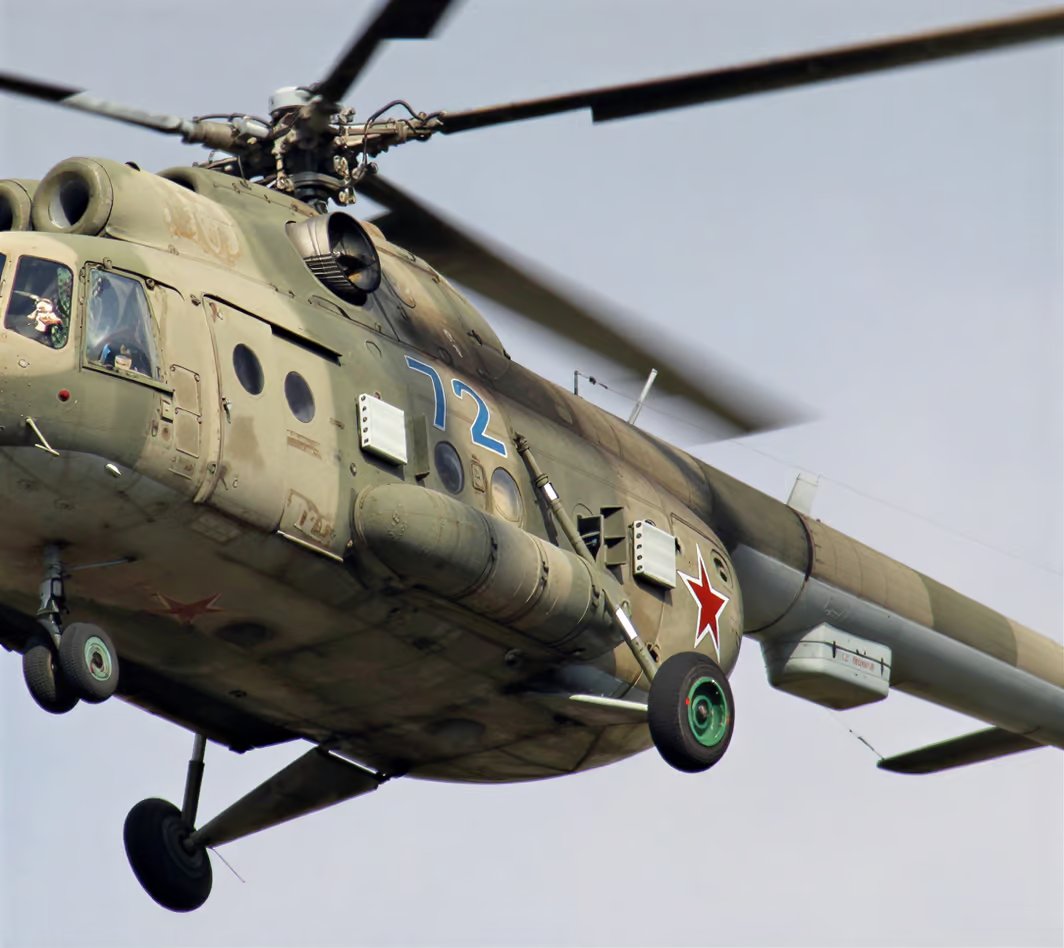


In the first of a new series of articles, Armada examines the history, performance and specifications of Russia’s P-324 Smalta airborne radar jamming system.
Despite being developed and deployed by the Soviet Union’s (USSR’s) Red Army during the Cold War, Armada understands that variants of the P-324 Smalta airborne electronic attack system may still be deployed onboard Russian Aerospace Forces (RASF) aircraft. Specifically, the apparatus is thought to be installed on dedicated Mi-8SMV (North Atlantic Treaty Organisation Reporting name ‘Hip-J’) medium-lift utility helicopters.
Concept of operations
The Smalta jammer was developed to protect Soviet tactical aviation, primarily rotary-wing attack and medium-lift helicopters, against detection, identification and tracking by hostile ground-based air surveillance and fire control/ground-controlled interception radars. Back in the Cold War, the assumption of Red Army planners was that any battle with NATO, most likely to be fought across the Inner German Border separating West and East Germany, would require Soviet airborne forces to perform desant vertical envelopments from the fixed-wing airlifters or via helicopter.
Attack helicopters would engage ground targets performing close air support and battlefield interdiction in support of the desant. A contemporary example of the desant attack would be the doomed Russian airborne forces operation to capture Hostomel airport, northwest of Kyiv, during the opening stages of the second invasion of Ukraine on 24th February 2022. Airborne operations such as these are at significant risk of engagement from Ground-Based Air Defence (GBAD) systems like Surface-to-Air Missiles (SAMs) and anti-aircraft artillery, both of which are often supported by radars like those mentioned above.
History
Open sources translated from Russian suggest the first Smalta system was housed on a truck and designed as a ground-based radar jammer, with the prototype appearing in 1970. Nonetheless, mounting the system on an aircraft, specifically an Mi-8 series helicopter, was found to be more effective. This was most likely because a helicopter would have a longer line-of-sight range vis-à-vis ground-based radar targets compared to a truck-mounted system: A helicopter flying at 5,000 feet (1,524 metres) can have a hypothetical jamming range of 86 nautical miles (160 kilometres), although this would be contingent on the jamming system’s effective radiated power and antenna gain. Gain is a measure of the amount of power an antenna can concentrate in a specific direction. The higher the antenna gain, the more power the signal can focus on a particular point.
The first helicopter-mounted Smalta variant was known as Smalta-V and deployed onboard a Mi-8T helicopter for testing in Syria, then a USSR client state, during the mid-1970s. At that time, the country was locked in a simmering conflict with Israel. Initially, Smalta-V showed itself to be effective against the Raytheon MIM-23 Hawk medium-range SAM system, specifically the battery’s AN/MPQ-34 X-band (8.5 gigahertz/GHz to 10.68GHz) low-altitude ground-based air surveillance radar. It made sense deploying such a jammer on dedicated Mi-8s supporting the desant as the air component would already be flying low-altitude profiles. Other MIM-23 battery radars could be engaged kinetically and electronically by Soviet Air Force Suppression/Destruction of Enemy Air Defence (S/DEAD) assets.
Israeli air defenders soon learned how to recalibrate their AN/MPQ-34 radars to reduce the efficacy of the Smalta-V. In keeping with the continuous cat-and-mouse game often characterising Electronic Countermeasure (ECM) and Electronic Counter-Countermeasure (ECCM) development, the Smalta-V was adorned with modifications to outflank the Israeli ECCM adornments. Two new variants, the Smalta-VM and Smalta-U, were developed and deployed with Soviet airpower in rapid succession in 1981 and 1982. The definitive version, the Smalta-PG, debuted onboard the Mi-8SMV in 1998. It is this latter variant which may remain in RASF service.
Status
It is entirely possible that Russian Aerospace Forces electronic warfare experts believe the Smalta-PG retains some utility against X-band ground-based radars. Some reports state that the Mi-8SMV, and its accompanying Smalta-PG jammer, have now left frontline service. Nonetheless, accounts from Ukraine contest this claiming the helicopter has been used in the ongoing war against GBAD targets. The jammer was also deployed during the 2008 Russo-Georgian conflict. There is no evidence to suggest that either the Mi-8SMV or Smalta jammers were ever exported. Instead, they appear to have been reserved for Soviet and Russian use. Regarding the latter, the Smalta-PG may have either already been replaced, or is being replaced, by the Rychag-AV electronic attack system. The Rychag-AV is deployed onboard dedicated Mi-8MTPR-1 helicopters.
by Dr. Thomas Withington
