

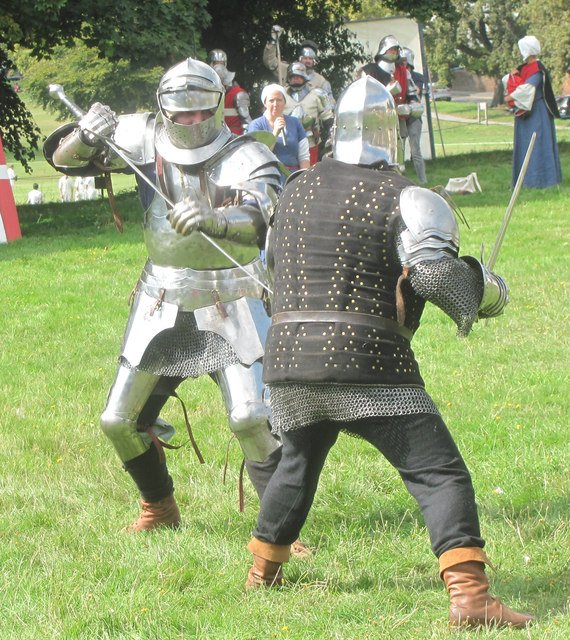
Feradach mac Tralin took interest in the Society for Creative Anachronism (SCA) in 2011, watching the combat portion of the community and felt that was what he needed in his life. He has yet to look back. Focusing on German longsword and Italian rapier, Tralin discusses how the SCA balances the historical and modern aspects of training, and where does a martial art begin and when sport begins.
Martial Arts of Yesterday, Today, and Tomorrow: Thank you for joining us!
Baron Feradach Mac Tralin: Thank you for having me.
MAYTT: What first drew you into the Society for Creative Anachronism?
FT: I’ve been doing things like soap making. One of my partners was involved in Renaissance Faires, so she took me to some of those. I tried a few, but they weren’t quite my style. They’re a bit too commercial for my tastes. They’re great for a lot of people, a lot of vendors, and it’s not really my shtick.
We had done a little bit with a college club for the SCA. We touched that a few times, but schedules didn’t really allow us to get too much into it. Then, I think it was late 2011, she found out about a local event about thirty or forty miles north of us. We went to the event, which was a pretty small little gathering, not much to it. They had some archery, they had a feast, and they had some fighting. We played around with the archery a bit, which was cool, and then they went to the tournament. She likes to tell this story because, before we went, she had told me that if I didn’t like the event, I didn’t have to go back. She wasn’t going to pressure me; she just wanted me to try it once and see if I liked it. I’m not a super social person – kind of an introvert.
So, we’re sitting there watching the tournament, and there are maybe three or four fighters. None of them are very good, they’re pretty newish, and they’re out there smacking each other in armored combat. She looks over at me and thinks, “Oh, I’m not sure he’s enjoying this.” Then she asks, “Are you okay?” And I said, “I need this in my life now.” So the next day, after the event, she came home from work, and I was like, “Okay, we’re both members of the SCA now. I’ve registered my name in heraldry, I’ve found and downloaded a book about how to build armor, I’ve bought a bunch of pieces, and I just need your help, since you’re a professional pattern maker, to start building armor in the garage right now.” And I kind of just went from there.
But yeah, I was really drawn in. I’ve done martial arts for a long time, so seeing that and being able to be part of that culture was a lot of fun for me.
MAYTT: That sounds like fun! With that in mind, what is it about the SCA that has kept your interest in it for this long?
FT: Well, the answer a lot of people give – and we even had a study that the Society did on itself – is that the relationships you form are the big thing that gets you to stay. And that is true to a degree. For me, though, I am really, really into the fighting, and I enjoy it a lot. It’s kind of the best place to find that huge, broad community of people who are interested in this kind of sport. Historical European Martial Arts (HEMA), because I know we were talking about that, is a little more fractured as a community and not quite as big, at least at the moment. It certainly wasn’t nearly as large as it is now back in 2011. So, this is the community where I find the most people, the most fighters, and the most opportunities to engage. I’ve also formed those relationships, and I do a lot of work as an officer for the nonprofit in various roles. But for me, it’s mostly the fighting. This is the best place to get the widest variety of different fighters, different styles, and different people I can play with, work with, learn from, and teach.
MAYTT: You mentioned that the SCA has the largest variety of styles/fighting systems. What weapons-based systems does the SCA use to teach and draw people in?
FT: This is actually one of the things I use when comparing the SCA to HEMA and other Asian martial arts. A lot of those martial arts traditions have the idea that there’s a specific style you’re learning, and everybody works on that style together. There are a lot of advantages to that approach. The SCA is a little more chaotic. It’s more like, “Here’s a sword” or “Here’s a stick. Try to hit me.” There are a lot of people who study historical styles, and there are a lot of people who try to develop their own styles, but it’s not universal. For instance, I’m really interested in German longsword and one of the Italian rapier masters. I know somebody in my local area who does a lot of Italian longsword, so we get to play off each other. Most of the people around us are just like, “I don’t know, I’m here to hit people.” But I like the fact that it gives me a broader range of experiences.
In a more traditional martial arts studio setting, where everybody is learning the same style from the same book, you really learn how to fight yourself – the mirror version of yourself. The SCA, because it’s so chaotic, means I have to learn my style more deeply because I have to be able to address anything that’s brought against me, not just the mirror image of myself.
MAYTT: There are fighters who study manuals and follow that structure. How do the other fighters who are forming their own style first learn the basics of swordplay?
FT: So, the SCA runs, for the most part, on sort of an apprentice-master model. For the basic basics, there’s some general community understanding. For instance, in armored fighting, we have a couple of foundational techniques, like the flat snap, the way of holding your shield, the wrap shot, and various other techniques that we teach people. It’s basically, “Here’s your beginner level.” In rapier fighting and steel fighting, we have what we call a “generic Italian,” which is sort of a vague mishmash of all the different Italian masters because that’s what a lot of people learn. So we’ll generally teach people that. It’s not Hollywood-level training, but it’s also not specific to any one historical source. It’s more a collection of learned practices; these are the things that actually work. That’s usually people’s introduction to the activity. Then they’ll find someone they work well with and begin developing more of a mentor relationship. Through that one-on-one instruction, they can move beyond the beginner level and continue progressing toward the advanced or master level. There are certain things that are totally ineffective, so we don’t spend time on those, but it’s not tied to any specific style. It’s relatively loose in what it includes.
MAYTT: Did you go through a similar process, or was 2011 an odd time for the SCA regarding that?
FT: We’ve had that model since forever. The Society is in its sixty-first year now.
One of the things it does differently than a lot of other schools is that it’s somewhat more in line with Asian martial arts training, where you have ranks, degrees, and recognized levels of achievement. We have our peerages, which are people who have been recognized as masters of their craft. For instance, we have knights for our heavy fighting, or armored combat. Those knights will take formal students. Knights take on squires, and that creates a one-on-one relationship. Squires wear a red belt to signify to everybody that they are in a student relationship with a knight. The knight works with them not only on how to do actual combat, but also on how to function well within the Society, how to become a leader, and how to conduct themselves. We put a lot of emphasis on honorable behavior and pro-social interactions. So, they’re not just teaching fighting; they’re also mentoring you on how to integrate into the Society and become a strong member of the community.
As for me personally, I predominantly do steel fighting. I’ve done some armored combat, but it’s not my favorite. I much prefer steel fighting, which is more similar to what HEMA does today.
For a while, I was what we call a provost, which is a student to a Master of Defense. I was elevated to Master back in 2019, but before that I was working with someone up in Eugene, which is about three hours north of here. I learned a lot of my material in different ways. I studied manuals on my own, fought a lot of different people, and tried to absorb their styles. I worked with my teacher, of course, but a lot of my development came from absorbing things from the community and experimenting with them. Personally, I really specialize in and enjoy being creative and unique. If I’m doing something and it’s working well, I have a tendency to think, “Okay, I’ve learned that. Now I’m going to put it away and try something new.” For me, the excitement comes from learning and discovering new things more than it does from simply winning.
MAYTT: Previously, you mentioned that you study German longsword and Italian rapier?
FT: Specifically, the tradition of Lichtenauer for the German longsword and the tradition of Capo Ferro for the rapier.
MAYTT: What drew you to longsword and rapier?
FT: So, again, my partner, my wife, had grown up reading fantasy novels and playing Dungeons & Dragons in high school. She was like, “I want to be a wizard, but I want to be a wizard with a longsword.” So, she really wanted to learn sword fighting. Back in high school, I did karate, some iaijutsu, and some kendo. So when we got to college and she said, “I really want to learn sword fighting,” I was like, “Okay, I know a little bit about sword fighting.” We grabbed some kendo swords and smacked each other around for a bit. Then we rejoined the SCA. She found out that rapier fighting wasn’t very exciting for her, but she discovered that cut-and-thrust was a thing. At the time, it was still relatively early in the discipline’s development. Armored combat had been around since the very beginning of the Society, so it was already about sixty years old. Rapier fighting had really taken off in the 1970s. Cut-and-thrust, though, I would have to look up the exact date, but I know it was sometime in the early or mid-2000s when it really became established.
So, it was still spreading, growing, and not nearly as large as it is today. We didn’t have anyone local teaching it. She found the nearest practitioner, who was a couple of hours away, and basically badgered him into letting us come up for a workshop so he could teach us. Honestly, I mostly went to support her. I’d been fighting in the Society for about a year, and I already knew a little sword fighting. She hadn’t really engaged in combat because she wasn’t interested in armored fighting. So, I went along to support her, we worked on cut-and-thrust, and I realized, “You know what? This is actually a lot more fun than armored fighting.” I ended up enjoying it a lot. I went to support her and then realized it was a ton of fun and stuck with it.
MAYTT: When you first began studying longsword, how much did you dig into the historical manuals and how much did you have and indirect crossover with Historical European Martial Arts?
FT: Yeah, definitely. Originally, a lot of my early interaction with this was really about supporting my partner. We had tried some Japanese sword arts, but they didn’t really click with her. So, I thought, “Hmm, maybe German stuff. I’ve heard good things about that.” I picked up a book and figured I’d teach her, and it ended up really clicking with me as well. I got some books on the subject – I think the big one I was looking at was by Christian Tobler. A lot of my initial work came from the academic research that the HEMA community had done and from some of the books written by the major figures in that community. So, I was really pulling a lot from their work. We didn’t have anybody nearby who specialized in German longsword. Honestly, I’m probably one of the people who knows the most about it in the kingdom right now, simply because I’ve been working on it the longest. The cut-and-thrust community is still growing, though. We have people interested in it, but there still isn’t a huge depth of expertise within our kingdom yet.
MAYTT: What do you think is the appeal to the cut and thrust within the Kingdom that allows it to continue growing the way that it does?
FT: Yeah, so this is something that varies quite a bit across the world. Different regions and kingdoms approach cut-and-thrust in very different ways. We actually got a good look at that when we traveled to the Society’s fiftieth anniversary event, which I think was held in Indiana. We went out there and ran a number of the cut-and-thrust activities. We did the same thing at Pennsic War during its fiftieth anniversary celebration. Through those events, we got to see how different communities approached the discipline. I’ve always been strongly of the opinion that cut-and-thrust and rapier are fundamentally very similar. They’re both steel sword disciplines, and they both operate under the same basic rule: if I touch you with a sword, you have to acknowledge it as a hit.
As I like to tell people, cut-and-thrust just adds one extra rule: I can smack you with the blade, and you have to take it. In rapier, I generally have to draw the blade across your body for it to count. Because of that similarity, there are a lot of kingdoms where the two activities aren’t really differentiated. I’ve been to tournaments where someone can walk up and say, “Hey, do you want to do cut-and-thrust today?” and the other person says, “Yeah, let’s do that.” Suddenly you’re doing cut-and-thrust instead of rapier, but you’re still using the same rapiers and largely having the same experience. What I’ve found is that if a discipline doesn’t have a unique identity, a unique selling point, the community doesn’t really grow. People need a reason to choose this activity instead of something else.
So here in An Tir, we’ve worked really hard to develop a distinct culture around cut-and-thrust. I like to think of it as being more martial. In my mind, rapier represents nobles settling street duels, while cut-and-thrust represents militiamen who have been recruited into an army and have to fight on a battlefield. That’s the general vibe we try to cultivate. Because of that, we generally discourage the use of the longer, single-handed, later-period rapiers in cut-and-thrust. We love seeing longswords, and we encourage earlier-period weapons and swords that are more cutting-focused. The goal is to create a different enough experience that there’s a meaningful reason for people to choose one discipline over the other.
MAYTT: You bring up tournaments, rule sets, and regular bouting with cut and thrust. In your experience, how does the SCA go about their cut and thrust duel compared to that of historical fencing’s longsword duels?
FT: So, the communities are very similar. I actually like to say that the SCA is HEMA. They’re both historical, they’re both European, and they’re both martial arts. I know HEMA has some organizations and loose affiliations that we’re not formally part of, but as a concept, we’re basically doing the same thing. Generally speaking, both communities operate on the idea that if I hit you with a sword, that’s a bad thing, and you should be unhappy that you got hit with a sword, regardless of how hard the hit was.
One of the things the SCA does differently is that we’re much more unified. The entire world operates under a single rules manual that everybody follows. Each kingdom is allowed to make modifications, but it’s kind of like the difference between federal and state laws. We can be more restrictive in some areas, but we’re still working from the same basic ruleset. That gives us a lot more consistency. For example, we have a fairly unified understanding of calibration; how hard a blow needs to be before it goes from “that wasn’t really a hit” to “that was a good hit,” and eventually to “that was too hard, please don’t do that.” The HEMA community, because it isn’t as centralized, has a much wider range of standards. I’ve fought HEMA practitioners who thought our calibration standards were too hard, and I’ve fought others who thought our standards were way too light and wouldn’t have counted those hits at all. There’s just a lot more variation because there isn’t a centralized leadership structure. That’s one of the major differences.
The other difference is that we don’t use judges in our tournaments. We have safety officers whose job is to watch for safety issues. Did a piece of armor fall off? Did somebody’s sword break? Did a small child run onto the field? That one has actually happened. What we don’t do is what many HEMA tournaments do, where you have corner judges determining who struck first and who scored the point. As far as I’m aware, most HEMA schools conduct their regular training the same way we do: if I get hit, I acknowledge it and say, “Yep, you got me.” The difference is that we simply carry that same honor-based system into our tournaments as well.
MAYTT: Like you said, there are only so many ways to swing a longsword and count points. Since you brought up fighting HEMA fighters, did you feel your training in Lichtenauer, through the SCA lens, was adequate, substandard, or better than a HEMA-Lichtenauer longsword fighter?
FT: I haven’t done a ton of HEMA events and activities. Honestly, I’d like to get to more of them, but there are fewer events available, and they’re generally more expensive. I remember looking at one that was around a hundred dollars to attend, whereas our events are usually in the twenty-to-thirty-dollar range, and people are already complaining about how expensive those are getting. But with the HEMA practitioners I’ve worked with, whether they’ve come to our practices, I’ve gone to theirs, or I’ve met them while traveling, the experience has been very similar. Usually, all it takes is a quick conversation about calibration and how hard we’re planning to hit, and after that it’s basically the same as working with another SCA fighter. Some of them have specialized knowledge in really interesting areas. There was one guy from Portland I worked with who was deeply interested in Georgian sword-and-buckler fighting – Georgian as in the country in Asia. It was a lot of fun learning some of his material and hearing his ideas. Overall, though, it never felt fundamentally different from working with another SCA person who simply had a different area of interest or a different historical focus they enjoyed studying.
MAYTT: This goes back to what you were saying earlier, where SCA and HEMA are essentially the same thing, going at it in different ways. As a side question, why do you think there is a large price difference between SCA and HEMA?
FT: I think a lot of it comes down to the communities we’re drawing from. The SCA is a really, really big organization, which means we can pull from a much larger population when we hold events. For example, at our local coronet-level events – our principality covers most of Oregon, though not Portland, which is the state’s largest city – we’ll typically draw somewhere around 100 to 150 people. Of those attendees, though, maybe only thirty to forty are fighters across all disciplines combined. Most people aren’t there to fight. They’re there to visit with friends, work on arts and sciences projects, participate in archery tournaments, or pursue any number of other activities. Because we’re drawing so many different kinds of people to an event, we have a larger base helping to cover costs, which means we can charge each individual attendee less. As with most events, the primary expense is the site itself and any resources needed to run it.
I haven’t helped run any HEMA events, so I don’t know, for example, whether they pay their volunteers. I know we don’t pay ours. I’ve held officer positions throughout my entire SCA career, at multiple levels of the organization, and nobody has ever paid me a dime for any of it. Which is fine; I do it because I love it. We’re also much more willing to use primitive sites. We’ll hold events at campgrounds and similar locations. It’s actually pretty rare for us to rent conference facilities. Maybe four or five events a year will use a hotel with conference space, and even then, we often get relatively favorable rates because we can tell the venue that a lot of people will be attending and renting rooms.
My understanding is that many HEMA events operate more like conventions. They rent convention centers or similar facilities, and nearly everyone attending is there specifically to fight. You don’t have that larger group of non-combat participants helping to spread out the costs. I also know that a lot of HEMA tournaments offer monetary prizes. We never do that. Occasionally we’ll have donated physical prizes, but even those are fairly uncommon. Maybe somewhere between ten and twenty percent of our tournaments have prizes at all. So, without having actually run a HEMA event myself, that’s my best understanding of the price difference. The SCA benefits from having a broader participant base to help offset costs, and we’re generally much more willing to use primitive sites than convention-style venues.
MAYTT: From that, the SCA is, essentially, a centralized organization of people. HEMA, through my research, the community is very loose. The closest organization, the HEMA Alliance, is purposely not centralized. Do you feel that the centralization within the SCA has helped it grow in the way it has? Do you think that same level of centralization in HEMA would help it spread further in America?
FT: I think the centralization does help in some ways. I have a business degree, so I tend to think about these things from a marketing perspective. For example, the meeting invite you sent me was in Eastern Time, so I’m going to guess you’re on the East Coast. Because the SCA is a shared organization, I can talk to you somewhat intelligently about what the SCA experience is likely to be like near you. Sure, there will be local differences, but I can still give you the basic rules, the general structure, and a rough idea of what you’ll find if you visit a branch. Because HEMA is less unified, I have a lot less confidence in describing the experience you’re going to have. That means I have a harder time communicating the selling points and explaining what someone should expect.
A unified system also allows for high-level initiatives. If you think about other sports – soccer, football, and similar activities with large governing bodies – those organizations can draw funds from a broad membership base and then use those resources for advertising campaigns or other projects that benefit the organization as a whole. That’s something a more loosely affiliated system can’t do as easily. There’s a reason nearly every major sport has tried to form larger organizations. Those economies of scale are real. That said, there are advantages to HEMA’s more federated structure as well. It allows for more freedom and more experimentation. If you find a school that doesn’t really vibe with you, you’re much more likely to find another one that better matches what you’re looking for. By comparison, if you don’t like one SCA branch or local area, another branch is likely to be more similar because we’re all operating within the same overarching structure. The consistency is a strength, but it also means there’s a greater chance that if you dislike one group’s culture or approach, you’ll find the next group somewhat similar as well.
Part two coming soon!
