

A tank can have a huge gun, thick armor, and an engine powerful enough to move a 60-ton machine across rough ground, but none of that automatically makes it the best battle tank in the world.
That’s because modern tank warfare has become much more complicated than a simple contest of armor versus armor. A crew may need to detect a target before it is detected, engage accurately while moving, survive anti-tank missiles, and deal with threats from drones and loitering munitions. Even maintenance, spare parts, fuel consumption, and battlefield recovery can influence whether an impressive tank remains useful after weeks of combat.
So, what really separates the world’s best battle tanks from the rest?
In this ranking, we look beyond headline specifications. Firepower, protection, mobility, sensors, crew survivability, battlefield technology, operational experience, and adaptability all matter.
The familiar “iron triangle” of protection, firepower, and mobility remains fundamental, but modern systems such as active protection and advanced thermal sights have added new dimensions to the equation.
There is also no universal winner. A tank optimized for open terrain may not be ideal in dense urban areas, while a highly sophisticated machine can become a liability if its logistics are difficult to sustain.
Recent analysis of modern armored warfare has reinforced that point: technology matters, but so do maintenance, supply chains, and the ability to adapt to changing threats.
With that in mind, here are five of the best battle tanks in the world and the particular qualities that make each one stand out.
How We Ranked the Best Battle Tanks
Calling one tank the best battle tank is a little like calling one sports car the best vehicle on every road. The answer changes with the terrain, mission, crew, logistics, and threats involved.
That’s why this ranking uses a broader yardstick. Instead of focusing on a single specification, each tank is considered as a complete fighting system.
Firepower: More Than the Main Gun
A powerful cannon is important, but it’s only part of the equation. We consider the main gun, ammunition options, fire-control system, stabilization, thermal sights, and the tank’s ability to detect and engage targets accurately while moving.
Protection: Keeping the Crew Alive
Modern tank protection is no longer just about piling on more steel. Composite armor, modular protection, explosive reactive armor, and active protection systems (APS) can all influence survivability.
The crew matters, too. A tank that can absorb damage while giving its occupants a reasonable chance of surviving is more valuable than one that simply looks formidable on paper.
Mobility: The Ability to Get There
Power-to-weight ratio, suspension design, road speed, cross-country mobility, and operational range all matter. A tank doesn’t win much by being exceptionally well armed if difficult terrain turns it into an expensive bunker.
Technology and Battlefield Awareness
Modern MBTs increasingly function as mobile sensor and communications platforms. Thermal imaging, digital networks, laser warning systems, and hunter-killer targeting systems can shorten the time between spotting a threat and engaging it.
Combat Experience and Practicality
Finally, we consider operational history, reliability, modernization potential, and logistics. A technically brilliant tank still needs fuel, ammunition, maintenance, trained crews, and recovery support.
That combination, not one spectacular statistic, is what determines where each contender belongs among the best battle tanks in the world.
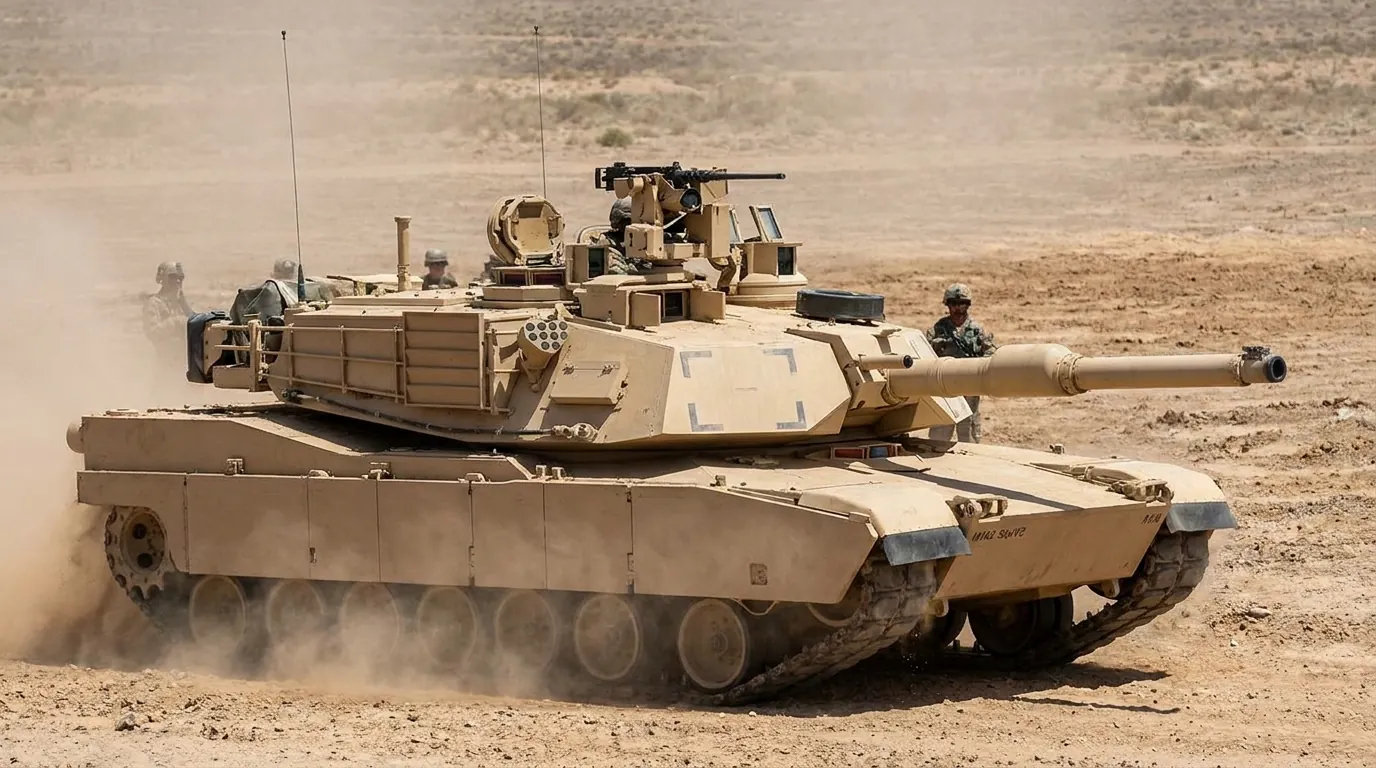
1. M1A2 SEPv3 Abrams (United States)
If one tank has earned a reputation for combining overwhelming firepower with exceptional crew protection, it’s the M1A2 SEPv3 Abrams.
Introduced as the latest major evolution of America’s iconic main battle tank, the SEPv3 isn’t a completely new design; it refines decades of combat experience into a far more capable battlefield platform.
| Specification | Details |
| Country | United States |
| Crew | 4 |
| Main Gun | 120 mm M256 smoothbore |
| Engine | Honeywell AGT1500 gas turbine (1,500 hp) |
| Combat Weight | Approximately 66–73 tons (configuration dependent) |
| Top Speed | About 67 km/h (42 mph) |
So, why does many analysts consider it among the best battle tanks in the world?
The answer starts with survivability.
The Abrams was designed around protecting its crew. Ammunition is stored in armored compartments fitted with blow-off panels, meaning an internal explosion is directed away from the crew compartment. Combined with advanced composite armor and, on many upgraded vehicles, the Israeli-developed Trophy Active Protection System, the tank offers multiple layers of defense against modern anti-tank threats.

Firepower remains equally impressive. Its 120 mm smoothbore cannon can fire a wide range of armor-piercing and multi-purpose rounds with remarkable accuracy, even while the vehicle is moving.
A sophisticated digital fire-control system, thermal imaging sights, and hunter-killer capability allow the commander to identify a new target while the gunner is still engaging the previous one. That continuous target acquisition dramatically reduces engagement time during high-intensity combat.
Another strength often overlooked is the Abrams’ constant modernization. Instead of replacing the platform every few decades, the U.S. Army has steadily upgraded its electronics, networking, armor, sensors, and onboard power systems. As a result, today’s M1A2 SEPv3 shares surprisingly little internally with the original Abrams that entered service in 1980.
Of course, no tank is perfect. The gas turbine engine delivers outstanding acceleration and smooth performance, but it consumes significantly more fuel than comparable diesel-powered rivals. At well over 65 tons, strategic transport also becomes more challenging, especially across older bridges or soft terrain.
Still, when firepower, protection, battlefield awareness, and decades of proven combat performance are weighed together, the M1A2 SEPv3 Abrams remains one of the strongest contenders for the title of the best battle tank in the world. Few armored vehicles have demonstrated such an ability to evolve alongside changing battlefield threats while continuing to set the benchmark for modern main battle tanks.
2. Leopard 2A8 / Leopard 2A7 (Germany)
The Leopard 2 takes a different route to becoming one of the best battle tanks in the world. Where the Abrams is famous for its imposing presence and distinctive gas-turbine powerplant, the Leopard 2 has built its reputation around balance.
That balance is one reason the platform has remained relevant for decades. Germany introduced the Leopard 2 in 1979, yet successive upgrades have kept the basic design competitive against much newer tanks.
| Specification | Leopard 2A7 / 2A8 |
| Country | Germany |
| Crew | 4 |
| Main Gun | 120 mm Rheinmetall smoothbore |
| Engine | MTU MB 873 Ka-501 diesel |
| Engine Power | 1,500 hp |
| Combat Weight | Approximately 64–69+ tons, configuration dependent |
| Transmission | Renk HSWL 354 |
The Leopard 2A7 represents one of the most mature versions of the family, while the Leopard 2A8 pushes the design further with improved protection, electronics, and provisions for active protection.
Its 120 mm smoothbore gun is a major strength. The weapon is compatible with modern NATO ammunition and is paired with sophisticated stabilization and fire-control equipment. The result is a tank designed to engage targets accurately while moving rather than relying on the old-fashioned idea of stopping first and shooting second.
Protection has also evolved considerably. Modern Leopard 2 variants use layered armor and modular protection packages, allowing operators to tailor the vehicle to different missions.

The 2A8 is particularly notable for its planned integration of the EuroTrophy active protection system, giving the tank another defensive layer against incoming anti-tank weapons.
Then there’s mobility. The Leopard 2 is heavy, but its 1,500-hp diesel engine gives it strong acceleration and cross-country performance. Unlike the Abrams’ gas turbine, the diesel powerplant also offers a practical advantage in fuel efficiency and logistics for many operators.
And that’s perhaps the Leopard 2’s secret weapon: adaptability.
More than a dozen countries operate Leopard 2 variants, creating a large international user base and an extensive ecosystem for training, maintenance, upgrades, and ammunition. Germany’s tank has effectively become a common armored language among several European armies.
The Leopard 2 isn’t necessarily the most exotic tank on this list. That’s exactly why it stands out. It has survived the test of time by continuously absorbing new technology without abandoning a fundamentally sound design.
For a modern army looking for a proven combination of firepower, protection, mobility, and upgrade potential, the Leopard 2 remains exceptionally difficult to ignore.
3. K2 Black Panther (South Korea)
Imagine a main battle tank that can change its posture to suit the ground beneath it. That sounds like something from a futuristic military game, but the K2 Black Panther actually does it.
Developed by South Korea’s Hyundai Rotem, the K2 is among the most technologically ambitious modern battle tanks in service.
Its design reflects a very specific strategic problem: how do you build a heavily armed vehicle that can move effectively through mountainous terrain, narrow roads, and rapidly changing battlefield conditions?
| Specification | K2 Black Panther |
| Country | South Korea |
| Crew | 3 |
| Main Gun | 120 mm L/55 smoothbore |
| Engine | 1,500 hp diesel |
| Combat Weight | Approximately 55 tons |
| Top Speed | About 70 km/h |
| Suspension | Hydropneumatic |
The suspension is one of the K2’s signature features. Its hydropneumatic system allows the tank to adjust its ride height and tilt the hull.
On uneven terrain, that can help keep the vehicle stable and improve its firing position. It’s a clever solution to a very old armored-warfare problem: terrain doesn’t care how advanced your tank is.
Firepower is equally serious. The K2 carries a 120 mm L/55 smoothbore gun and an automatic loader, allowing the crew to be reduced to three. The autoloader also supports a consistent loading cycle while freeing the commander and gunner to concentrate on finding and engaging targets.
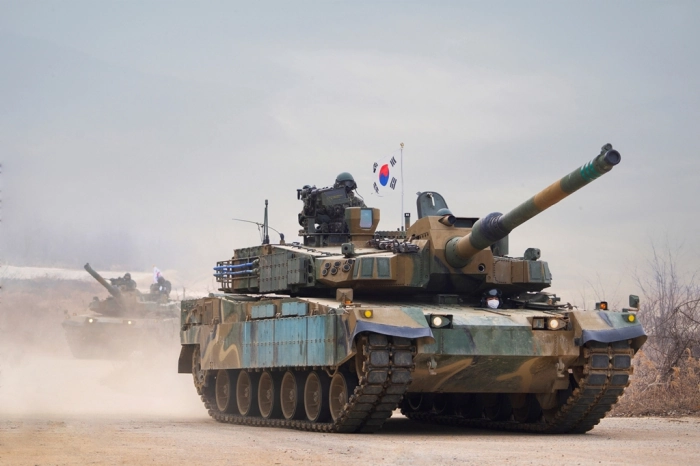
The tank’s electronics are arguably even more interesting. Advanced thermal sights, digital fire-control equipment, automatic target tracking, and hunter-killer functionality allow the K2 to detect and engage threats rapidly. Its battlefield-management capabilities also help integrate the tank into a wider network rather than treating it as an isolated fighting vehicle.
Then there is weight.
At roughly 55 tons, the K2 is considerably lighter than some Western MBTs while retaining a 1,500-hp engine. That gives it a power-to-weight ratio of roughly 27 hp per ton, a useful advantage when mobility matters.
The K2 isn’t as combat-proven as the Abrams or Leopard 2 family, and its sophisticated technology can come with greater complexity. Yet that doesn’t make it less interesting, it makes it a glimpse of where the best battle tanks are heading.
The Black Panther shows that future tank design isn’t necessarily about becoming heavier. Sometimes, the smarter answer is to become more precise, more connected, and more adaptable.
4. Merkava Mk.4 Barak (Israel)
Most tanks begin with a familiar question: How much firepower and protection can you fit into a vehicle that can still move effectively?
The Merkava Mk.4 Barak starts from a slightly different philosophy: How do you give the crew the best possible chance of coming home?
That idea has shaped Israel’s Merkava family for decades, and it remains one of the reasons the Mk.4 is considered among the best battle tanks in the world.
| Specification | Merkava Mk.4 Barak |
| Country | Israel |
| Crew | 4 |
| Main Gun | 120 mm smoothbore |
| Engine | 1,500 hp diesel |
| Combat Weight | Approximately 65 tons |
| Protection | Modular armor + Trophy APS |
| Primary Role | Main battle tank |
The Merkava Mk.4’s most distinctive feature is its emphasis on crew survivability. Its internal layout places the engine toward the front of the vehicle, while the rear hull can provide additional internal space for ammunition, equipment, or personnel depending on the mission configuration.
That makes the Merkava different from many conventional MBTs. It isn’t simply a heavily armored gun platform; the design reflects Israel’s experience operating armored forces in environments where ambushes, anti-tank missiles, and close-range threats are persistent concerns.
Protection is reinforced by Trophy, one of the world’s most mature hard-kill active protection systems. Rather than relying exclusively on armor to absorb an incoming projectile, Trophy attempts to detect and intercept certain anti-tank threats before they reach the vehicle. That’s a major conceptual shift in armored warfare: the tank’s defense starts outside its armor.
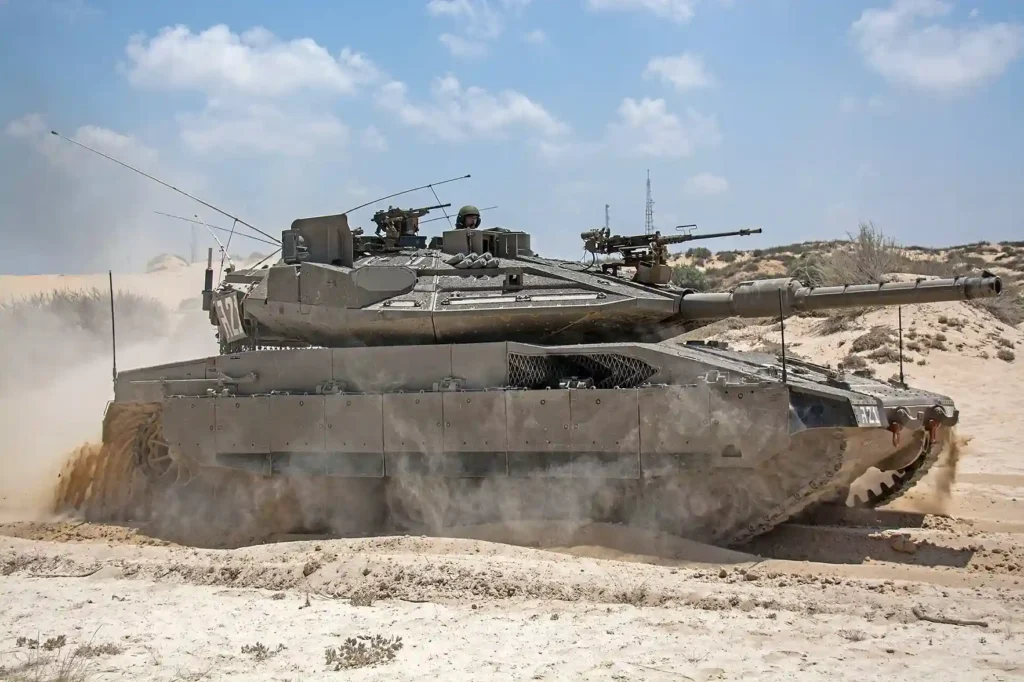
The Mk.4 Barak pushes the concept further with upgraded sensors, digital systems, and improved crew interfaces. Its advanced helmet-mounted display system is intended to give commanders a more intuitive view of the battlefield, reducing the need to remain exposed from the turret to understand what’s happening around the vehicle.
The Merkava also carries a 120 mm main gun and is powered by a 1,500-hp diesel engine. With a combat weight of roughly 65 tons, it isn’t a lightweight machine, but its design prioritizes protection and tactical survivability over raw speed.
Its greatest strength, then, isn’t one spectacular specification. It’s the way the entire vehicle is built around survival, awareness, and rapid response.
That makes the Merkava Mk.4 Barak a fascinating contender for the title of best battle tank, particularly when the battlefield is crowded with missiles, drones, and threats that can appear from almost anywhere.
5. Challenger 3 (United Kingdom)
The Challenger 3 is the unusual entry on this list. It isn’t simply another incremental upgrade with a few new electronics bolted onto an older tank. Britain is effectively transforming its Challenger 2 fleet into a significantly more capable main battle tank.
That makes the Challenger 3 especially interesting when discussing the best battle tanks in the world, although there’s an important caveat. Unlike the Abrams or Leopard 2, the Challenger 3 is still moving through its introduction process, so its battlefield reputation has yet to be established.
| Specification | Challenger 3 |
| Country | United Kingdom |
| Crew | 4 |
| Main Gun | 120 mm L55A1 smoothbore |
| Engine | Approximately 1,200 hp |
| Protection | Modular armor + active protection planned |
| Primary Role | Main battle tank |
| Program | Challenger 2 modernization |
The most visible change is the turret and main armament. Challenger 3 replaces the Challenger 2’s distinctive 120 mm rifled gun with the Rheinmetall 120 mm L55A1 smoothbore, aligning the British tank with the ammunition ecosystem used by other NATO tanks.
That change matters for more than standardization. The L55A1 is designed to fire advanced ammunition and provides the Challenger 3 with a modern kinetic-energy weapon suitable for contemporary armored warfare.

Protection is another major focus. The tank is receiving a new modular armor package and is designed to incorporate an active protection system. This layered approach recognizes a reality that today’s tank crews can’t ignore: armor alone isn’t enough when guided missiles and increasingly sophisticated drones can attack from unexpected directions.
The Challenger 3 also receives a modern digital architecture and improved sensors, giving its crew better access to battlefield information. That may sound less exciting than a bigger cannon, but detection speed can determine who gets the first effective shot.
There is, however, a trade-off.
The Challenger 3’s relatively modest engine output compared with some 1,500-hp competitors means outright mobility isn’t its defining advantage. More importantly, the tank has not accumulated the same operational record as established platforms.
And that’s precisely why it deserves a place here.
The Challenger 3 represents where European modern battle tanks are heading: modular protection, advanced sensors, NATO ammunition compatibility, digital networking, and active defenses working together rather than relying on one technological trick.
It may not yet be the most proven tank on this list. But as a modernization program, the Challenger 3 could become one of Britain’s most important armored warfare investments in decades.
Final Thoughts
So, which is the best battle tank in the world? The honest answer is that there isn’t one machine that dominates every battlefield, every mission, and every category.
The M1A2 SEPv3 Abrams stands out for its combination of firepower, protection, sensors, and decades of operational experience. The Leopard 2 remains one of the most balanced and widely adopted Western MBTs, while the K2 Black Panther demonstrates how automation, mobility, and advanced electronics can reshape tank design.
Israel’s Merkava Mk.4 Barak takes a distinctly crew-focused approach, particularly through layered protection and active defense. Meanwhile, the Challenger 3 represents an ambitious attempt to bring a proven British platform into a new era of digital warfare and modern protection.
What makes these best battle tanks fascinating isn’t simply their armor thickness or gun caliber. It’s how each country has made different trade-offs based on geography, doctrine, industrial capability, and battlefield experience.
And the definition of a great tank is changing fast. Drones, loitering munitions, anti-tank weapons, electronic warfare, and networked sensors are forcing MBTs to become more than heavily armored gun platforms.
The next generation may be decided less by who builds the heaviest tank, and more by who can make armor, sensors, protection, mobility, and human decision-making work together most effectively.
That is where the future of the best battle tank will be decided.
