

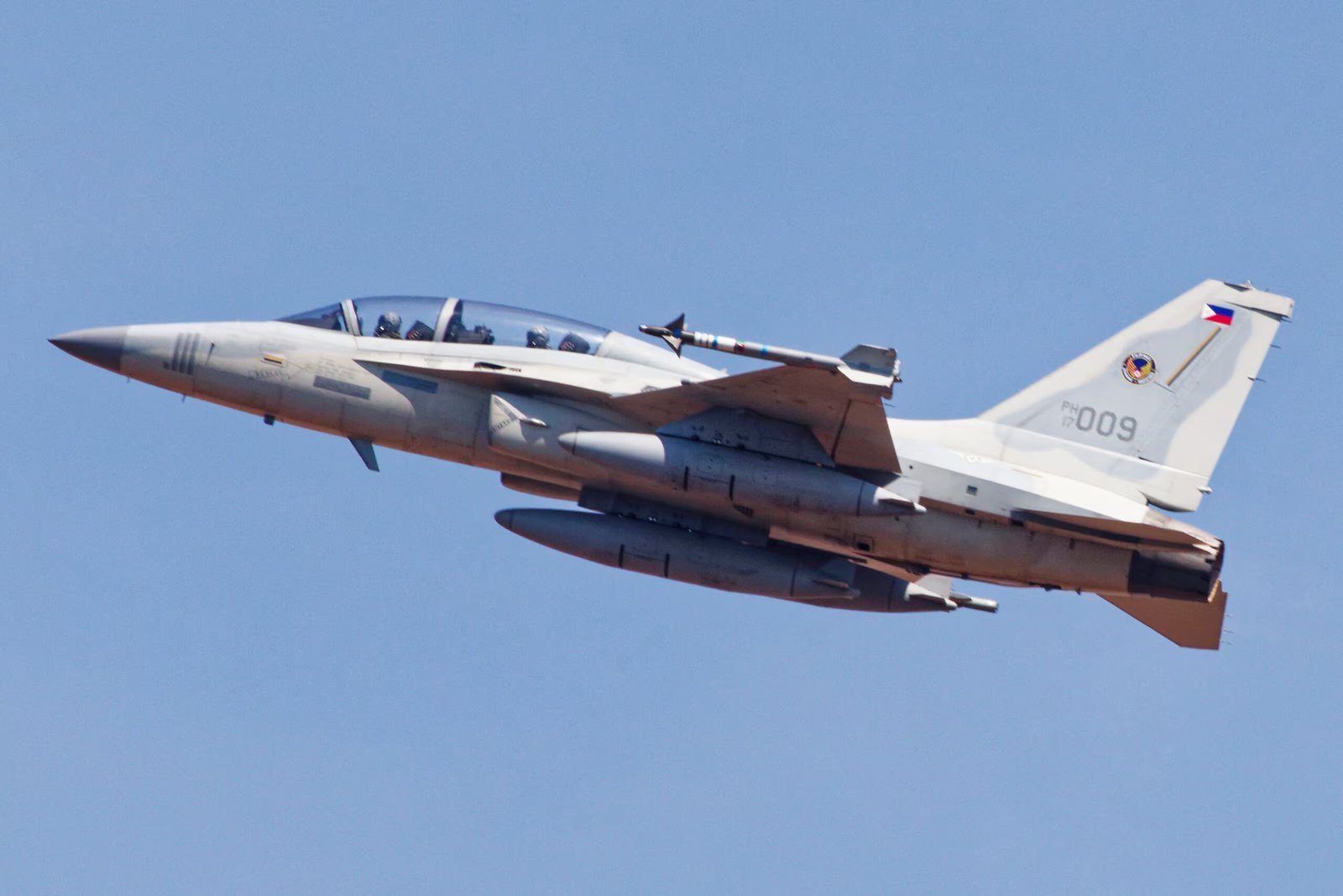
Building on their debut at the multinational Exercise Pitch Black in Australia’s Northern Territory in 2024, the Philippines returned for the 2026 iteration with a similarly sized contingent of four Korea Aerospace Industries (KAI) FA-50PH fighters and over 160 personnel.
Conducted in July-August, the exercise provided the Philippine Air Force (PAF) with an opportunity to practise large-force employment (LFE) alongside – and against – a diverse range of fighter types operated by participating nations across the vast airspace of northern Australia.
Lieutenant Colonel Mario Mendoza, the PAF contingent commander, told media covering the exercise, including Asian Military Review, that the FA-50PH fleet – which comprises eleven aircraft – has received upgrades to its avionics and weapons systems since the last exercise, though he declined to provide further details.
The aircraft are understood to have been upgraded towards a configuration approaching the Block 50 standard.
According to KAI, the resulting configuration includes a precision air-to-ground capability. However, the PAF is not known to currently operate the Sniper Advanced Targeting Pod, which is required to designate targets for precision-guided munitions.
During Exercise Pitch Black 2024, the then PAF contingent commander told AMR that the FA-50PH was equipped with a Link 16 tactical data link, although it was unclear whether this applied across the entire fleet.
A US$64.5 million contract was awarded to KAI in December 2025 to undertake a further upgrade of the FA-50PH fleet. Designated FA-50 Systems Upgrade Lot 1 by the Philippines, this effort is thought to be the first of a series of upgrades that could ultimately bring the aircraft to either Block 60 or 70 standard.
The Philippines also ordered twelve additional FA-50s in June 2025, which it has confirmed will be delivered in the latest Block 70 configuration. They will thus feature an active electronically scanned array radar, an air-to-air refuelling probe and other capability enhancements.
Mendoza said of the PAF’s participation in Exercise Pitch Black 2026, “Our FA-50s are a valuable contributor. While they may not be at the same level as some of the more advanced platforms participating in the exercise, they bring capabilities that our coalition partners recognise and that contribute value to the overall mission.”
Mendoza shared that Philippine FA-50s conducted offensive counter-air and defensive counter-air missions during the exercise, flying in a four-ship formation as part of a larger multinational force package.
PAF crew were also assigned mission commander roles to plan and lead packages during the LFE phases of the exercise, giving them the opportunity to develop complex mission planning and command skills.
Mendoza also said the training provided valuable insights that will help inform the PAF’s future procurement efforts, namely the Multi-Role Fighter programme.

“Operating alongside a wide range of advanced fighter aircraft – including potential contenders for our future acquisition programmes – gives us a better understanding of their capabilities and how they can interoperate with allied platforms.”
He continued: “Those lessons will help inform our future modernisation and procurement decisions, ensuring we acquire capabilities that meet both our national requirements and interoperability needs with our partners.”
The Philippines had shortlisted Saab’s JAS 39 Gripen and Lockheed Martin’s F-16C/D Block 70/72, while the KAI KF-21 Boramae is also reportedly under consideration.
During Exercise Pitch Black 2026, PAF personnel had the opportunity to observe upgraded F-16C/Ds operated by Singapore, and F-16A/B eMLU fighters from Thailand.
While the Gripen was not present at this year’s exercise, PAF personnel gained exposure to the platform through the participation of Royal Thai Air Force JAS 39C/Ds during the previous iteration of Exercise Pitch Black.
Confrontations between the Philippines and China over disputed waters and overlapping territorial claims in the South China Sea continue to intensify.
In response, the PAF has been enhancing its tactical fighter training as the country’s armed forces move their focus from counterinsurgency towards higher-end conventional operations.
“Our focus has shifted significantly from counterinsurgency towards territorial defence and air defence. However, we’re not abandoning the counterinsurgency mission, as those threats continue to evolve,” Mendoza indicated.
“We still maintain dedicated aircraft for close air support and air interdiction to ensure we remain prepared to respond, if required.”
by Roy Choo
