

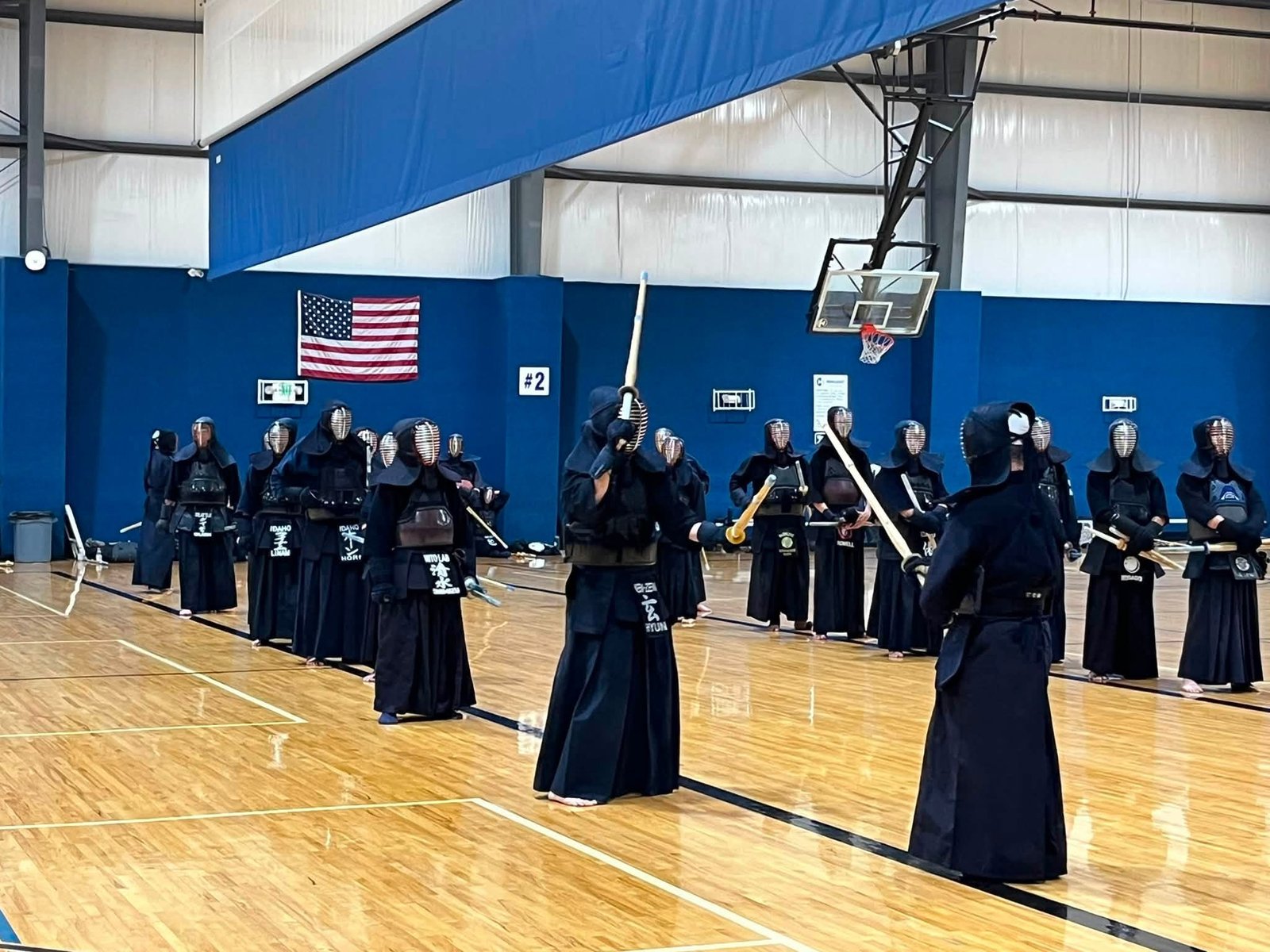
Courtesy of Idaho Kendo Club
Every year, I look forward to attending the US Nitō Kendo Seminar. It has become a highlight of my kendo calendar—not because I practise nitō myself, but because it reminds me that there are always new ways to understand kendo.
This year’s seminar, held from 16–19 July 2026 at Meridian Homecourt, was another fantastic success. As usual, Robert Stroud sensei (Kyoshi 7-Dan) hosted with the support of his dojo members of Idaho Kendo Club.
The seminar was originally scheduled for a different location, but a severe thunderstorm hit Idaho at the end of June and flooded the facility. Stroud Sensei had to find a new venue for the seminar at the last minute! We really appreciate his efforts.
The seminar resumed last year after several years of interruption caused by COVID. This year marked the second seminar since its return, and nearly 70 participants gathered from across the United States and the world. Seeing so many people dedicated to studying Nitō was inspiring.
Last year, we were fortunate to have my Kiwi brother, Alex Bennett Sensei, join us from Japan. Unfortunately, he was unable to attend this year, and we certainly missed him. He published his translation of Eiji Yoshikawa’s novel, Musashi. He shares a unique and strong connection to the Nitō technique!
Even so, the seminar maintained the same friendly atmosphere and high level of instruction for which it has become known.
Interestingly, just like last year, there was a travel hiccup. The same Nitō instructors were delayed by an entire day last year due to flight problems. This year, their flights were delayed by a few hours! But they still managed to arrive in time for Friday’s sessions. Phew! Thankfully, the seminar began exactly as planned.
Our instructors were again:
- R. FUJII sensei (Kyoshi 8-dan) ,
- Y. UGAJIN sensei (Kyoshi 7-dan),
- F. SATO sensei (Kyoshi 7-dan),
- A. FUJII sensei (Kyoshi 7-dan)
They have their YouTube Channel, Ichini-Ichijo.
The Level Keeps Rising
 A New 5-Dan Nitō Practitioner Going Against a Senior Sensei From Japan. Courtesy of Idaho Kendo Club.
Perhaps the biggest impression I came away with was just how much the level of Nitō kendo has improved.
Of course, much of that comes from the excellent instruction provided by the senior teachers. However, I believe there is another reason.
People spend an entire year practising what they learned, looking forward to meeting the instructors again the following summer. They return, receive corrections, go home motivated, practise for another year, and come back again.
For Nitō practitioners, this seminar is one of the rare opportunities to learn from the top Nitō sensei in the world. Their focus is quite different compared to us, the Ittō practitioners. While there are countless Ittō sensei, there are very few Nitō sensei; this concentration of expertise surely plays a significant role in their improvement.
This cycle has continued for nearly twenty years. When you have dedicated people following that process year after year, improvement becomes inevitable.
Today, there are already several Nitō practitioners who have earned 5-dan, something that would have been difficult to imagine years ago. Watching that progress has been incredibly rewarding. It won’t be long before we see the first 6-dan Nitō practitioner in the US.
If you follow kendo online, you have probably seen the fantastic content Dash Shimizu Sensei produces for Nitō Lab. This was my second year training with him, and I was really struck by his energy. We had a great jigeiko on the first day, but when he sought me out for another round the very next day, I was truly humbled. Usually, with so many wonderful Senseis and practitioners available, you want to vary your training partners to make the most of the seminar. It is very rare to approach the same Sensei two days in a row. I deeply appreciated his vibrant spirit and his clear devotion to both Nitō and Kendo. If you have not checked out his YouTube channel yet, I highly recommend it.
A Different Theme This Year
Every year, the instructors adjust the seminar to focus on different aspects of Nitō.
Traditionally, much of the seminar has concentrated on helping Nitō practitioners improve their own techniques and tactics.
This year, however, the instructors introduced something different: they spent time teaching how Ittō practitioners should fight against Nitō.
I thought this was an excellent idea.
After all, if only Nitō practitioners improve, the overall standard cannot rise as quickly. Both sides need to understand each other. When Ittō practitioners become better at facing Nitō, Nitō practitioners must also continue evolving. Both styles push each other forward. That is exactly how kendo should develop.
 At this seminar, you can even learn how to fight against Nitō. Courtesy of Idaho Kendo Club.
The Toda Cup
One of the most unique parts of the seminar is the Toda Cup. The tournament is held in memory of the late Toda Sensei (Hanshi 8-dan), honouring both his contributions to kendo and his passion for promoting Nitō.
The format is unlike any tournament you have seen. Each pair of competitors fights twice:
- One competitor uses ittō while the other uses nitō.
- The same two people immediately fight again, but each changes roles.
It is a fascinating format because both competitors experience exactly the same challenge from opposite perspectives.
Congratulations to the Atagi brothers for reaching the final of the tournament. The little brother won the final and reclaimed the huge trophy—he might as well have left it at home! Congratulations to Rhett Atagi for winning the tournament two years in a row!
Understanding Is Different From Executing
One thing I found particularly interesting was how difficult it was for regular Nitō practitioners to defeat Nitō when they switched to Ittō.
At first glance, that seems surprising. After all, these are people who use Nitō every day. They know its strengths and its weaknesses. You might expect them to have a huge advantage.
Sometimes they did. But often they struggled.
Why? I suspect psychology plays a major role.
In shiai, nobody wants to make the first mistake. Being hit means losing. That pressure naturally makes people more cautious. Instead of attacking decisively, they become concerned about not getting hit. That slight hesitation can completely change the fight. Knowing how to defeat Nitō is one thing; actually doing it under tournament pressure is something entirely different.
Keiko and Shiai Are Different
 Two High-Ranking Sensei Fighting Beyond Victory and Defeat. Courtesy of Idaho Kendo Club.
This also reminded me how different keiko and shiai really are. During keiko, if I am struck, I do not immediately think, “I lost.” Instead, I ask myself a different question: Was my spirit defeated?
If my opponent broke my spirit before landing the strike, then I know I have something to improve. That is the purpose of keiko.
Shiai naturally changes our priorities. Winning and losing become more immediate. Avoiding mistakes sometimes becomes more important than expressing good kendo. That difference became very clear while watching the Toda Cup.
Personally, I view tournaments as my testing grounds. Kendo is kendo. You do your kendo in shiai. If you are defeated, you appreciate your opponent for highlighting your weaknesses. Go back to your dojo and train to improve. If you win, look back at your shiai, analyse what you did correctly, and consider how you can do it again or improve upon it next time.
What Separates the Great Nitō Teachers
Perhaps my biggest personal takeaway came from watching the senior instructors. Many people assume Nitō is primarily about using the short sword. Of course, the shōtō is important; the instructors certainly use it to control their opponent’s shinai and create opportunities.
But something else stood out: they never seemed to rely on it. Instead, they applied pressure through their seme. The feeling was exactly the same pressure I experience from outstanding Ittō practitioners.
That reminded me of something the instructors often say: Nitō is not different from Ittō. Ittō and Nitō are the same. After fighting and watching them closely, I think I understand that statement much better than before.
The difference between an experienced teacher and the rest of us is not simply how they use two swords; it is how they dominate through spirit, presence, distance, and seme.
The swords are only the tools. The kendo itself is exactly the same.
Final Thoughts
 The Atagi brothers did a fantastic job as MCs for the seminar auction again! Courtesy of Idaho Kendo Club.
I have no plans to become a Nitō practitioner myself. However, seminars like this always deepen my understanding of kendo as a whole. Whether we practise Ittō or Nitō, we are all trying to understand the same principles.
The 14th US Nitō Kendo Seminar once again reminded me that great kendo is never about finding shortcuts or special techniques. It is about polishing the fundamentals, strengthening our spirit, and continuing to learn from one another.
A big thank you to:
- Stroud Sensei, who has been organising this excellent event for years.
- His wife, Lynn, who has been a great supporter of our kendo community.
- The Idaho Kendo Club members.
- The Atagi brothers for their excellent MC work at the auction.
- The participants, who made this year’s seminar another memorable experience.
- California Budogu, for providing the kendo community with equipment at the venue.
- Our families, who support us “crazy kendo bums.”
- Last but not least, the instructors who travelled all the way from Japan: Fujii sensei, Ugajin sensei, Sato sensei and Ako sensei,
I am already looking forward to next year.
