

Celebrations of America’s founding and reflections on its ideals often overlook the central role of civil-military relations. This is a mistake. In the Declaration of Independence, a chief complaint was that King George III “affected to render the Military independent of and superior to the Civil power.” George Washington himself worried about this abuse of power and went to great pains to avoid it in his own career. Throughout the Revolutionary War, he constantly deferred to the Continental Congress despite its calamitous delays and erratic instructions, because he recognized that his authority over the Continental Army flowed from the people’s representatives. Given his immense personal popularity, he was often encouraged to redress this or that political dysfunction, but he knew that the republic would suffer in the long run if the military were to become an instrument of the commander’s will rather than of the people’s elected leaders.
The United States has not recently had leaders of Washington’s popularity, but in other ways the present moment recalls the era that followed the country’s founding. Today, as it was then, there is gridlock in the civilian political system. Similarly, Americans today hold the military in high regard compared with civilian branches of government. When the public is confronted with a problem that seems too big for the civilian branches to solve, the reflex is to ask the military to handle it. Both Presidents Donald Trump and Joe Biden, for instance, looked to the military to play a leading role in responding to the COVID-19 pandemic.
The temptation for mission creep is understandable: the U.S. military is the most advanced in the world, with a budget two to three times that of its nearest competitor. As the recent capture of Venezuelan dictator Nicolàs Maduro demonstrated, U.S. service members can do things no other military in the world can do. And in the face of a genuine national disaster, the public will readily embrace the military’s help; during the Great Depression, for instance, President Herbert Hoover directed the military to set up relief camps and President Franklin Roosevelt ordered it to establish the Civilian Conservation Corps, which put unemployed men to work to develop public land.
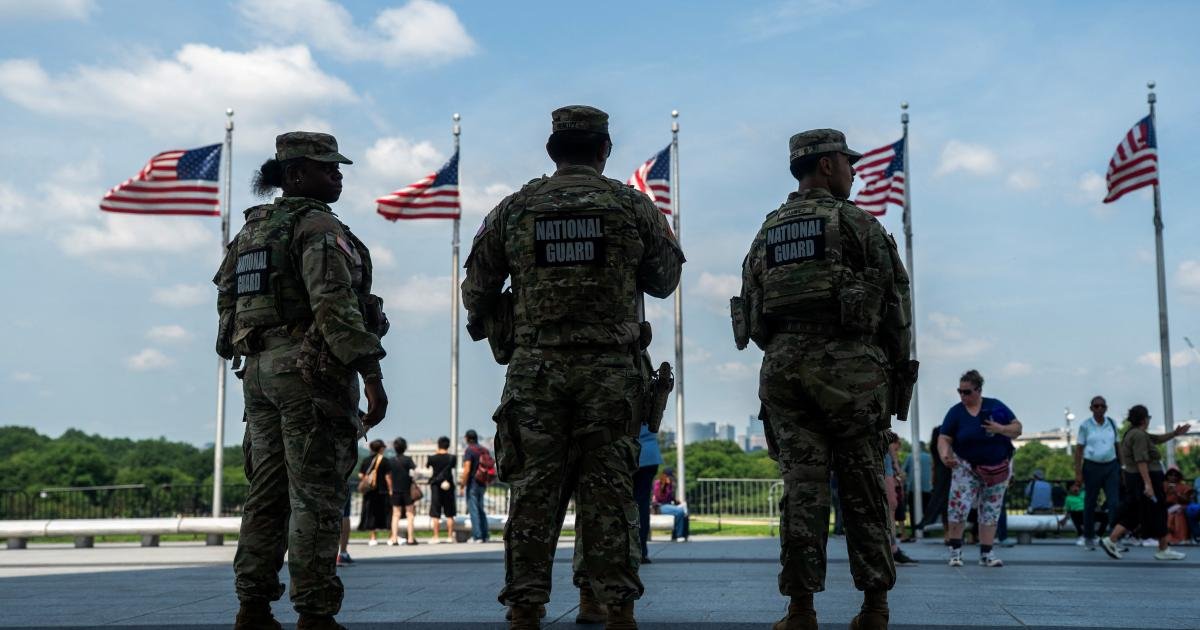
But when presidents use the armed forces for more politically contentious missions, such as addressing domestic crime in cities, the work of the military becomes more fraught. Resorting to a military solution rather than fixing the underlying incapacity or dysfunction in civilian institutions diverts the military from focusing on its primary combat mission. And, as Washington knew, it is not the military’s job to save the republic from political impasses. Indeed, if you ask too much of the military, you risk the entire enterprise.
THE AMERICAN INHERITANCE
A quarter millennium after the first Americans rejected monarchy, representative democracy remains an “experiment entrusted to the hands of the American people,” as Washington said in his first inaugural address. It has been tenderly handed down from generation to generation, and it has been bitterly contested. The Civil War was only the greatest test of whether this experiment could survive its divisions, as the United States has faced disagreements throughout its history, including in the agrarian discontent of the 1890s, the depression and isolationism of the 1930s, the progress and tumult of the 1960s, and the political polarization of recent years.
In each chapter, the best political leaders found inspiration to overcome political divisions in the ideals that prompted the first patriots. These leaders held dear the self-evident truths “that all men are created equal [and] endowed by their Creator with certain unalienable Rights.” Of course, those ideals, so well articulated by the founders, were not so well practiced by them. Thomas Jefferson held the pen for the stirringly universal Declaration of Independence, yet he also held people in bondage. Washington, the indispensable man, considered the institution of slavery to be indispensable to the nation’s prosperity (at least initially). All the founders left women out of the equation entirely. But the American experiment strengthens each time its leaders recognize that the founders’ project to create a more perfect union is an enduring one—one to be passed down to every generation.
The ideal was better than the reality 250 years ago, and so it is today. For every American institution, including the military, this project of continuous improvement takes concerted effort and is not easy. Indeed, despite its advantages, the U.S. military today must stay humble and learn the lessons of the wars in Ukraine and Iran, including questioning traditional assumptions of U.S. air supremacy. To maintain professionalism in its all-volunteer force, the military must also find new ways to remain connected to American society and to persuade capable young men and women from all walks of life to serve. And the military must protect the respect that it has earned from American society by scrupulously following all lawful orders and by demonstrating every day that it is nonpartisan. In so doing, service members honor the oath they swear not to a particular party or political leader but to the Constitution itself.
What is at stake, ultimately, is the moral fabric from which the military draws its deepest strength. As Lieutenant General Hal Moore observed in his 1992 book, We Were Soldiers Once … and Young, “American soldiers in battle don’t fight for what some presidents say on TV, they don’t fight for mom, apple pie, the American flag. They fight for one another.” This is the same mutual obligation that, at its core, defines citizenship itself. The country’s liberty depends on a mutual commitment to one another—regardless of color, creed, party, or military service.
THE MODERN PATRIOT
Those who asked General Washington to save the country from a dysfunctional Congress expected the military to fix something that was the duty of civilians to fix. A century and a half later, another general turned statesman, President Dwight D. Eisenhower, pointedly asked the political establishment—and ultimately the electorate—to save the country from the “conjunction of an immense military establishment and a large arms industry.” In his farewell address, he warned about the risk of an increasingly powerful military industrial complex, saying, “We must never let the weight of this combination endanger our liberties or democratic processes.” Like Washington, Eisenhower understood that the health of the republic depended on ordinary civilians exercising their political power and not outsourcing it to the military.
This lesson is critical today. Throughout this year of remembrance, the military has played an outsize ceremonial role. Asking the uniformed military to serve in an honor guard, lead a parade, or conduct stirring flyovers makes sense; the military excels at ceremony and provides a unifying symbol, and these acts help citizens look with pride on the republic’s capacity for strength and resilience. They may even inspire some to join the ranks of the all-volunteer force. But they should not be seen as a military monopoly on patriotism. Instead, patriotism means recognizing the promise of America’s founding, the progress of its past, and the potential of a shared future. Patriots should also find inspiration to serve in government or to deepen their involvement in local communities, both of which provide the foundation of national strength. The military can help by honoring the important national service that civilians do out of uniform.
Service to a cause greater than oneself, a virtue cultivated in military training, is accessible to all regardless of whether they wear the uniform. In ways big and small, Americans can recognize this milestone of 250 years as a moment to rejuvenate the national interdependence that our founders proclaimed along with independence.
Loading…
