

The Office of Management and Budget is expecting to receive thousands of comments about its proposed rewrite of federal grants management.
Since OMB issued the update to 2CFR Part 200 on June 1, it has received 3,648 comments and there still are 11 days left to submit feedback.
Congresswoman Rosa DeLauro (D-Conn.), ranking member of the Appropriations Committee, said she fears OMB already is implementing the rewrite despite OMB still accepting comments.
“We’ve already seen OMB implementing political review of grants. It’s led to massive delays at the National Science Foundation (NSF), the National Institutes of Health (NIH), which has had about a 34% decrease in new awards in 2026 compared to what they’ve done in the past. We understand that the decrease is due to new layers of political review at the NIH, at the Department of Health and Human Services, at OMB and at the Office of Extramural Research, which has issued directives limiting the number of funding opportunities that are allowed,” DeLauro said Tuesday during an Appropriations Committee hearing with OMB. “There have been cases where people are still awaiting approval, and political appointees have really denied the award going forward. The same problem is occurring across the government at [the departments of] Interior and Homeland [Security]. What is a governmentwide problem? What can you do to address it? Where is the holdup, and quite frankly, how would requiring a political appointee to approve every single grant improve government efficiency?”
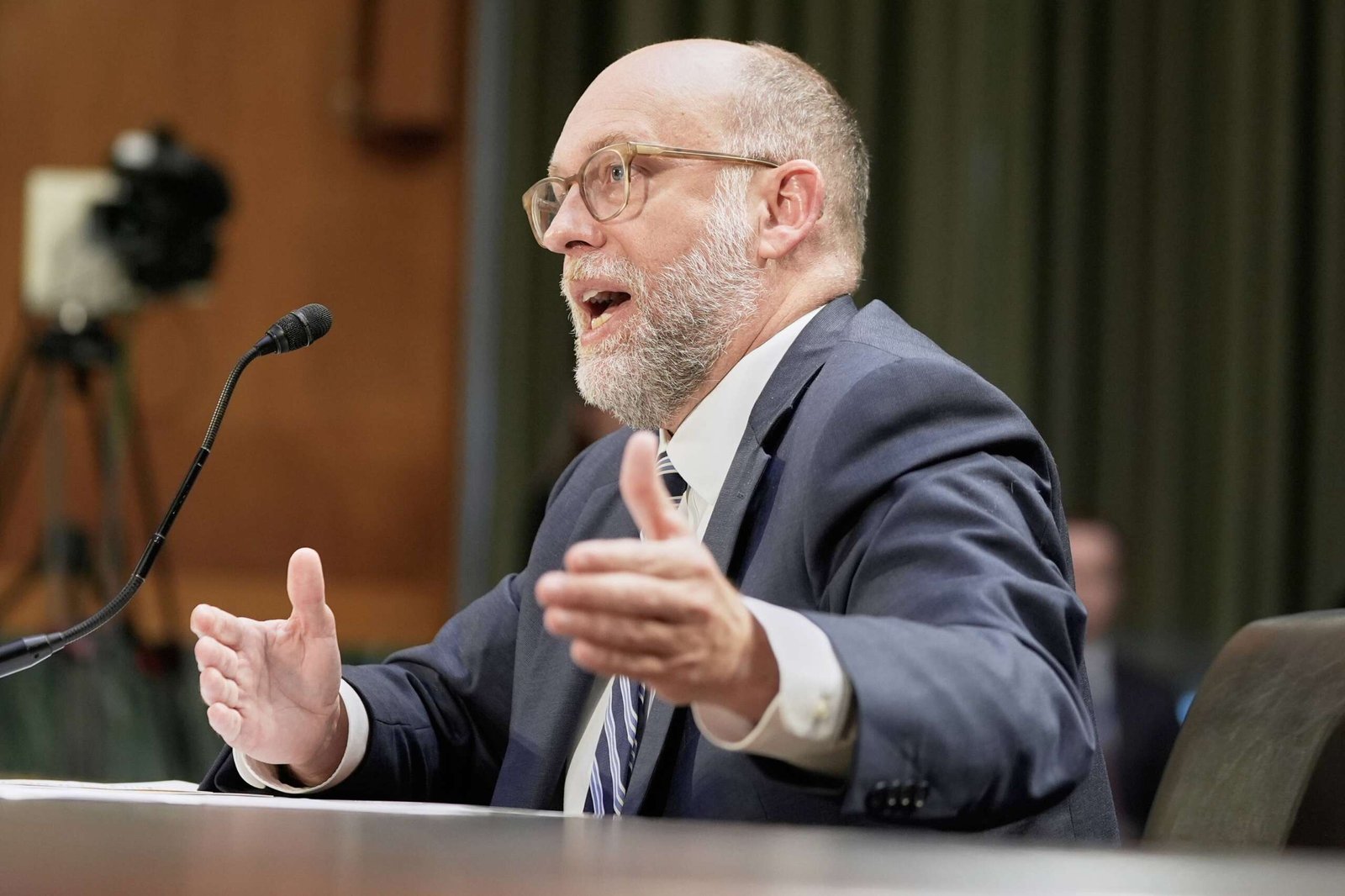
Russ Vought, the OMB director, responded to DeLauro’s questions by saying the administration is focused on providing “good oversight” on federal spending and that takes time.
“You don’t do that in the middle of a 30-day period after you pass the appropriation,” Vought said.
Concerns about the grants rewrite are rising across Capitol Hill.
Concerns over weaponizing federal grants
Every Senate Democrat sent a letter July 1 to Vought insisting the administration rescind the draft regulations immediately. The lawmakers say the proposal exceeds OMB’s statutory authority, undermines Congress’s constitutional power of the purse and would allow the president to weaponize federal grants for political purposes.
“The proposed rule undermines federal agencies’ and grant recipients’ ability to faithfully carry out the programs enacted by Congress. When Congress authorizes and appropriates money for federal grants, it does so with the understanding that all administrations will distribute those grants consistent with Congressional intent and the funding instructions articulated in law. The type of discretion the President intends to bestow upon himself through this proposed rule is counter to all past precedent and ignores the reality of how appropriations and authorizing laws are drafted,” the lawmakers wrote. “OMB’s grantmaking power grab is not only bad policy; it is also unlawful. OMB lacks the legal authority to issue binding regulations about how to cancel federal grants for each agency. In its proposal, OMB points to the Chief Financial Officers Act (CFO Act) for its sweeping assertion of power. However, the CFO Act in no way delegates to OMB the power to tell federal agencies that they can cancel grants at any time for any reason. Courts in Rhode Island and the District of Columbia have already rejected OMB’s claim that it can indiscriminately pause or terminate grants, holding that the CFO Act does not give OMB ‘the power to halt all finances, full-stop, on a moment’s notice.’ By dictating policy for grant recipients, OMB is attempting to supplant Congress’s primary role in appropriating funds and directing their purpose.”
This update follows a 2024 rewrite, which revised the regulations for the first time in four years and really made the first significant changes in more than a decade.
The 2024 update focused on making grant applications more understandable using plain English and improving grant applications access for underserved communities.
House Democrats at the hearing also pressed Vought time and again about the draft grants regulations.
Rep. Marie Gluesenkamp Perez (D-Wash.) asked Vought if he or anyone else at OMB directed agencies to follow the not-yet-finalized grants regulation.
“I saw an updated notice from the National Science Foundation from last week that included guidance to align with the proposed revision into 2 CFR 200. Have you suggested that agencies begin implementing this guidance before the rule was finalized?” she asked.

Vought said, “No, this stems from an executive order that the president signed last year. The President’s executive order had directed his agency officials to begin to have supervision at the policy official level. This regulation is catching up with that executive order to make it sure it’s actually reflected in that in the actual mechanics of grant making. We are certainly working with agencies. Agencies, like I just said, are looking at the executive order and trying to align with the executive order. That said, we are out for comment on our proposed rule. Record numbers of comments have come in. We’re going to assess each one of those comments and make any changes that we need to.”
Gluesenkamp Perez pushed Vought further about whether OMB would tell agencies to cancel grants that have been “explicitly funded by Congress?”
“Not with regard to earmarks. Sometimes you have an earmark to a specific person or specific organization, and that would probably be at the top of the list, that is, that needs to be funded, but that is not something that is impacted by this grant making,” Vought said.
Gluesenkamp Perez followed by asking whether states, cities or even Congress would have any recourse where OMB decided the grants were inconsistent with administration priorities.
“Do you believe the proposal provides due process?” she asked
Vought said he does believe there would be an avenue for recourse.
“You keep referring to this as OMB making these determinations again. This is agency officials that would be making these determinations based on the instructions given to them in the executive order,” he said.
Given the expected impact of the proposed changes and how many comments OMB already has received, DeLauro asked Vought if OMB would be extending the comment period by 45 days on the 400-page draft rule.
Vought said he would not, but acknowledged that with the number of comments OMB is receiving it will take time to go through them and respond.
“The fact of the matter is, as I understand it, this is probably the most consequential change of the rule. Senior political appointees, rather than career scientists and program officers, would now be required to conduct a ‘pre-issuance review’ of every discretionary grant before it is awarded. These appointees are explicitly forbidden from deferring to peer reviewers or routinely ratifying their recommendations,” DeLauro said. “This is in the 412-page document, and maybe you think that people weren’t going to read it, so and then there is no longer peer review. Peer review is no longer binding. A political appointee can simply override the scientific community’s judgment with finding, with no finding of cause. That is what is a part of this of the rule, which is it dismantles what we established after World War II for the National Institutes of Health, for the National Science Foundation, for the Department of Energy and for NASA. It really reverses how we have awarded grants in the future. Are you shaking your head no? But that in fact is what you are trying to do with a political lens and someone’s politically political ideology.”
Applying AI to grant decisions?
Lawmakers also are worried about OMB applying artificial intelligence tools to review grant applications.
Gluesenkamp Perez asked Vought if OMB is building “an AI tool to flag grants that are misaligned with the administration’s agenda?”
Vought said OMB is working on technology, including AI, to have a “wider angle lens about what is going on with the federal government, but it would be something that agencies would use in conjunction with us, and it’s certainly not to take the place of agency officials who would be making this determination.”
Gluesenkamp Perez pressed Vought again, asking if OMB has “awarded a contract for the development or the operations of such a system?”
Vought said he didn’t think they had.
Gluesenkamp Perez pushed on Vought again about the possibility of using an AI tool to review grants: “Why do you think that an AI system, which is itself neither accountable to Congress nor necessarily auditable, is an appropriate mechanism for making policy?”
Vought responded, “Well, the congressman from Maryland told me to read every GAO report, of which I would like to have the time to be able to read. For that, I would like to have a tool that collates and assesses everything in every GAO report in a way that I can actually make decisions based, that would just be one example. Similarly, there’s a lot of information out there on USAspending.gov that I would like to have the benefit for examiners to know who are already stretched in with regard to their portfolio. That would be an example.”
Gluesenkamp Perez still said she was concerned that such an AI tool would flag a grant as being inconsistent with administration priorities.
Vought said no grant has been flagged as inconsistent based on the use of AI tools.
“We are trying to make sure that we’re not funding some of this nonsense that I’ve articulated, and we work with agencies to do that, that’s policy official to policy official, and we work collaboratively with our agency partners,” he said.
Copyright
© 2026 Federal News Network. All rights reserved. This website is not intended for users located within the European Economic Area.
