

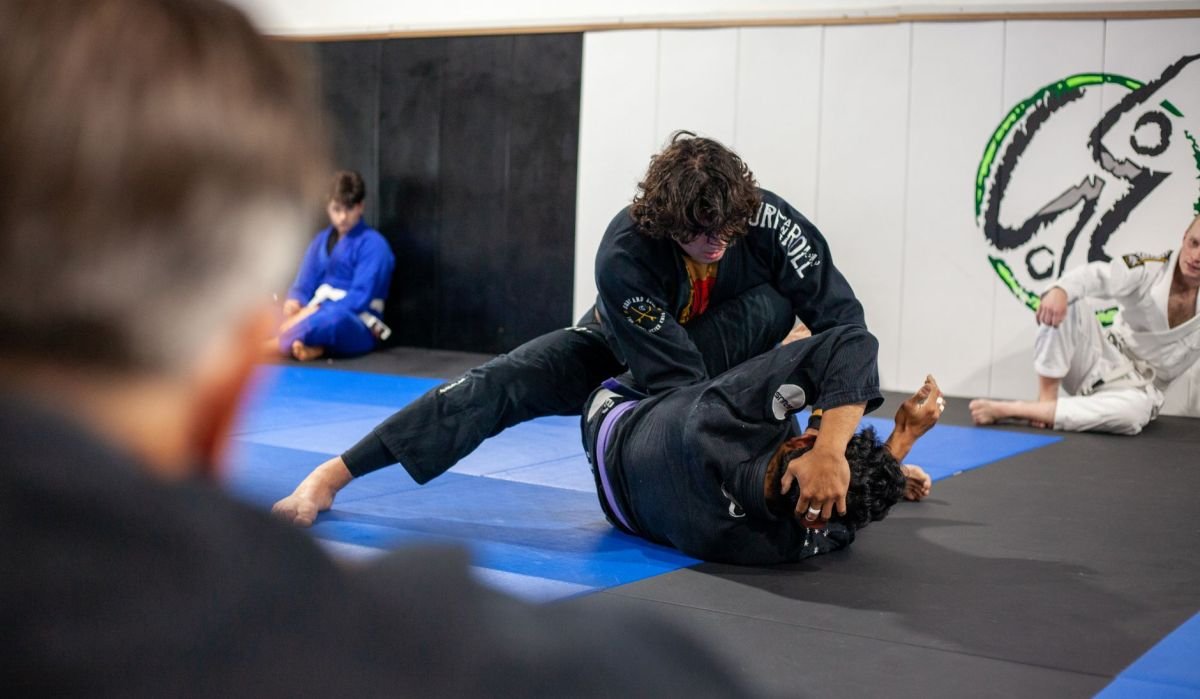
What BJJ Really Is
Brazilian Jiu-Jitsu (BJJ) is commonly described as a martial art defined by leverage, technique, and positional control. While these descriptions accurately capture its mechanics, they remain incomplete. They explain how BJJ operates, but not what it fundamentally represents. At a deeper level, BJJ can be understood as a system of creative problem-solving in motion, where two practitioners continuously generate, interpret, and resolve constraints in real time. Each movement presents a question, and each reaction attempts to answer it. Within this dynamic exchange, success depends not on physical dominance alone, but on the ability to navigate an evolving landscape of problems with adaptability, efficiency, and creativity.
Brazilian Jiu-Jitsu is presented here as a dynamic system of problem-solving structured through cycles of constraint, response, and adaptation. By introducing the Problem–Response–Escalation Cycle as a model of live interaction, it reframes techniques not as isolated solutions, but as tools for shaping the decision-making landscape of an opponent. In doing so, it positions BJJ not only as a martial art, but as an embodied framework for understanding how complex problems are constructed, navigated, and resolved under conditions of uncertainty and resistance.
Problems in Motion
At its core, Brazilian Jiu-Jitsu is a recursive interaction in which every action simultaneously solves a problem and creates a new one. A “problem” arises whenever one practitioner imposes a constraint, such as restricting movement, compromising posture, isolating a limb, or threatening a submission. These constraints reduce the opponent’s available options and force them to respond. That response, in turn, becomes new information that can be interpreted, anticipated, and exploited. In this way, BJJ unfolds as a continuous feedback loop of action and reaction, where each decision reshapes the conditions of the next.
The Core Cycle
This dynamic can be understood through the Problem–Response–Escalation Cycle. First, a practitioner imposes a problem through control, pressure, or threat. Second, the opponent responds, attempting to escape, defend, or neutralize the constraint. Third, the initial practitioner adapts to that response, escalating the exchange by introducing a more refined or severe problem. This cycle may repeat multiple times within a single sequence, gradually narrowing the opponent’s options and increasing the likelihood of a decisive outcome. Importantly, creativity emerges not from isolated techniques, but from how effectively a practitioner navigates and links these cycles together, adapting fluidly to the unfolding interaction.
Why It’s Not Chess
While Brazilian Jiu-Jitsu shares certain similarities with structured problem-solving domains such as chess, particularly in its reliance on pattern recognition, anticipation, and strategic sequencing, it ultimately provides a more complete model of real-world creative problem-solving. In chess, all relevant information is visible, actions are turn-based, and decision-making is largely abstract and deliberative. BJJ captures dimensions of real-world problem-solving, uncertainty, embodiment, and interaction, that are less present in chess.
In contrast, Brazilian Jiu-Jitsu unfolds in an environment defined by uncertainty, continuous interaction, and physical constraint. Information is partial and often ambiguous, timing is fluid rather than discrete, and execution requires the integration of thought and movement under pressure. Moreover, each practitioner can actively disrupt the other’s intentions in real time, transforming problem-solving into a deeply interactive and adaptive process. For these reasons, Brazilian Jiu-Jitsu more closely reflects the conditions under which complex problems are encountered and solved outside of controlled settings, making it not only a martial art, but a richer and more embodied representation of creative problem-solving in practice.
Fast Decision Loops
This dynamic can be further understood through the lens of the OODA Loop, developed by US Air Force Colonel John Boyd, which describes decision-making as a continuous cycle of observation, orientation (interpretation), decision (choice), and action. In Brazilian Jiu-Jitsu, this cycle is not only constant, but also deeply compressed, unfolding in fractions of a second through both visual and tactile information. Practitioners observe through contact, orient through sensitivity to pressure and balance, decide based on evolving constraints, and act through movement. Crucially, however, BJJ is not the execution of a single decision loop, but the interaction of two competing loops, each attempting to outpace, disrupt, and manipulate the other. By imposing constraints, a practitioner can limit how their opponent observes and interprets the situation, effectively shaping their decisions before they are made. In this sense, the Problem–Response–Escalation Cycle can be understood as an applied expression of OODA, in which each action not only advances one’s own position, but interferes with the opponent’s ability to perceive and respond effectively.
Dealing with Uncertainty
Unlike static forms of problem-solving, BJJ takes place in a live environment shaped by resistance, uncertainty, and mutual adaptation. Both practitioners are simultaneously engaged in posing and solving problems, which creates a uniquely complex system. There is no fixed sequence of correct actions, no guaranteed solutions that work in every context. Instead, practitioners must operate under conditions of incomplete information, making decisions in real time while their opponent actively attempts to disrupt those decisions. This requires a form of intelligence that is not purely abstract, but embodied: an integration of cognition and physical action in which thinking occurs through movement.
Constraints Create Reality
To better understand what constitutes a “problem” in BJJ, it is helpful to think in terms of constraints. Constraints define the boundaries within which solutions must be found. In BJJ, these constraints may be physical, such as being pinned beneath an opponent; technical, such as limited familiarity with certain positions; or situational, such as fatigue, time limits, or competition rules. Skilled practitioners learn not only to operate within these constraints, but to manipulate them. By shaping the constraints of an interaction, they effectively shape the decision-making landscape of their opponent.
Controlling Choices
This ability to structure decision-making space is central to creative problem-solving. Rather than simply reacting to problems, practitioners in BJJ actively design them. For example, controlling an opponent’s posture in the guard forces them to prioritize posture recovery before attempting to pass. Applying pressure from a dominant position may compel the opponent to move in predictable ways to relieve discomfort. These actions do not eliminate the opponent’s choices entirely, but reduce them to a manageable and increasingly predictable set. In doing so, the practitioner creates opportunities to anticipate and exploit responses.
A clear illustration of this process can be seen in a common exchange from the mount position. When a practitioner establishes mount, they impose a significant constraint: their weight restricts movement, their position enables multiple submission threats, and their control limits the opponent’s ability to escape. The opponent, recognizing the danger, must respond often by bridging forcefully in an attempt to disrupt balance and create space. This response, while necessary, introduces new vulnerabilities. The opponent may extend their arms, shift their weight unevenly, or momentarily lose structural integrity.
The practitioner on top reads these changes and adapts. Rather than rigidly applying a predetermined technique, they exploit the opponent’s reaction, perhaps isolating an arm that has become extended. From there, the exchange escalates: the practitioner transitions into an armbar or another submission. What began as a positional problem evolves into a decisive outcome through a sequence of interconnected decisions. Each step in the process is contingent on the opponent’s response, illustrating how solutions in BJJ are constructed dynamically rather than applied in isolation.
Think in Chains
This example highlights a broader principle: techniques in BJJ do not exist as standalone solutions, but as components within larger sequences. Skilled practitioners think in terms of chains, linking movements together in anticipation of possible reactions. A guard pass may transition into a submission attempt; a defended submission may create an opportunity to advance position. Each action is both a response to the present and a preparation for the future. This chaining of techniques reflects a higher level of strategic thinking, where practitioners navigate not just what is happening, but what is likely to happen next.
Timing Is Everything
Timing plays a crucial role in this process. The effectiveness of any given action depends not only on what is done, but when it is done. A technique applied too early may be anticipated and countered; too late, and the opportunity may no longer exist. Practitioners must develop a sensitivity to the rhythm and flow of the interaction, recognizing fleeting moments of opportunity and acting decisively. This sense of timing transforms static knowledge into functional skill, allowing practitioners to apply techniques in a way that is responsive to the dynamics of the exchange.
Leverage Over Strength
Equally important is the role of mechanics and leverage. BJJ is often distinguished by its emphasis on efficiency, enabling smaller or weaker practitioners to control and submit larger opponents. This is achieved through an understanding of angles, pressure, and body alignment. Techniques are designed to maximize mechanical advantage, allowing force to be applied in precise and effective ways. From a problem-solving perspective, each technique can be understood as a solution to a specific mechanical challenge: how to break posture, how to isolate a limb, or how to apply force in a way that compels submission. However, these solutions are not rigid formulas; they must be adapted to the specific context of each interaction.
Creativity Under Pressure
The variability of these contexts is what gives rise to creativity. The same problem may have multiple viable solutions, and the effectiveness of each depends on factors such as positioning, timing, and the opponent’s behavior. Practitioners must therefore improvise, selecting and modifying techniques based on real-time feedback. Over time, they develop personal styles: distinct approaches to problem-solving that reflect their physical attributes, preferences, and experiences. This individuality is a hallmark of creative systems, where practitioners are not merely executing predefined actions, but generating solutions in response to evolving conditions.
How You Actually Learn
The learning process in BJJ reinforces this creative framework. Training typically involves both drilling and live sparring, or “rolling.” Drilling allows practitioners to familiarize themselves with specific techniques, building a repertoire of potential solutions. Rolling, on the other hand, introduces unpredictability and resistance, requiring practitioners to apply those techniques in dynamic contexts. Through repeated exposure to varied situations, practitioners refine their ability to recognize patterns, anticipate responses, and adapt their strategies.
Feedback in this process is immediate and unambiguous. A failed escape results in continued control or submission; a successful technique leads to improved position or victory. This clarity accelerates learning, allowing practitioners to quickly identify effective and ineffective approaches. Over time, they develop an intuitive sense of what works, enabling faster and more accurate decision-making. This intuitive understanding is not separate from analytical thinking, but emerges from it, representing a deeply internalized form of problem-solving knowledge.
Recognizing Patterns
Pattern recognition plays a crucial role in this development. Experienced practitioners learn to identify subtle cues, shifts in weight, changes in grip, or adjustments in posture that indicate an opponent’s intentions. By recognizing these patterns, they can anticipate problems before they fully materialize, addressing them proactively rather than reactively. This predictive capability enhances both offensive and defensive effectiveness, allowing practitioners to stay ahead of the interaction.
Setting Traps
At the same time, BJJ incorporates elements of deception and misdirection. Not all problems presented are genuine; some are designed to provoke specific responses. A practitioner may feign a submission attempt to elicit a defensive reaction, creating an opening for a different attack. For example, threatening a choke may cause the opponent to raise their arms, exposing a vulnerability elsewhere. In this way, practitioners actively manipulate the decision-making processes of their opponents, guiding them toward predictable and exploitable behaviors. Creativity here lies not only in solving problems, but also in shaping how problems are perceived and addressed.
Managing Energy
Energy management introduces another dimension to the problem-solving process. BJJ is physically demanding, and inefficient use of energy can quickly lead to fatigue. Practitioners must therefore balance effort and conservation, deciding when to exert themselves and when to remain relaxed. This adds a resource-management component to decision-making, where actions are evaluated not only in terms of effectiveness, but also sustainability. Skilled practitioners learn to achieve maximum effect with minimal effort, aligning with the broader emphasis on efficiency and precision.
Staying Calm
The psychological dimension further enriches BJJ as a form of creative problem-solving. Under pressure, the ability to remain calm and think clearly is essential. Panic often leads to rushed decisions and predictable reactions, while composure enables careful assessment and deliberate action. Through experience, practitioners develop resilience and mental discipline, learning to treat challenging situations not as threats, but as problems to be solved. This mindset supports creativity, allowing for flexible and adaptive responses even in difficult circumstances.
Finishing the Problem
Ultimately, the goal of BJJ is to achieve a submission: a choke, strangle, or joint lock that forces the opponent to concede. However, this endpoint is best understood not as a singular act, but as the culmination of a sequence of successfully navigated interactions. Establishing control, advancing position, isolating a target, and applying the submission all represent intermediate problems that must be solved. Failure at any stage requires adaptation and persistence, reinforcing the iterative nature of the process.
Chokes/strangles and joint locks, for instance, are not merely physical techniques, but solutions to complex positional and mechanical challenges. Achieving a choke/strangle requires precise control of the opponent’s posture and alignment, while joint locks depend on isolating a limb and applying force in a controlled manner. In both cases, the opponent actively resists, introducing variability that must be addressed through continuous adjustment. The final submission represents a state in which the opponent’s options have been fully constrained and no viable solutions remain.
An Evolving System
What makes BJJ particularly compelling as a system of creative problem-solving is its openness. Unlike games with fixed possibilities, BJJ offers a vast and evolving landscape of techniques and strategies. New approaches are constantly being developed, tested, and refined. This openness encourages innovation, allowing practitioners to explore novel solutions and adapt existing ones to new contexts. The art is not static, but continuously evolving through the collective creativity of its practitioners.
Embodied Thinking
Moreover, BJJ provides a tangible and embodied form of problem-solving. The problems encountered are not abstract, but physical and immediate, experienced directly through the body. This embodiment enhances learning and retention, as practitioners feel the consequences of their decisions in real time. The integration of mind and body creates a holistic problem-solving experience, where understanding is inseparable from action.
In this sense, Brazilian Jiu-Jitsu can be understood as a form of embodied intelligence. It requires practitioners to think through movement, to perceive and act simultaneously, and to adapt continuously to changing conditions. Each exchange becomes a dialogue of action and reaction, where every movement carries meaning. The practitioner is not simply executing techniques, but engaging in a process of inquiry: testing hypotheses, interpreting feedback, and refining solutions in real time.
Adapt or Lose
In the end, Brazilian Jiu-Jitsu is not merely a system for controlling an opponent, but a practice in navigating uncertainty itself. Each exchange reveals a simple but profound truth: that control is never absolute, solutions are never final, and understanding emerges only through continuous interaction. To engage in BJJ is to accept that problems cannot be eliminated, only transformed, and that every resolution gives rise to new conditions requiring awareness, adaptation, and creativity. In this way, the art reflects a broader reality beyond the mat. Life, like grappling, unfolds as a series of evolving constraints, where success depends not on imposing rigid plans, but on remaining responsive to change. The practitioner who learns to move with this process, to perceive clearly, act decisively, and adapt without hesitation, develops more than technical skill. They cultivate a way of thinking: one that treats complexity not as an obstacle, but as an invitation to engage, explore, and create.
Author
Michael Martin has been involved with the martial arts for more than six decades, beginning in the Japanese/Okinawan martial arts for fifteen years and then through the past fifty years with the Burmese martial arts and Muay Thai.
