

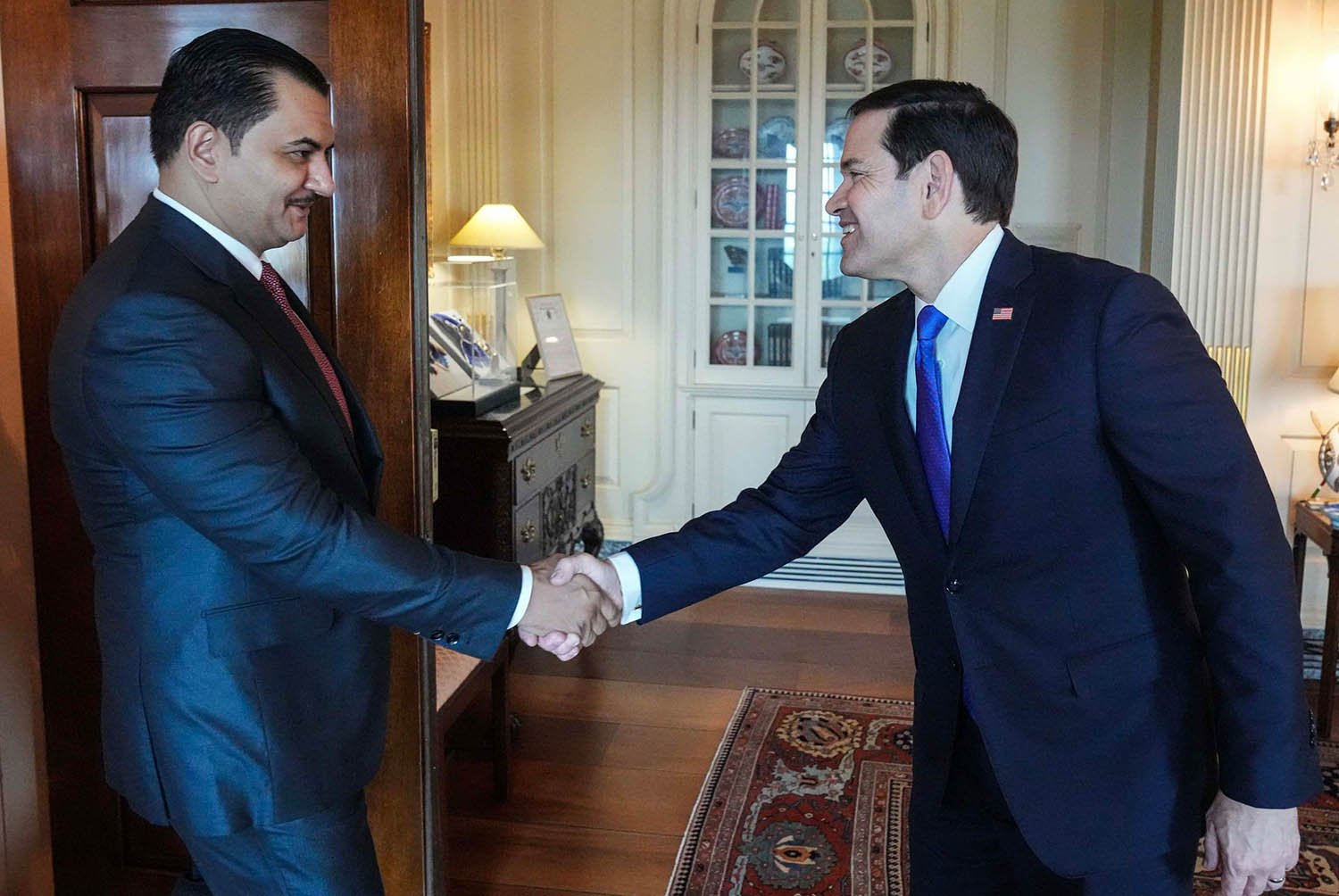
On June 29, Lieutenant General Saddam Haftar—deputy commander of the eastern-based Libyan National Army and the designated heir of Field Marshal Khalifa Haftar—was received in Washington by Secretary of State Marco Rubio. During that same timeframe, another Libyan was also brought to the US capital: Abdul Salam al-Zoubi, deputy defense minister of the internationally recognized Government of National Unity (GNU) in Tripoli and one of the pillars of Tripoli’s ontologically volatile security system. Zoubi met Senior Advisor to the US President Massad Boulos, Deputy Commander of US Africa Command Lieutenant General John W. Brennan, members of the National Security Council, and Deputy Secretary of State Christopher Landau—one rung below the secretary himself.
In diplomacy, form is substance, and the choreography matters. The formal representative of Libya’s recognized government was handled a tier down, while the heir of an armed faction that calls itself a national army—but still functions as a militia—was elevated to the secretary of state. In Washington’s protocol of honors, legitimacy and force have quietly traded places.
What Rubio’s handshake blesses is a plan described as a form of “familistic consociationalism”: a peculiar form of power-sharing arrangement built not on inclusive and impersonal institutions but rather centered on formalizing existing and dominant family networks. This type of settlement does not so much unify Libya as freeze its current balance of power by formalizing the families and patronage networks that already dominate it. Under the framework promoted by Boulos, GNU Prime Minister Abdulhamid Dbeibah—or his nephew Ibrahim—would keep the premiership, while Saddam Haftar would head a new presidential council, with national elections deferred to a later, unspecified phase. For months, this was Boulos’s initiative. Now the US secretary of state has put his own weight behind it.
The method is the problem. Libya’s transition has not stalled by accident. It has been engineered by domestic spoilers who persist precisely because they expect foreign patrons to shield them from consequences. A deal that rewards the strongest of those spoilers with Washington’s recognition does not break that logic, it merely ratifies it. It turns managed instability into a formal settlement.
It also bypasses the very people it is supposed to be helping. Elections might not be an immediate panacea: a rushed national vote in a country still partitioned among armed factions could entrench a “winner take all” logic of its own. But that risk does not mean that settling Libya’s future in the hands of a handful of families is a good answer. The August 2025 municipal elections suggest where Libyans actually stand. Turnout reached 71 percent in the twenty-six municipalities where voting was allowed to proceed, even as the vote was suspended in the east and south and electoral offices were torched in the west. That local, bottom-up exercise revealed less an appetite for any particular ballot than an exhaustion with top-down, externally brokered arrangements that pass over young Libyans and whole communities. A pact negotiated over their heads offers them precisely more of the same.
The economic case for the deal is just as thin. Libya is pumping oil at the highest rate in a decade, yet the windfall does not reach households and their purchasing power keeps declining steadily. The central bank devalued the dinar twice in under a year, and the World Food Programme’s minimum expenditure basket rose nearly 20 percent in twelve months. In February, protesters across western cities demanded the removal of the entire political class they blame for the cost-of-living crisis. The wealth exists, it is simply captured before it reaches the public.
Most damaging of all, the plan writes off an entire generation. Libya’s median age is roughly twenty-eight, nearly half the population is under twenty-five, and youth unemployment hovers near 50 percent: among the highest rates in the world. These are young Libyans raised between the diaspora and a post-revolutionary homeland that promised them a state. This stalemate has delivered a society held back by violence and nepotism, where power and opportunities pass by surname and connections rather than by vote and skill. It tells young Libyans that 2011 was not a new beginning but a mutation of the old order—familism and patrimonialism under a new name. That is not a formula for stability, it is a deferred detonation.
Nor are the clans the cohesive blocs the plan assumes. Misrata, once the symbol of unity in the wake of Muammar Qaddafi’s rule, is now split between pro- and anti-Dbeibah factions, and an externally imposed settlement is as likely to ignite that fracture as to contain it. Within the Haftar camp, resentment is already building over the concentration of power in Saddam’s hands, starting with his brothers. Washington is wagering Libya’s future on the durability of networks that may not outlast their patriarchs.
There is a better use of American leverage. The United States should tie its recognition and its support to measurable progress toward elections, joint oversight of oil revenue, and protection for the institutions Libyans actually turned out to choose—not to the elevation of those very same men who have spent a decade obstructing all three. The choice was visible in this week’s guest list: Washington chose the militia over the ministry.
In throwing its weight behind an elite accord that commands no genuine popular consent—save from those who profit directly from the status quo—Washington is making a dangerous bet. The wager may even pay off at first: Such an arrangement could hold, and appear to work, for its opening months. But its many structural contradictions will surface soon enough, and when they do, they risk bringing the whole edifice down in violence.
That is the part of the story the architects of this short-sighted compromise would rather not hear. But it is essential that they do. What is at stake is not only the Libyan crisis but a more general approach to stability across the globe. The US must understand that preserving a fragile stability today while increasing the risk of a much larger crisis tomorrow is neither a sustainable nor a wise approach.
Karim Mezran is the director of the North Africa Initiative and a resident senior fellow with the Rafik Hariri Center and Middle East programs at the Atlantic Council.
Further reading
Image: Secretary Marco Rubio meets with Libyan National Army Deputy Commander Saddam Haftar at the Department of State in Washington, DC on June 29, 2026. Official State Department photo by Freddie Everett via Flickr’s US government work license.
