

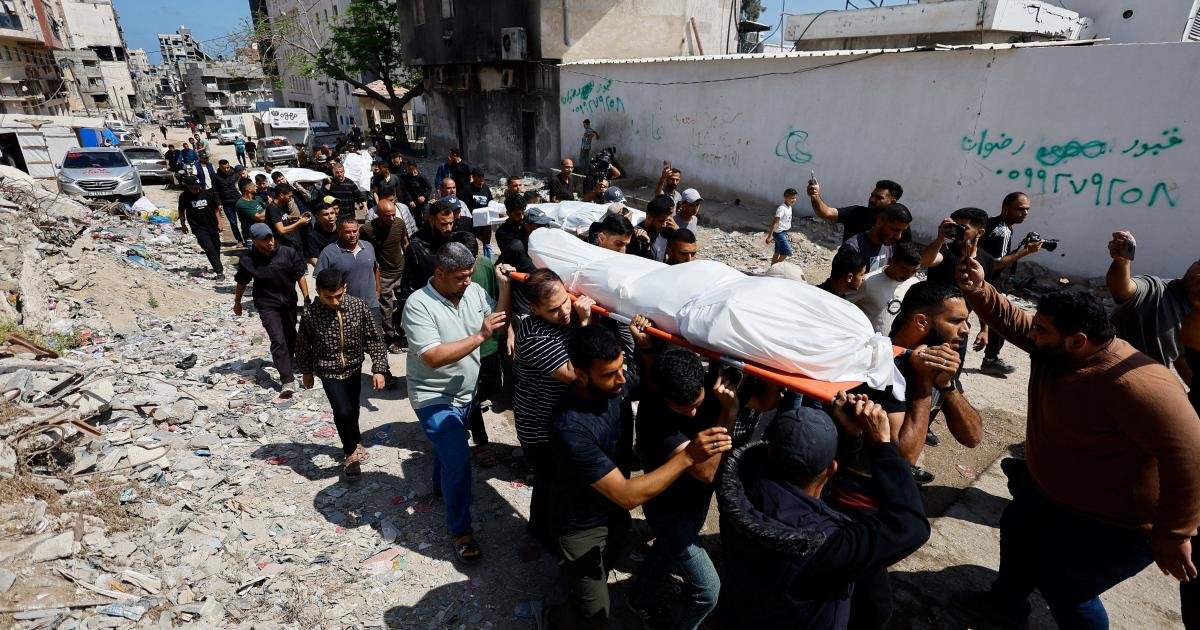
The consensus among analysts is that Hamas is down, but hardly out. The group may be badly battered, but it has been around since 1987, and in that time, it has been repeatedly attacked by Israel and has always grown back. The conditions that gave rise to the organization—occupation, dispossession, and humiliation at the hands of Israel—are as severe as ever. And in the Gaza Strip, there is no comprehensive alternative to Hamas’s governance. Even in its weakened state, the group has institutional memory, administrative infrastructure, and coercive capacity that its competitors cannot match.
But in truth, Hamas’s two-year war with Israel has decimated the organization beyond the point of recovery. It may still be more powerful than other groups in Gaza. But Israel’s bombing campaigns and invasion have cost Hamas essential military infrastructure, torn apart its leadership, and cut it off from its patrons. As a result, the organization lacks the power to actually rule Gaza. It is suffering from political paralysis and facing financial disaster in the enclave. Finally, it has lost public support: many Gazans blame the group for starting a war that has resulted in the destruction or damage of 90 percent of the homes in the Gaza Strip and the deaths of roughly four percent of the prewar population.
Despite these facts, officials on both sides of Gaza’s yellow line have embraced the idea that Hamas is alive and well. Members of Hamas perpetuate this farce for an obvious reason: they do not want to admit that they lost. But Israel is also pretending that its nemesis remains strong so it can justify its continuing military operations—and avoid having to answer difficult questions about the future of Palestinians.
UNAUTHORIZED OBITUARY
Since Hamas attacked Israel on October 7, 2023, Israel has killed an entire echelon of Hamas leaders. This includes its former top officials: Yahya Sinwar, Ismail Haniyeh, Mohammed Deif, and Mohammed Sinwar. In May of this year, Israeli forces assassinated Izz al-Din al-Haddad, the head of Hamas’s military wing, at a residence, along with some of his family. Eleven days later, it killed Haddad’s replacement, Mohammed Odeh, along with his wife and two of his children. Today, only one Hamas commander who held a senior position before October 7 is left standing: Imad Aqel. Israel has also taken out hundreds of midlevel commanders. What it has done, in other words, goes beyond a mere decapitation strategy. It has removed Hamas’s entire nervous system.
Israel has also rendered Hamas incapable of regeneration. The fact that Haddad and Odeh were killed in their homes, with their families, indicates that the safe houses, tunnels, and countersurveillance architecture that once made Hamas’s senior leadership elusive are now gone. So are its overseas outposts. In the last three years, Israel has killed (or tried to kill) Hamas officials in Iran, Lebanon, and Qatar.
It is therefore little wonder that Hamas is experiencing a leadership crisis. Since Yahya Sinwar was killed, in October 2024, the group has been unable to decide who should take the helm of its political bureau. Hamas’s Shura Council, made up of 50 to 80 members, was supposed to elect a new leader in early 2025, but it could not meet and vote because of Israel’s ongoing bombardment. When a vote was finally held in February 2026, it did not produce a winner. For now, the group is run by a five-man council that has been hamstrung by infighting.
The relationship between Iran and Hamas is effectively over.
Hamas has settled on two leadership candidates: Khalil al-Hayya and Khaled Mashal. Each has a very different agenda. Hayya and his supporters favor close ties with Iran and continued armed confrontation, whereas Mashal and his backers want more sponsorship from Sunni states and more pragmatic negotiations with Israel. Of course, many healthy organizations have factional disagreements that they negotiate and resolve. But these divisions have instead resulted in deadlock. When the United States and Israel began bombing Iran on February 28 of this year, for example, Hamas could not agree on a statement or a response. It thus remained silent for three weeks. When it spoke, it sent conflicting signals. The group’s political leadership in Qatar called on Iran to “avoid targeting neighboring countries,” whereas the group’s military spokesman in Gaza put out a statement with a markedly different tone that praised Tehran’s war efforts.
Hamas’s political crisis is more than just internal. Since October 7, the group has lost external support. For decades, Hamas was an integral part of the so-called axis of resistance—Iran’s network of partners across the Middle East. This partnership was never seamless, in part because Hamas is a Sunni Islamist movement embedded in a Shiite-led alliance. But it was functional. Iran provided Hamas with weapons, training, and funding to the tune of $100 million annually. Hamas, in return, allowed Iran to indirectly attack its Israeli nemesis. Hamas also gave the axis moral legitimacy by allowing it to directly confront Israel’s occupation and to proclaim itself as a cross-denominational movement.
But that relationship is now effectively over. Iranian leaders seemed frustrated that Hamas launched the attacks of October 7 without giving them sufficient warning. Iran, in turn, did not do much for Hamas during the war in Gaza. Hamas then did little when Iran itself came under attack. Both entities are currently rebuilding, but Iran’s new leaders are more focused on controlling the damage in their country, rebuilding, preserving their nuclear program, and managing a cease-fire than on aiding their onetime ally.
Hamas has also lost much of its support from Qatar. For over a decade, Qatar granted the organization’s leaders permanent residency, let them maintain a formal office in Doha (at Washington’s request), and featured them on Al Jazeera—Hamas’s primary platform for reaching the Arab world. Qatar also funneled around $360 million per year to the group in Gaza. But in November 2024, after Hamas killed the American Israeli hostage Hersh Goldberg-Polin and rejected several cease-fire proposals, Qatar kicked some officials out of Doha at the behest of the United States. Qatar expelled more Hamas leaders in 2026 when they refused to condemn Iranian missile attacks on Gulf capitals. Many left for Turkey, but the Turkish government, which is wary of antagonizing the United States and interested in warming relations with Israel, has offered Hamas leaders far fewer perks than they enjoyed in Qatar.
LAST GASPS
In Gaza, Hamas is not only suffering from a political crisis. It is also experiencing an economic one. Thanks to sanctions, the loss of external funding, and war damage, the organization is nearly broke. It is still trying to pay salaries to roughly 49,000 officials, but those checks are arriving intermittently. The organization has taken some dramatic measures to raise revenue: since May 2026, Hamas has started collecting taxes of up to 30 percent from merchants selling relief supplies diverted to the black market and has imposed high taxes on the 15 companies in Gaza that are cleared by Israel to import goods. These efforts are hardly enough to sustain the group, but they do make life worse for everyday people. Today, Gazans pay four times as much for basic commodities as they did before 2023.
Such financial troubles make it hard for Hamas to govern. They also make it hard for Hamas to carry out its founding mission: resisting Israel. The group, for example, does not have the money to fully replace or rebuild the heavy weapons, tunnels, and communications systems that made October 7 possible. The rockets and longer-range projectiles that once reached Tel Aviv and Jerusalem have already been fired or destroyed in Israeli strikes. The workshops, lathes, chemical mixing facilities, and warhead assembly lines that Hamas built over two decades are buried under rubble, and the group lacks the resources needed to recover or remake them. Even if the organization had enough money to secure more, Israel’s blockade would make getting such materials difficult, and the Israel Defense Forces might quickly take military action to stop reconstruction.
Hamas still has enough small arms to control a check point, intimidate a merchant, or execute a collaborator. According to U.S. intelligence estimates, it also has about 20,000 fighters left. But this does not mean it can mount a meaningful military response to continued Israeli attacks. Before 2023, whenever Israel would strike Gaza, Hamas would fire rockets back in a tit for tat. Since the October 2025 cease-fire went into effect, Israel has killed over 1,000 Gazans and announced it would expand its control of the territory from 53 to 70 percent. Yet Hamas has responded with nothing more than statements.
Netanyahu needs a threat to justify his alliance with the far right.
In fact, Hamas is so weak it can no longer suppress armed challengers in its own territory. Today, five militias, each made up of a few dozen to a few hundred men, are fighting Hamas for control over Gaza, including the Popular Forces led by Ghassan al-Dahini and the so-called Strike Force Against Terror led by Hussam al-Astal. Hamas is also up against several armed families, such as the Dughmush and Shuhaiber clans in Gaza City and the al-Majayda clan in Khan Younis. These groups will not develop into a Hamas 2.0 because they lack relationships with Iran or Arab governments and are openly backed by Israel, which has provided them with weapons, money, and aerial support. But they are nonetheless dangerous to Hamas because they have undermined the group’s authority over certain areas and targeted its members.
Although many Gazans rallied around Hamas in the immediate aftermath of October 7, some are starting to sour on the group, having concluded that it brought catastrophe onto Gaza and is incapable of governing. In fact, it appears that many Gazans have started to give up on the idea of armed resistance overall. In September 2023, according to the Palestinian Center for Policy and Survey Research, 51 percent of Gazans thought that armed struggle was the best way to end Israeli occupation and build a Palestinian state. By October 2025 (the latest month for which polling data is available), that share had fallen to 34 percent. That hardly means Gazans want an Israeli occupation, a government led by the Palestinian Authority, or any other externally imposed governing body. But they do want electricity, safety, freedom of movement, jobs, education, and, above all, to stop burying their children—outcomes that Hamas cannot deliver.
Perhaps the most damning evidence of Hamas’s collapse is that the once zealously defiant group is starting to surrender. In January 2026, it said that it would abolish its administrative bodies in Gaza, and by May, Hazem Qasem, a spokesman for the organization in Gaza, had stated that the Hamas-run government was “ready to hand over administration” to the National Committee for the Administration of Gaza, the technocratic body overseen by U.S. President Donald Trump’s Board of Peace. Some analysts view Hamas’s willingness to transfer authority as a tactical concession. But it is better understood as a distress signal.
WEEKEND AT BIBI’S
Even though Hamas is fiscally, militarily, and politically ruined, its leaders are unwilling to completely give in. Some seem to be hoping that they will eventually stage a comeback akin to what followed Hamas’s wars against Israel in 2008–9 and in 2014, when the group rebuilt its tunnel network and replenished its rocket arsenal. Other Hamas leaders cling to the group’s survival to simply keep their jobs and stay relevant. Almost all of them want to avoid answering for a war that killed over 73,000 Palestinians and displaced almost the entire population.
That Hamas wants to portray itself as strong makes intuitive sense. More surprising is Israel, which is likewise carrying on as if Hamas is still formidable. Yet Israeli Prime Minister Benjamin Netanyahu has a good reason for maintaining this charade: he needs a threat to justify his aggressive approach to security, his refusal to engage with Palestinian statehood, and his alliance with the far right, especially ahead of Israeli elections in October. He has said that Israel will not allow Gaza to begin reconstruction until Hamas is demilitarized. And it appears that Israel intends to control the enclave indefinitely. According to an investigation by Al Jazeera, Israel now has 40 military outposts in Gaza—eight of which have been built from scratch since the October 2025 cease-fire. A force on its way out would have no need for such permanent structures. If Netanyahu acknowledged that Hamas was in fact a phantom, he would come under mounting global pressure to stop occupying Gaza without offering its people political rights.
For Netanyahu, this cynicism is nothing new. His entire political career has been built on managing the Palestinian question, not resolving it, and he has been happy to indirectly partner with Hamas to do so. In the years leading up to October 7, Netanyahu encouraged Qatar to fund Hamas in order to keep the leaders of the West Bank and Gaza divided and thus less capable of negotiating on Palestinians’ behalf. The logic that produced the policy remains essentially the same: whereas Netanyahu once needed a strong Hamas to prevent a peace process, he now needs only its specter.
The rest of the world, then, needs to stop being complicit in the fiction that Hamas is still a menace. U.S. and European governments must begin asking Israel to account for the gap between the threat it describes and the reality on the ground. Donor countries should condition reconstruction funding on Israeli compliance with the cease-fire’s provisions—which mandate a complete withdrawal of Israeli forces from Gaza, the opening of all border crossings, and the unrestricted return of displaced civilians—not on Hamas’s disarmament alone. Seeing through Netanyahu’s ploy is a prerequisite for rebuilding the lives of the two million Gazans left in the strip.
Loading…
