

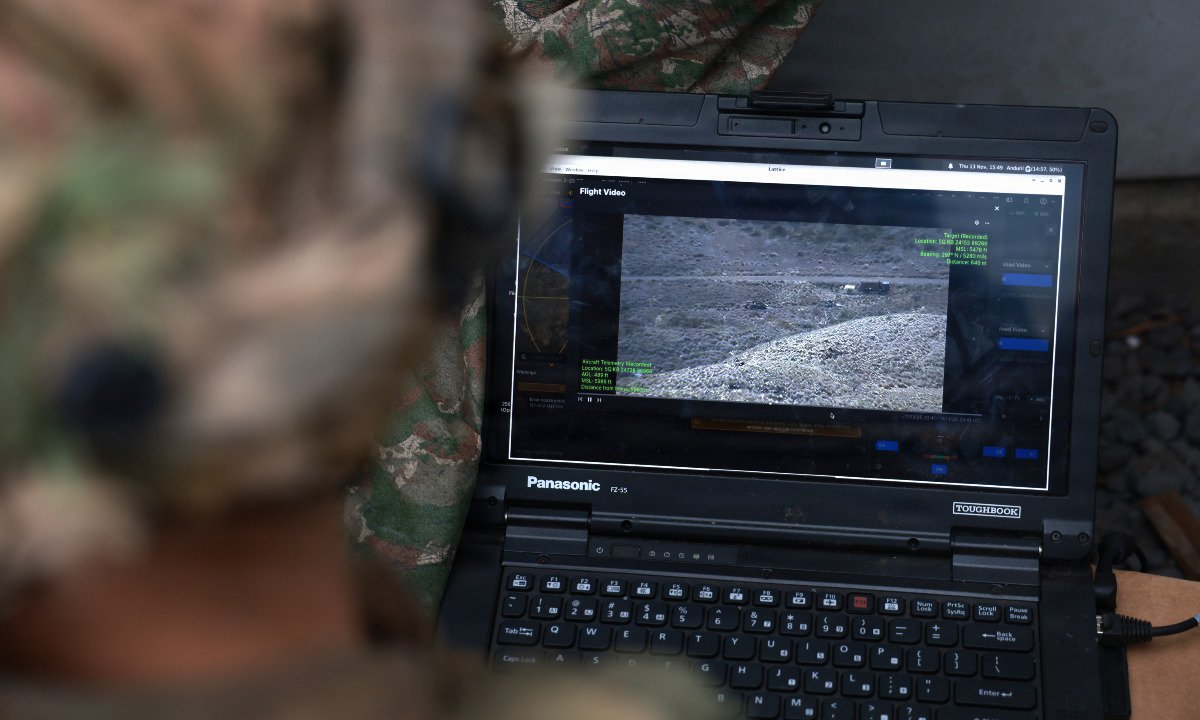
In the summer of 2023, during Ukraine’s southern counteroffensive, I watched two soldiers working under a camouflage net behind a battered school in Zaporizhzhia carry out in ninety seconds a sequence of tasks that the Army distributes across an entire fire support team. A folding table, a cracked tablet, and a power bank sat between them. One of them flew the drone; the navigator did everything else. The drone was finding targets for the gun line. While the navigator talked to the pilot beside him, he tracked the drone feed on one screen and friendly positions on another; the gun line heard him over a radio he never looked at. He confirmed the target was clean of friendlies, passed a correction in a voice so flat it sounded almost bored, and watched the splash.
I had done a version of that job a decade earlier in Kunduz—as a forward observer trained as a joint fires observer. The job I trained for spread those functions across a room full of people. In Zaporizhzhia, they fit inside one soldier. What I watched was the same fire mission with the labor redistributed: A drone gives an observer a sensor he or she can move, park over a target, and hold there, so the coordination that once traveled between the observer and the guns now happens inside one soldier’s head. A soldier who requests fires starts a process that other people finish. The navigator in Ukraine finished it himself. He was composing fires—and US Army doctrine, which still describes only the soldier who requests them, has no name for the man I watched. Call him an unmanned fires observer.
The Army is rewriting its drone doctrine at every echelon—a force-wide overhaul announced in March, a new career field for drone operators, and fresh manuals for employing small drones and for defeating them. The effort has been organized around the platform, and the fire support publications have been left untouched. No manual names a qualified soldier who turns what a drone sees into a fire mission—and no manual describes what that job requires beyond the drone itself, including the friendly ground picture and the airspace above the target, which the drone does not supply. The direction in which strike approval itself flows is well established: A commander holds it, and has always been able to hand it to a trusted subordinate. When a drone has cued that strike, Army doctrine gives little information on who it is handed to. A commander who wanted to push approval down to the soldier watching the drone feed would find no qualification to check and no course that produces one.
The Army is modernizing the tools of drone warfare faster than the rules that govern who coordinates and clears the fires those tools produce. It can write that soldier into doctrine now, in a handful of paragraphs, or its warfighters can define the job the way Ukrainian ones did—in combat.
Composing Fires
A call for fire has always moved through a chain of people—the forward observer sees the target and sends the request; a fire support officer checks it against the maneuver picture and the coordination measures in effect; an airspace element confirms nothing is flying through the gun-target line; and a commander, or someone holding the commander’s delegated authority, approves the mission before the guns fire. Doctrine’s name for this whole sequence is clearance of fires. Those checks sit with different people at different echelons because no one soldier held all the information they required. The observer saw the target. The fire support officer knew the maneuver plan. The airspace element tracked the aircraft. Assembling that picture took minutes, and minutes were available: A target spotted from a hilltop stayed put long enough for the request to move from hand to hand.
The Ukrainian navigator I watched performed every one of those checks himself; he saw the target on one screen and the friendly picture on the other, he knew where his drone was because he was looking through it, and he knew where the round would fall because he had asked for it. He did it that way because the minutes were gone. Both sides watch each other constantly from the air, and a vehicle that stops in the open, a squad that breaks cover, a gun that fires and does not move is spotted and struck before a request could travel the length of the traditional chain. Ukrainian teams improvised most of this, and they improvised toward the same answer: consolidating those functions into one soldier. The drone has shortened the distance between observation and effect—nothing has disappeared from the fire mission, but the functions have compressed.
The same consolidation is arriving in American formations, carried by software. Project Shrike, built by Army Futures Command, generates the call for fire itself: A drone feed identifies the target, the software writes the mission, and a soldier accepts or rejects it on a screen. Soldiers of the 101st Airborne Division have already run it at a combat training center. Every design choice in that loop—what the request contains, which checks run automatically, where the human sits—is a doctrinal decision taken in the absence of doctrine. No publication says what the soldier touching the approve button must know or be qualified to judge.
A Rewrite Organized Around the Platform
On March 30, 2026, the Combined Arms Doctrine Directorate at Fort Leavenworth announced a force-wide drone doctrine overhaul. “Most efforts this past year focused on fielding systems and learning to use them,” its director, Richard Creed, said in the announcement. The doctrine, he added, will follow as operational forces gain experience. The directorate had already revised Field Manual (FM) 3-0, Operations, in March 2025, prioritizing two imperatives drawn from Russia’s invasion of Ukraine: shield the force from an enemy who is always watching, and let a drone or a sensor, never a soldier, be the first thing the enemy touches. Fort Benning is finalizing Army Techniques Publication (ATP) 3-90.51, the tactical drone employment manual, while Fort Sill rewrites its counterdrone counterpart, ATP 3-01.81. In February, the Army established a tactical unmanned aircraft system specialist career field, designated 15X, under the aviation branch. By any measure of institutional movement, this is a serious response, but its subject throughout is the drone as a platform—who owns it, who flies it, who shoots it down. The portfolio leaves out the fire support library entirely—the manuals that govern how an observed target becomes an approved strike. The March announcement never uses the words “fire support.”
The role is missing from the manual that should supply it. ATP 3-09.30, the Army’s manual for observed fires, defines the forward observer and the procedure that turns a request into a fire mission. Paragraph 7-12 of the 2017 edition (the most recent version) does address unmanned aircraft, permitting an observer to call for and adjust fire through a drone. What the paragraph offers is an analogy—the process is “similar to” fires conducted with manned aircraft—and it runs four sentences. It creates no qualification, and it never says how a mission that begins at a drone gets approved.
FM 3-09, the Army’s capstone fire support manual, compounds the omission in the way it categorizes lethal fires. Paragraph 1-3 of the August 2024 edition lists the systems that deliver lethal fires: field artillery, mortars, naval gunfire, and munitions delivered from fixed- and rotary-wing aircraft—a list inherited whole from the manned aviation era. The manual references “armed UAS [unmanned aircraft systems]” three times elsewhere; the branch knows the weapons exist, and yet they do not appear on the list. A drone that spots for the guns gets four sentences in ATP 3-09.30. A drone that is the munition appears nowhere in FM 3-09’s categories.
Joint doctrine names the standard without naming the soldier. JP 3-09, the joint fire support publication, cautions in its fratricide guidance that no single system or safeguard, including digital trackers that display friendly positions, should serve as the sole means for clearance of fires. What reduces the risk of striking friendly troops, it says, is vesting engagement decisions in “well-trained and qualified personnel.” The publication then handles unmanned aircraft as flying machines: They should be “requested, tasked, routed, controlled, and deconflicted” like their manned counterparts. Who turns what they see into an engagement decision, and what qualifies them to make one, goes unasked and unanswered.
The Pentagon, meanwhile, has articulated a goal of pushing decisions downward. A July 2025 directive on drone dominance moved the authority to buy and operate drones “from the bureaucracy to our warfighters.” The department is handing drones to the lowest level of the force, but the fire support system has not yet written down who may turn those drone feeds into an approved strike or the level at which they may do so.
Three Paragraphs
The fix is far smaller than the rewrite already underway; three additions, placed in the publications that govern how an observed target becomes an approved strike, could close the gap.
The first belongs in ATP 3-09.30, beside the four sentences it already gives the subject: a paragraph that names the unmanned fires observer and states what this individual must be trained and certified to do—originate a fire mission from a drone’s video and carry it through approval. The manual already permits the technique. Naming a duty position converts the technique into a training requirement, the requirement into a school seat, and the seat into a soldier who a battalion commander can point to when deciding how far forward to push an approval authority. At the price of a single paragraph, it is the cheapest tool the Army has.
The second is a shared picture of the lowest airspace, which would address two needs at once: a capability the Army currently lacks and a rule about where that capability lives. Today, units keep aircraft and artillery apart by procedure: altitude blocks and timing, managed by airspace cells at brigade and division levels—a method built for an airspace sparse enough to schedule. Since the advent of small drones, the bottom five hundred feet is no longer sparse. The graphics used by commanders to control fires and aircraft need to show a zone running from the surface to five hundred feet that displays friendly drone tracks, artillery trajectories, and helicopter traffic together, so the conflicts sit in front of the soldier about to release a weapon. The green-amber-red status board the 3rd Combat Aviation Brigade ran in an exercise earlier this year is a working prototype of the capability. The rule belongs in the joint airspace control publications, because an Army-only graphic will not survive contact with the joint airspace system.
The third fix belongs in JP 3-09, the joint fire support publication, which should recognize the qualification of an unmanned fires observer and state what it entails. Joint fires observers hold no approval authority of their own—the qualification buys trust. A commander can act on a qualified observer’s report without putting a second set of eyes on the target because the commander trusts the skills behind the role. Unmanned fires observers should buy the same trust. Because they watch the target, the friendly picture, and the low airspace at once, they are the soldiers a commander can hand approval authority to when the fight moves faster than the chain above them. The delegation should always remain the commander’s choice—but a qualification is what makes the choice available.
Writing the Missing Manual
Neither a wider common picture nor a new organization closes the gap between observation and cleared fires. Retired Gen. James Mingus, the Army’s former vice chief of staff, has argued for an integrated fires complex that would centralize sensing and fires in one architecture, and the Army is experimenting with multi-effects companies that consolidate those capabilities in one formation. Both still depend on a soldier who can turn what an unmanned aircraft sees into a request that can be cleared and executed. The Army cannot push that function to the sensor operator, who only sees the drone’s field of view and none of what surrounds it: the adjacent battalion’s scheme of maneuver, the aviation mission launched twenty minutes earlier, the reconnaissance element that moved without reporting its new position, or the artillery already firing into the next grid square.
The natural objection may contend that naming this soldier pushes strike decisions too far down—but the decisions already live at the tactical level. A certified terminal attack controller grants weapons release to attacking aircraft; a soldier without the certification cannot, regardless of the target he or she sees. The standard is the safeguard. Delegation itself is routine; doctrine already allows commanders to hand engagement authority down—the legal obligations of targeting stay at their level either way. Qualifying this soldier moves no authority anywhere. ATP 3-09.30 has permitted an observer to originate a fire mission from a drone’s video since 2017, but has never said what that observer must know in order to do so. The risk the objection raises already exists, and commanders who delegate today are handing the decision to a soldier in a role the Army has never articulated; writing it down would tell them what they are trusting.
Absent a defined role, American units will work the problem out at the operational level, as Ukrainian ones had to, and the war’s record shows what that costs. Jakub Jajcay, a former Slovak Army officer who spent six months on a Ukrainian first-person-view drone team, has written that arranging a strike could eat more than thirty minutes, much of it spent coordinating with other friendly teams so that one drone’s control link did not jam another’s. The half hour Jajcay describes did not go to approval; it went to traffic, which is the layer a shared low-airspace picture exists to absorb. A trained mortar crew, by comparison, turns a call for fire into rounds in minutes. The mortar crew is fast because the Army, decades ago, wrote the crew’s job down and drilled it to reflex; the drone crew is slow because each team works the sequence out for itself. Ukrainian teams have spent four years composing that coordination under fire; an American battalion in its first peer engagement will be asked to compose it from a standing start.
Under the camouflage net in Zaporizhzhia, I caught myself looking around for the people who would have surrounded me in Afghanistan: the radio operator, the fires cell, the officer whose job was to translate maneuver into permission. They had not gone anywhere; they had been folded inward—into the software and into the idea that the soldier closest to the problem should also be the soldier to solve it.
The joint fires observer exists because twenty years ago the Air Force could not supply enough terminal attack controllers—the airmen qualified to direct strike aircraft—for the Army’s fights in Iraq and Afghanistan. The services needed a soldier who could carry an observation into more than one fires system, and the fix arrived as a memorandum of agreement that produced a qualification commanders learned to trust. The Army is in the same position again, one technology later. The drone operator may find and track the target, but who turns that observation into a request and carries it through clearance remains undefined. That soldier needs a name and a qualification. Unmanned fires observer will do.
Alexei Hoffman is a research associate at the Center for Strategic and International Studies’ Aerospace Security Project, where he focuses on unmanned systems policy. He served as a forward observer in the US Army, with deployments to Afghanistan, and later volunteered as a defense training adviser in Ukraine.
The views expressed are those of the author and do not reflect the official position of the United States Military Academy, Department of the Army, or Department of Defense, or that of any organization the author is affiliated with, including the Center for Strategic and International Studies.
Image credit: Pfc. Jose Nunez, US Army
