

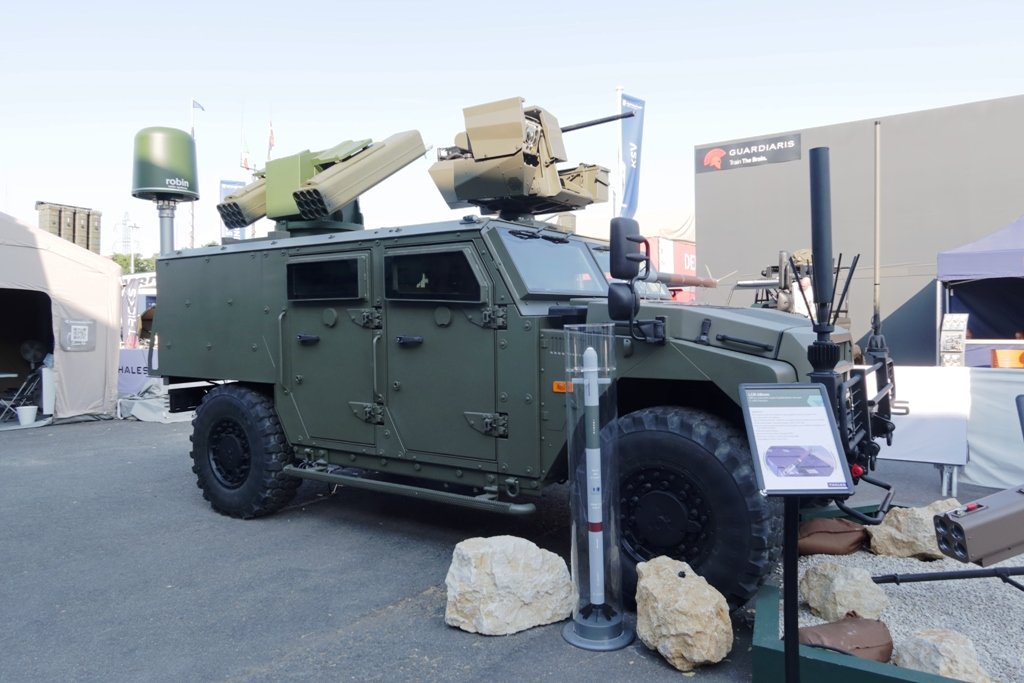
Thales has developed a vehicle borne counter-uncrewed aerial systems (C-UAS) system dubbed RapidStriker and unveiled it at Eurosatory 2026
Julien Assoun, Thales vice president for vehicles and tactical systems said that “it has come from the lessons learned from current conflicts and the need to address the increasing threat from drones and loitering munitions. RapidStriker is an air defence solution that is able to detect, identify, track and neutralize threats”.
For the first three functions RapidStriker integrates a 360° radar from Robin Radar Systems, a multi-sensor optronic system, the Thales IRIS detection and classification system and an “advanced weapon management system”. The system is vehicle agnostic but was displayed on a Thales Bushmaster Utility vehicle.
To engage targets, RapidStriker combines 68mm or 70mm laser-guided rockets in a twin12-round launcher, a remote control weapon station (RCWS) with cannon, the Thales Eclipse jammer and the Toutatis remotely operated munition. The weapon management system fuses data from the different sensors and provides the targeting solutions for the different effectors to engage. It operates with a man-in-the-loop, enabling the operator to select the most appropriate response.
Assoun noted that to counter the drone swarm threat a rocket containing steel balls was under development as “an unguided saturation weapon” which can be fired in a salvo. The system’s rocket launcher would be likely to carry a mixed load and the weapon management system would allow the operator to select the appropriate rocket type.
Assoun said that the individual elements of the system were all well-tested, and the intention is to test and demonstrate the whole package by the end of 2026 with the aim of entering production in 2027. He added that work was also in progress to integrate other effector types, particularly direct energy weapons.
He said that the tactical concept was for the vehicles to operate in pairs, with one moving while the other provided surveillance and defence. He noted that surveillance data can be passed between vehicles and into a wider air defence network.
Photos by P. Valpolini
