

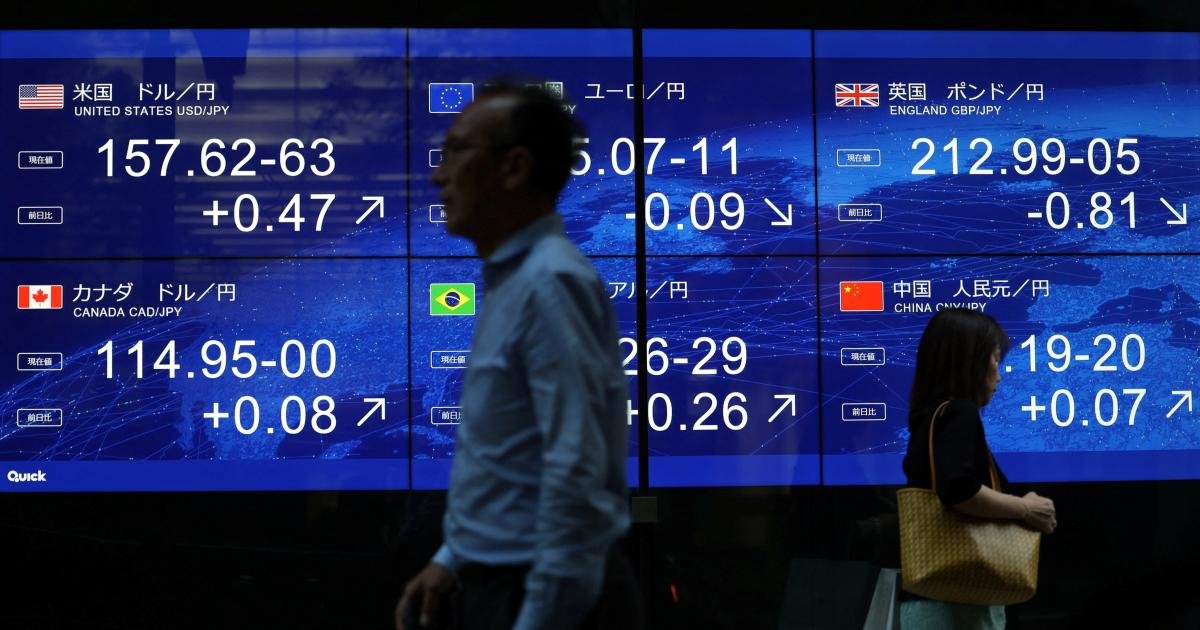
As the Group of Seven meets in Évian, France, beginning June 15, French President Emmanuel Macron has pushed to bring about a broad recognition that rising trade imbalances are a global economic problem. But G-7 leaders will nevertheless likely ignore one of the most important sources of those imbalances: the undervaluation of the currencies of Asia’s large economies, especially China’s.
This is unfortunate. There is a growing consensus that Asia’s trade surplus has grown too big. But without discussion of currency undervaluation, there is little chance that the G-7 can mount a meaningful effort to change the policies that have given rise to these imbalances. In 2021, when China’s property bubble collapsed, it weakened the renminbi, which helped Beijing’s pivot to export-led growth. The currency’s reduced value made Chinese goods cheaper for foreign buyers, and foreign goods more expensive in China. Weak growth in demand, a falling currency and widespread industrial subsidies have led China’s overall trade surplus to triple since 2018. Moreover, Chinese state banks and other state institutions are now giving China’s exporters an artificial edge in foreign markets by holding China’s currency down.
U.S. President Donald Trump’s tariffs were meant to slow China’s export juggernaut. But it has not worked out that way. Rather than assembling its own parts for shipment direct to the United States, China now ships intermediate goods—often high-tech components—to neighboring countries for final assembly, thus sidestepping tariffs. To keep their own exports competitive and workers in their manufacturing sectors employed, many of China’s neighbors have felt compelled to keep their own currencies weak. Indeed, several other Asian currencies are at historic lows against the dollar.
These rising imbalances in global trade are as much a problem for Europe as for the United States. Europe’s automotive, chemical, steel, and machine-tool industries are on the frontline of this so-called second China shock. This is why Macron has made global trade imbalances a major theme of this year’s G-7. But in Europe, as in the United States, there is still a reluctance to make currency diplomacy integral to the broader trade discussion. This is an intellectual and policy blind spot that risks a failure of economic policy coordination. As long as it persists, trade imbalances will only grow. This situation is unsustainable. The G-7 must present Beijing with a choice: it must allow its currency to appreciate, or it must face new trade restrictions.
TRADING TROUBLES
Large surpluses and large deficits create financial risks as well as trade tensions. To address these problems, G-7 finance ministers have agreed to a minimal communiqué that does little more than highlight the “common interest” that surplus and deficit economies share in bringing down persistent trade imbalances. But they did not press for a change of China’s exchange rate policy. Moreover, the G-7’s call for yet another IMF report on the underlying drivers of imbalances are unlikely to persuade Beijing to move away from its current reliance on exports to achieve growth targets that it cannot meet from domestic demand. Chinese think tanks, state media, and officials still attribute its rising surplus to its comparative advantage in new industrial sectors.
The United States, meanwhile, appears to have lost interest in an agenda that would try to facilitate a simultaneous reduction in trade surpluses and deficits. U.S. Treasury Secretary Scott Bessent’s early talk of a grand global economic reordering has disappeared into a world of communiqués that promise “constructive strategic stability.” Beijing likely understands this to mean that Washington will not demand major changes to its current set of economic policies. Bessent’s initial ambition to bring the fiscal deficit, which is once again trending back above six percent of GDP, down toward three percent seems to have vanished. The administration is instead celebrating a surge in AI-related capital goods imports that is likely to push the U.S trade deficit even higher.
Against this backdrop, a strange disconnect has emerged, as the recognition of a growing problem has not translated into support for the most obvious solution. Economists across the ideological spectrum recognize that China’s scale, its technological sophistication, and the yawning gap between its rapidly growing exports and its stalled imports have created a profound challenge to the world’s other manufacturing powers. Similarly, few would challenge the proposition that reliance on China for critical inputs creates an important strategic and economic vulnerability. Indeed, there is even a grudging acknowledgment in Washington—though less so from the IMF—that Beijing’s mix of central government support and subsidies from competing local governments has been effective in mastering and scaling the production of cutting-edge technologies.
And yet the consensus does not extend to recognizing the need to end deep currency undervaluations— notwithstanding the fact that ending them is the one policy change that would directly bring balance to global trade. International economic policy decision-makers seem to be studiously avoiding any commitment to macroeconomic coordination or talk of exchange rate policy, and instead maintain that cooperation should be limited to each country making its best individual efforts to pursue appropriate monetary and fiscal policies.
SOMETHING IS MISSING
Over the last five years, governments and international financial institutions have adopted the view that the currency policies of the world’s largest economies do not have any real or persistent effect. As the IMF’s recent paper on imbalances argues, moves in the exchange rate will be offset by changes in the level of domestic prices. But the empirical evidence to the contrary is overwhelming: domestic prices are rigid and only move slowly.
This neglect of currency issues was evident at the latest G-7 Finance Ministers’ meeting in May. Attendees did not even acknowledge that a growing undervaluation of the renminbi played a meaningful role in China’s recent export outperformance. Similarly, there is a lack of appreciation—including at the IMF—of how China’s capital controls make the exchange rate an independent policy tool under Beijing’s direct control. For example, the IMF’s most recent assessment of China’s economy did not mention, let alone analyze, the role of the state banks in maintaining the tight trading band around the renminbi that effectively lets China’s central bank control the movement in the currency. Only a few specialists—and actual currency traders—understand the tools that Beijing, and some other Asian capitals, use to maintain deeply undervalued currencies.
The current neglect of currency issues is a break from the past. Economists in the aftermath of World War II understood the connection between currencies and the balance of trade. The Bretton Woods system of fixed but adjustable exchange rates was built around this principle. And recognition that currency moves were central to external adjustment persisted for decades. As the U.S. trade deficit ballooned, in 1985, representatives of France, Japan, the United Kingdom, the United States, and West Germany met at the Plaza Hotel in New York to solve the problem. They agreed to coordinated intervention in the foreign exchange market, and they adopted economic policies to weaken the dollar. Doing so successfully brought down the U.S. trade deficit. Although this is sometimes attributed to the concurrent tightening of U.S. fiscal policy, in reality, dollar adjustment and fiscal adjustment were mutually reinforcing.
Currency moves were also central to the development of the trade imbalances that preceded the 2008 global financial crisis. From 2002 to 2005, for instance, the renminbi was tightly linked to a depreciating dollar even as Beijing’s entry to the World Trade Organization turbocharged Chinese exports. The resulting depreciation is a key reason why China’s surplus reached ten percent or so of its GDP—the first China shock. Conversely, the 40 percent real appreciation in the renminbi from 2005 to 2014 was a big reason why China’s surplus fell back to under two percent of its GDP. Exchange rates still matter, and they have a meaningful impact on the balance of trade.
FIDDLING THE FIGURES
Since the COVID-19 pandemic, China has seen steady technological advances and rising productivity in a number of industrial sectors. These are developments that should normally cause the renminbi to appreciate. Yet it has depreciated by roughly 15 percent in real terms. The IMF suggests that a 15 percent depreciation should increase China’s net exports by between two and 2.5 percentage points of China’s massive GDP—not far from the three percentage points of GDP rise observed in the last two years.
China is not the only Asian country with an undervalued currency. Compared with the dollar and the euro, the Korean won is as weak as it was during the global financial crisis of 2008. This is despite the fact that Seoul has experienced record trade surpluses. Taiwan’s massive export of chips and rising trade surplus in the last few quarters has also coincided with a five percent depreciation of the already weak Taiwan dollar. The Japanese yen, when adjusted for inflation, is as low as it was in the early 1970s. This broad Asian currency weakness is a key reason why the world’s trade surplus is so concentrated in East Asia. At $1.5 trillion, Asia’s trade surplus is far larger as a share of world GDP than at any point since 1945. It is also the only large surplus in the global economy. These Asian undervaluations are not accidental. China has a long history of using its central bank to intervene in the foreign exchange market and to manage capital flows so that its currency does not appreciate. In 2025, China resumed foreign currency purchases that keep the renminbi’s value artificially low. Meanwhile, Taiwan has successfully found ways to get its dollar to depreciate, even as rising demand for chips has driven a massive increase in its trade surplus.
In March, the IMF proposed a timid policy package to reduce global imbalances. It shied away from calling for the appreciation of Asian countries’ currencies. The G-7 also seems poised to avoid any commitments of its own, let alone make any direct call on China or Asia to lead a broad revaluation. By taking this approach, the G-7 has neither made any real space for economic policy coordination nor laid the groundwork for creating pressure for action by the broader G-20. In some respects, this is understandable. The G-7’s approach is politically expedient, as it allows the group to steer clear of discussing how exchange rate coordination fits within the European policy architecture and avoids discussion of the global consequences of Washington’s runaway fiscal policy amid a domestic investment boom. But the time for such evasions has passed. The G-7 and its partners should offer China a clear choice. Beijing can elect to face coordinated tariffs against its exports, or it can allow a coordinated appreciation in its currency—to the benefit of all.
Loading…
