

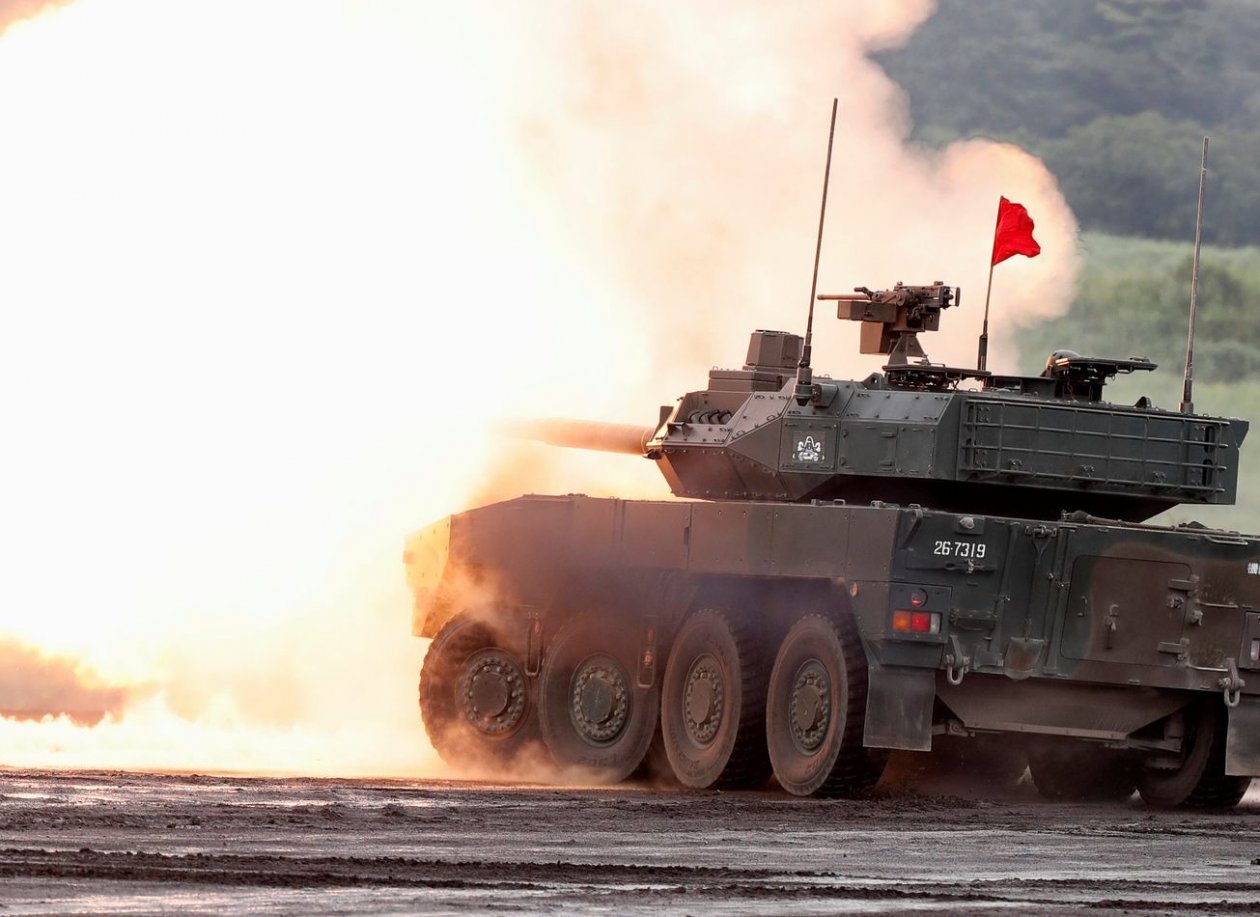
The Japan Self-Defense Force’s (JSDF) participation in the multinational Exercise Balikatan 2026, held in the Philippines from 20 April to 8 May, gave another opportunity to showcase first hand its capabilities and equipment in an overseas venue.
Involvement by units of the Japan Ground Self-Defense Force (JGSDF) was a first, and it included the deployment of combat systems potentially relevant to the Philippine Army’s ongoing modernisation.
The recognition by both Japan and the Philippine governments of their mutual defence interests had been formalised by a May 2025 reciprocal access agreement. Possibilities were further expanded by Japan’s recently announced more open defence export policies, which could lead to greater, direct military cooperation.
Among Japanese ground combat systems demonstrated during Balikatan were the Type 88 truck-based anti-ship missile system, and the Type 16 Mobile Combat Vehicle (MCV).
The Type 88 is a high-subsonic-speed (Mach 0.93) missile with inertial and terminal radar guidance and perhaps up to 180km of range. The Type 88 is being replaced in Japanese service by the more advanced Type 12.
Fielding coastal defence capabilities has been a priority for both the Philippine Marine Corps and Philippine Army, the former having fielded the Indian BrahMos already.
The JGSDF’s live demonstration of the Type 88 may have been associated with Philippine interest to acquire Type 88s retired by the JGSDF. Discussions concerning such a transfer were reported in both Tokyo and Manila news media in mid-May following the conclusion of Exercise Balikatan. The Type 88 would significantly enhance the county’s ability to safeguard extensive coastlines around its 7,641 islands.
In addition, the JGSDF conducted operations with its Type 16 8×8 MCV in Exercise Balikatan and follow-up Exercise Salaknib, which also caught the attention of the Philippine military. Designed specifically for rapid ground, air and ship-based deployment, the 26-tonne armoured vehicle mounts a high-velocity 105mm cannon.
These operational criteria closely match the demands of the Philippine Army, which must move extended distances on limited road networks and between the nation’s many islands. An objective of the exercise was to demonstrate the MCV’s lethality, mobility and compatibility with the environment, infrastructure and operational requirements of the Philippine Army.
Presently, the Philippine Army has nine ASCOD 2 Sabrah light tanks acquired from Israel’s Elbit Systems procured under its 2021 light tank acquisition project. The contract was for 28 combat vehicles, which includes Pandur II 8×8 fire support vehicles.
However, delivery of the balance of the contract has suffered repeated delays. Despite comments by Philippine General Antonio Nafarrette in February anticipating final deliveries, concerns remain about long-term procurement uncertainty.

These worries are influencing the army’s search for options to meet its ultimate objective of 144 “tanks”.
The 5 May 2026 signing of a defence cooperation agreement by the Japanese and Philippine defence ministers opened a feasible alternative road toward achieving this goal. As a result, the Philippines is considering not only the MCV to equip its armoured forces, but is also discussing the potential acquisition of the Mitsubishi Type 10 main battle tank.
The Type 10 design stresses mobility, with a 44-tonne combat weight that is compatible with most existing bridges and roadway limits. These parallel Philippine concerns. The platform has a 120mm main gun, state-of-the-art fire controls, autoloader and a crew of three. It is in active low-rate production, and thus could be made available to meet future export requirements.
A fatal April 2026 firing incident in Japan is being investigated, with all 120mm firing suspended in the interim. This could delay necessary demonstrations supporting a Philippine evaluation until the cause is identified.
by Stephen W. Miller
