

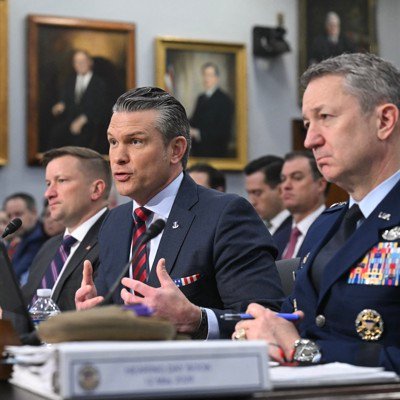
Lawmakers are preparing to make their edits to the Trump administration’s 2027 budget bill, but concerns are growing that the next round of funding won’t cover lost aircraft, damaged facilities, or expended munitions from the Iran war because the Defense Department has refused to provide details to Congress.
The war has cost an estimated $29 billion, Jay Hurst, the official performing the duties of the Pentagon’s chief financial officer, told the House Appropriation Committee’s defense panel during a Tuesday hearing, up from the $25 billion estimate he offered April 29.
“Obviously, we’re buying things in the reconciliation request that are being used in the Iran conflict, including munitions,” Hurst said, alluding to a $350 billion bill that would complement the DoD base budget and supplemental funding and bring the administration’s total proposed defense spending for 2027 to $1.5 trillion. “There’s over $40 billion in a munitions request, in reconciliation. So that would be part of the replacement.”
Under questioning, Hurst conceded that the $40 billion figure—put together well before the Trump administration began attacking Iran in February—was not actually meant to replace munitions expended in the war.
Hurst’s public estimates are about as much information as lawmakers have received about the costs of the Iran war, according to multiple lawmakers who directed frustration at his boss: Defense Secretary Pete Hegseth, who also testified at the hearing.
“Trying to get a reporting of the dollars that have been spent in this has been excruciating,” Rep. Joe Morelle, D-N.Y. “I think Gen. Washington reported quicker to the Continental Congress than this has been, in terms of reports to the United States Congress.”
Hegseth implied that the Pentagon is not required to comply with requests for information from lawmakers.
“I think we’ve updated on that number this morning,” he said. “But when it’s relevant and required, we will share it.”
Hegseth was also pressed on his lack of transparency during a Senate Appropriations Committee defense panel hearing, also on Tuesday.
“I would simply respond that—and I think it’s an important point, considering what the President is undertaking—what is the cost of Iran obtaining a nuclear weapon?” he said.
Recent reports have suggested that Iran is no further from building a nuclear bomb today than they were before Operation Epic Fury, or even last summer’s Operation Midnight Hammer’s attacks on nuclear facilities.
“Our job is to appropriate dollars, and we’re just told it’s coming, it’s coming, and we don’t get it. So it’s very hard to do our budgets,” Sen. Patty Murray, D-Wash., said Tuesday.
At the same time, lawmakers are waiting to see whether the administration reignites the war with Iran, having passed the 60-day deadline to get congressional approval for hostilities.
Though the White House told Congress May 1 that Operation Epic Fury has “terminated,” the U.S. continues a naval blockade of Iran, while Hegseth has erroneously insisted that the ceasefire paused the 60-day clock, while the president said Monday the ceasefire is “on life support.”
The lack of information-sharing with Congress, which has oversight of how the Defense Department spends its money, is part of a larger pattern, according to the ranking member of the Senate Armed Services Committee.
“The Department of Defense does not brief us, frankly, on anything, and I’m also including my Republican colleagues,” Sen. Jack Reed, D-R.I., told reporters Tuesday during an event with the Project for Media and National Security. “They just refuse to give us any meaningful data. They refuse even to follow a law which requires reporting to us in a certain number of days.”
If the president continues to ignore the War Powers resolution, Reed said, there is some hope that both Democratic and Republican lawmakers will step in.
“This is just a key issue of, do all the members of Congress take seriously their constitutional obligation to ensure the laws are faithfully executed?” he said. “I think there are some people on the other side, they’ve expressed concern and nervousness, etc., and if they come forward and say, ‘We have to do this,’ then that will help us.”
The Senate is scheduled to convene Tuesday afternoon to consider a War Powers resolution that would formally end the conflict in Iran and compel the administration to withdraw troops deployed there to support it.
“And I know there’s different opinions, and it changes from day to day, whether or not the War Powers clock is paused, but this law states beyond May 2, the administration needs congressional authorization to continue military operations,” Betty McCollum, D-Minn., said during the HAC hearing. “The president just recently said yesterday that Epic Fury is not over. Military operations have continued. We have a naval blockade, and both sides are exchanging fire. They did so over the weekend.”
Hegseth told lawmakers during the SAC hearing Tuesday that he believes the president has “all the authorities necessary” to restart hostilities against Iran at any time.
