

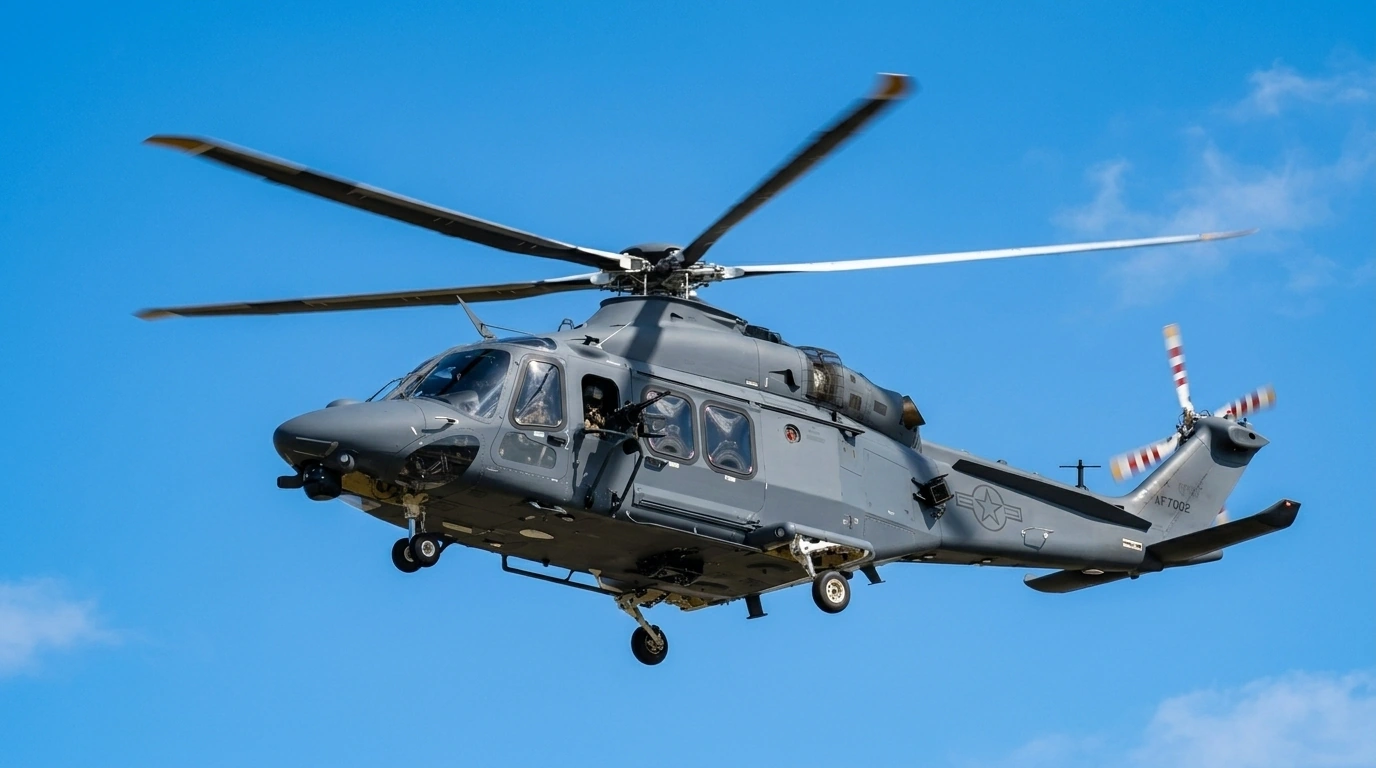
There’s a strange kind of irony in modern military aviation: some of the most important aircraft in America never appear in blockbuster movies, never perform flashy carrier landings, and rarely get talked about outside defense circles. The MH-139 Grey Wolf is one of them. Quiet job. Massive responsibility.
While stealth bombers and fifth-generation fighters soak up headlines, this helicopter has been slipping into one of the most sensitive missions in the U.S. military, protecting America’s nuclear arsenal.
That alone makes people pay attention.
The MH-139 Grey Wolf, built through a partnership between Boeing and Leonardo Helicopters, wasn’t designed to look dramatic. It was designed to work when conditions are ugly: freezing plains in Montana, midnight security patrols over missile fields, emergency troop transport, rapid-response operations. The sort of missions where reliability matters more than glamour.
And honestly? The helicopter it replaces, the aging UH-1N Huey, had been hanging on far longer than most people realize. Some of those aircraft trace their roots back to the Vietnam era. Imagine relying on a half-century-old platform to guard intercontinental ballistic missile sites spread across thousands of square miles. That’s a bit like protecting a modern data center with dial-up internet. Functional, technically. But not ideal.
The MH-139A Grey Wolf changes that equation.
It’s faster. Safer. Longer-ranged. It carries more personnel and requires less maintenance downtime than the Huey fleet it replaces. Boeing claims the aircraft can fly nearly 50% faster and travel much farther without refueling, a serious advantage when responding to security threats across remote missile fields.
But the real story isn’t just the helicopter itself. It’s what the Grey Wolf represents: a broader shift in how the U.S. Air Force modernizes the hidden infrastructure behind nuclear deterrence. Not flashy. Not cinematic. Just essential.
And weirdly enough, that’s what makes the MH-139 Grey Wolf fascinating.
What Is the Boeing MH-139 Grey Wolf?
At first glance, the MH-139 Grey Wolf doesn’t look radically different from other twin-engine helicopters. No sci-fi angles. No stealthy black triangle silhouette. In fact, if you spotted one at a civilian airport from a distance, you might mistake it for a corporate transport aircraft.
That’s because the Grey Wolf started life in the civilian world.

The helicopter is based on the widely used Leonardo AW139, a commercial aircraft trusted for offshore oil transport, medical evacuation, search-and-rescue work, and executive travel across more than 80 countries.
Boeing and Leonardo essentially took a proven civilian platform and transformed it into a military workhorse tailored for the U.S. Air Force’s most sensitive security missions.
It was a smart move. Maybe even a slightly unconventional one.
Military procurement usually leans toward building entirely new aircraft from scratch, expensive, slow, complicated. The MH-139 program flipped that formula. By adapting an existing helicopter already known for reliability, Boeing shortened development timelines and reduced operational risk. The Air Force noticed.
In 2018, Boeing won the contract to replace the aging UH-1N Huey fleet used by Air Force Global Strike Command. The goal wasn’t just modernization for the sake of modernization. The Huey fleet had become increasingly expensive to maintain, and its performance limits were difficult to ignore. Lower speed. Smaller payload. Aging avionics. More downtime.
The Grey Wolf solved several of those problems at once.
What’s especially interesting is the Grey Wolf’s mission profile. This isn’t primarily an attack helicopter like the Apache. It’s a security-and-support platform. Its responsibilities include:
- Protecting nuclear missile sites
- Transporting security forces
- Supporting continuity-of-government operations
- Conducting emergency evacuation missions
- Performing search-and-rescue operations
And because America’s missile fields stretch across enormous rural regions, especially in states like Montana and Wyoming, speed and endurance matter a lot more than many civilians realize.
The “Grey Wolf” name fits surprisingly well, too. Wolves operate in harsh territory, move quickly, and protect territory relentlessly. The Air Force clearly leaned into that symbolism. A little dramatic? Maybe. But it works.
MH-139 Grey Wolf Specifications
Military aircraft brochures tend to throw numbers at you like confetti. Maximum gross weight. Rotor diameter. Service ceiling. Useful payload. Most readers glaze over by line three.
But with the MH-139 Grey Wolf, the specifications actually tell a bigger story, one about reach, survivability, and sheer operational practicality.
The first thing the Air Force noticed was speed.
The old UH-1N Huey cruised at roughly 120 knots on a good day. The MH-139 Grey Wolf pushes closer to 165 knots. That difference may not sound dramatic until you picture security teams racing across hundreds of miles of isolated missile fields during a real emergency. Minutes matter out there. Terrain is unforgiving. Winter weather in Montana doesn’t exactly negotiate.
Then there’s range. The Grey Wolf can travel more than 570 miles without refueling under certain conditions. That’s over double the operational reach of some legacy aircraft still flying similar missions. Fewer fuel stops mean faster response times and less logistical vulnerability.
Here’s where the numbers get interesting:
| Specification | MH-139 Grey Wolf |
| Manufacturer | Boeing & Leonardo |
| Base Platform | Leonardo AW139 |
| Engines | 2 × Pratt & Whitney PT6C-67C |
| Maximum Speed | ~190 mph (165 knots) |
| Range | ~570 miles |
| Service Ceiling | ~20,000 feet |
| Crew | 2 pilots + mission personnel |
| Passenger Capacity | Up to 15 |
| Rotor Diameter | 44 feet |
| Max Takeoff Weight | ~15,600 lbs |
One underrated advantage? FAA certification.
That’s unusual in military aviation. Since the MH-139 is derived from the civilian AW139 platform, it benefits from safety systems and operational standards already tested extensively in commercial service. In plain English: the helicopter entered military use with millions of flight hours’ worth of real-world experience behind it.
Its avionics suite also represents a leap forward from the Huey era. Digital flight displays, advanced navigation systems, encrypted communications, night-vision compatibility, all integrated into a cockpit that looks more like a modern business jet than a Vietnam-era utility helicopter.
And oddly enough, that civilian DNA may be the Grey Wolf’s greatest strength. It wasn’t engineered to look intimidating. It was engineered to keep flying, day after day, with fewer headaches for crews and maintenance teams.
That kind of reliability wins wars quietly.
MH-139 Grey Wolf Capabilities
The easiest mistake people make about the MH-139 Grey Wolf is assuming it’s “just” a transport helicopter.
It isn’t.
The Grey Wolf sits in a strange middle ground between utility aircraft, security platform, emergency responder, and airborne command shuttle. Think of it less like a flying truck and more like a Swiss Army knife with rotor blades. Its mission set changes depending on the hour, weather, or threat environment.
One morning it may transport security forces to a missile site. By afternoon, the same aircraft could be flying medical evacuation support or escorting nuclear convoy operations across isolated highways. Flexibility is the entire point.
And flexibility was something the old UH-1N fleet struggled with increasingly over time.
The MH-139’s cabin can carry up to 15 passengers or be rapidly reconfigured for cargo, defensive equipment, or medical support gear. That modular interior matters because missile field operations rarely happen under predictable conditions. Snowstorms, mechanical failures, emergency deployments, crews need options fast.
Then there’s the environmental challenge.
America’s nuclear missile infrastructure sits in enormous stretches of open terrain, particularly around Montana, North Dakota, and Wyoming. Harsh winds. Ice. Subzero temperatures. Distances that feel almost absurd if you’ve never driven through the region yourself. The Grey Wolf was selected partly because it performs well in exactly those kinds of ugly conditions.
Its twin-engine setup also improves survivability and operational safety. If one engine fails, the aircraft can continue flying, not exactly a small detail when operating over remote territory at night.
Here’s a simplified breakdown of the helicopter’s operational strengths:
| Capability | Operational Benefit |
| High Speed | Faster emergency response |
| Long Range | Fewer refueling stops |
| Modular Cabin | Multi-mission flexibility |
| Advanced Avionics | Improved situational awareness |
| Twin Engines | Better survivability |
| Night Vision Compatibility | 24/7 operational readiness |
Another rarely discussed advantage? Lower maintenance burden.
Military helicopters spend shocking amounts of time grounded for inspections and repairs. The Grey Wolf’s commercial heritage means maintenance systems are more standardized and globally supported than many purely military platforms. Less downtime equals more aircraft available when crises happen.
Which, for nuclear security operations, is non-negotiable.
And maybe that’s the most interesting thing about the MH-139 Grey Wolf: it wasn’t built to dominate headlines. It was built to remove friction from missions where failure simply isn’t acceptable. Quiet competence. The military tends to value that more than spectacle.
Challenges and Controversies
Even relatively successful military aircraft programs collect turbulence along the way. The MH-139 Grey Wolf is no exception. In fact, some of its biggest hurdles came not from engineering failures, but from the strange collision between civilian aviation standards and military bureaucracy.
Which sounds dull until billions of dollars and national security missions get involved.
One early challenge centered on certification.
Because the MH-139 was derived from the civilian Leonardo AW139, the program relied heavily on FAA certification processes alongside military testing requirements. On paper, this seemed like an advantage, civilian aircraft already undergo extensive safety validation. But blending FAA procedures with Air Force operational standards created delays that frustrated both lawmakers and defense officials.
The helicopter wasn’t failing tests. The paperwork ecosystem around it became complicated. Very Pentagon.
Then there were procurement concerns.
The Air Force originally discussed buying as many as 84 helicopters, but shifting defense budgets and modernization priorities periodically raised questions about whether the final fleet would shrink. Defense analysts debated whether resources should instead flow toward stealth bombers, missile modernization, or next-generation drone systems.
The Grey Wolf occupied an awkward space politically: essential, but not flashy.
And flashy systems often attract more attention in Washington.
Here are some of the main concerns raised during the program:
| Challenge | Impact |
| FAA/Military Certification Delays | Slower deployment timeline |
| Budget Pressure | Questions about fleet size |
| Supply Chain Coordination | International manufacturing complexity |
| Transition From UH-1N | Training & logistics adjustments |
| Public Visibility | Lower political attention |
Another subtle issue involved culture inside the Air Force itself.
Replacing the UH-1N Huey meant more than swapping hardware. It required retraining crews, updating maintenance infrastructure, rewriting operational procedures, and adapting to modern digital systems. Some personnel welcomed the modernization immediately. Others felt cautious about transitioning away from a platform with decades of service history.
That tension happens in nearly every military modernization effort. People trust machines they know intimately, even old ones.
There were also broader debates about the decision to adapt a civilian helicopter for nuclear security operations. Critics wondered whether a commercially derived aircraft could truly withstand the demands of high-risk military missions long term. Supporters countered that the AW139 platform already proved itself under brutal real-world conditions worldwide.
So far, operational results seem to favor the latter argument.
Still, the Grey Wolf program highlights an uncomfortable reality about defense procurement: building advanced military capability isn’t usually limited by technology alone. Bureaucracy, politics, institutional inertia, and budget competition shape outcomes just as much as engineering does.
Sometimes more.
MH-139 Grey Wolf vs UH-1N Huey
The comparison between the MH-139 Grey Wolf and the UH-1N Huey almost feels unfair at times. Not because the Huey was a bad helicopter, far from it. The Huey became one of the most recognizable military aircraft ever built. Vietnam-era footage practically turned it into aviation folklore.
But legends age. Metal fatigues. Electronics become antiques. Maintenance crews start hunting for replacement parts like archaeologists digging through aviation history.
By the late 2010s, the Air Force faced a difficult truth: the UH-1N fleet simply wasn’t built for modern nuclear security demands anymore.
That’s where the MH-139 Grey Wolf enters the story.
The leap in performance isn’t incremental. It’s substantial enough that pilots transitioning from the Huey reportedly describe the Grey Wolf as operating in a completely different era of aviation.
Here’s the clearest way to see it:
| Category | MH-139 Grey Wolf | UH-1N Huey |
| First Flight Era | Modern platform | 1960s platform |
| Maximum Speed | ~165 knots | ~120 knots |
| Operational Range | ~570 miles | ~260 miles |
| Passenger Capacity | Up to 15 | Smaller cabin |
| Avionics | Fully digital | Analog-heavy systems |
| Safety Standards | FAA-certified design | Legacy military standards |
| Maintenance Demand | Lower | Increasingly high |
Speed alone changed operational planning.
Imagine a missile convoy requiring immediate aerial support across hundreds of square miles. The Grey Wolf can respond dramatically faster while carrying more personnel and equipment. In military terms, that creates what planners call “operational elasticity”, the ability to react to unpredictable events without stretching resources thin.
Then there’s reliability.
The Huey earned respect through durability, but maintaining aircraft designed decades ago becomes brutally expensive over time. Wiring systems age. Components disappear from production lines. Even skilled mechanics can spend hours troubleshooting systems modern helicopters diagnose automatically.
The Grey Wolf reduces much of that friction through digital systems and commercially supported parts networks. It’s less temperamental. Less maintenance-intensive. More available for actual missions.
There’s also a subtle psychological factor at play.
Replacing a legendary aircraft isn’t easy culturally inside the military. Crews often develop emotional attachment to older platforms, especially one as iconic as the Huey. But practicality usually wins eventually. Nuclear security operations demand consistency more than nostalgia.
And that, in many ways, defines the MH-139 Grey Wolf program: not flashy innovation for its own sake, but a deliberate effort to modernize the invisible backbone of America’s strategic defense system.
