

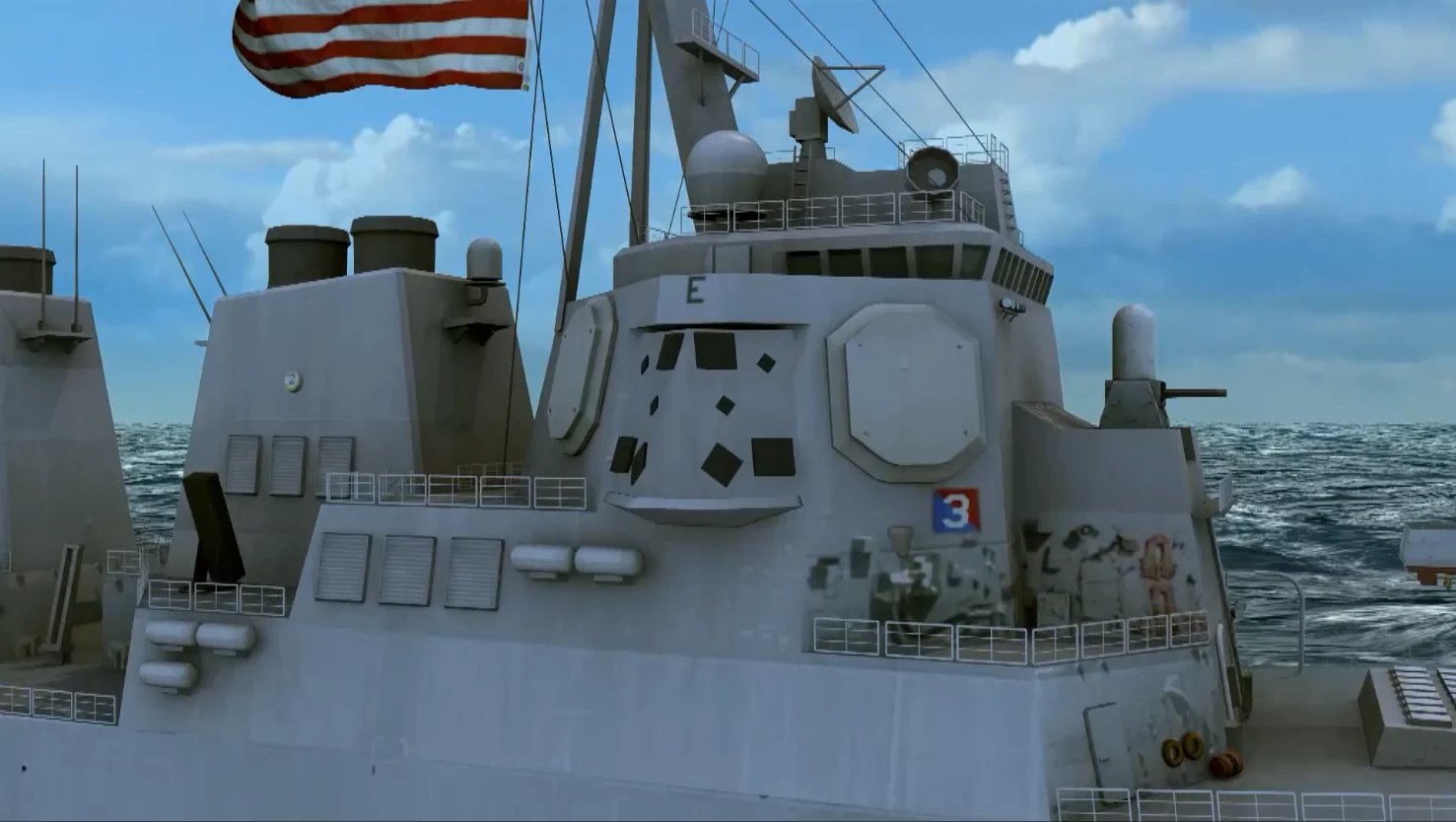

The US Navy’s Surface Electronic Warfare Improvement Programme continues apace with a new contract increasing the number of AN/SLQ-32 systems fleet surface combatants will receive.
Reports in late March disclosed that Northrop Grumman had won a contract to deliver an additional nine AN/SLQ-32(V)7 Surface Electronic Warfare Improvement Programme (SEWIP) Block-3 naval Electronic Warfare (EW) systems to the United States Navy from 2028. The SEWIP initiative commenced in 2002 as an effort to overhaul the capabilities of the AN/SLQ-32, dubbed ‘Slick-32’ in navy parlance. Raytheon was the original prime contractor for the system which entered service from the early 1980s.
Original variants
The baseline AN/SLQ-32(V)1 could detect signals across wavebands of five gigahertz/GHz to 20 gigahertz/GHz. In its original form the AN/SLQ-32(V) generated decoy waveforms for jamming. These waveforms would spoof the radar seeker of an incoming anti-ship missile regarding the target’s location. The AN/SLQ-32(V)2 expanded the system’s threat detection waveband downwards to 250 megahertz. The AN/SLQ-32(V)3 configuration added jamming to supplement the decoy capability. The AN/SLQ-32(V)4 configuration was designed for aircraft carriers. The AN/SLQ-32(V)5 was a jamming module added to the AN/SLQ-32(V)1/2 variants to enhance these systems’ jamming capabilities.
SEWIP
Several contractors have been involved in the overarching SEWIP effort. General Dynamics led AN/ALQ-32(V)6 SEWIP Block-1 project which was subdivided into the AN/ALQ-32(V)6 SEWIP Block-1B1/2/3 strands. AN/ALQ-32(V)6 SEWIP Block-1B1 added specific emitter identification functions to the system’s architecture, with AN/ALQ-32(V)6 SEWIP Block-1B2 upgrading the specific emitter identification displays. AN/ALQ-32(V)6 SEWIP Block-1B3 added high gain sensing improving the precision via which the system could detect, identify and locate emitters of interest.
In 2009 Lockheed Martin was chosen by the navy as the prime contractor for the AN/ALQ-32(V)6 SEWIP Block-2 project which enhanced the electronic support functions of the AN/ALQ-32(V) architecture. Size, weight and power-challenged vessels benefitted from the AN/ALQ-32(V)6 SEWIP Block-2 Lite configuration. In 2015, Northrop Grumman was contracted by the navy to produce the AN/ALQ-32(V)7 SEWIP Block-3 version. The key modification for this Slick-32 variant is the addition of an enhanced electronic attack capability. According to US Navy documents, AN/SLQ-32(V)6 examples equip the fleet’s ‘Arleigh Burke’ and ‘Zumwalt’ class destroyers, and the USS Gerald R. Ford eponymous class aircraft carrier.
Future plans
According to Lara Kopf, Northrop Grumman’s vice president for land and maritime sensors, the AN/SLQ-32(V)7 SEWIP Block-3 architecture is equipping Flight-IIA variants in the ‘Arleigh Burke’ class. The flight includes 45 vessels the first of which, the USS Jack H. Lucas, commissioned in October 2023. The remaining 44 examples are expected to commission from 2027, according to reports. Future Flight-III ‘Arleigh Burke’ class ships will accommodate the AN/SLQ-32(V)7 SEWIP Block-3 configuration. This same architecture is also expected to furnish the following vessels in the ‘Gerald R. Ford’ class.
Including the contract modification announced in late March, Northrop Grumman has been contracted by the navy to deliver 24 AN/SLQ-32(V)7 SEWIP Block-3 systems. Ms. Kopf states that “if all current US Navy SEWIP Block-3 contract options are exercised, system deliveries will continue through April 2030”. Nonetheless, “additional contract modifications could extend that period of performance”.
An outgrowth of the AN/SLQ-32(V)7 SEWIP Block-3 architecture has been developed in the guise of the Scaled Onboard Electronic Attack (SOEA) configuration. According to Northrop Grumman this variant is designed for size, weight and power constrained platforms. The company is currently under contract with the US Navy “to further develop” the SOEA system, Ms. Kopf continues. “We are in phase one” which she says forms the rapid prototyping stage of the programme and is “working closely with the navy to demonstrate the maturity of our solution”. There is no information in the public domain regarding which US Navy vessels the SOEA configuration may equip. Armada contacted the US Navy posing questions to this effect and asked how the overall SEWIP initiative may develop beyond Block-3. However, no responses were received by the time this article went to press.
There is still work to be done regarding SEWIP Block-3 production and deliveries. Moreover, the involvement of the US Navy in maritime combat operations in the Persian Gulf may yet have an impact on the SEWIP undertaking. The fleet is likely to have learned lessons concerning ship self-protection. These lessons maybe particularly applicable to the defence of surface combatants against suicide uninhabited aerial vehicles and anti-ship missiles.
by Dr. Thomas Withington
