

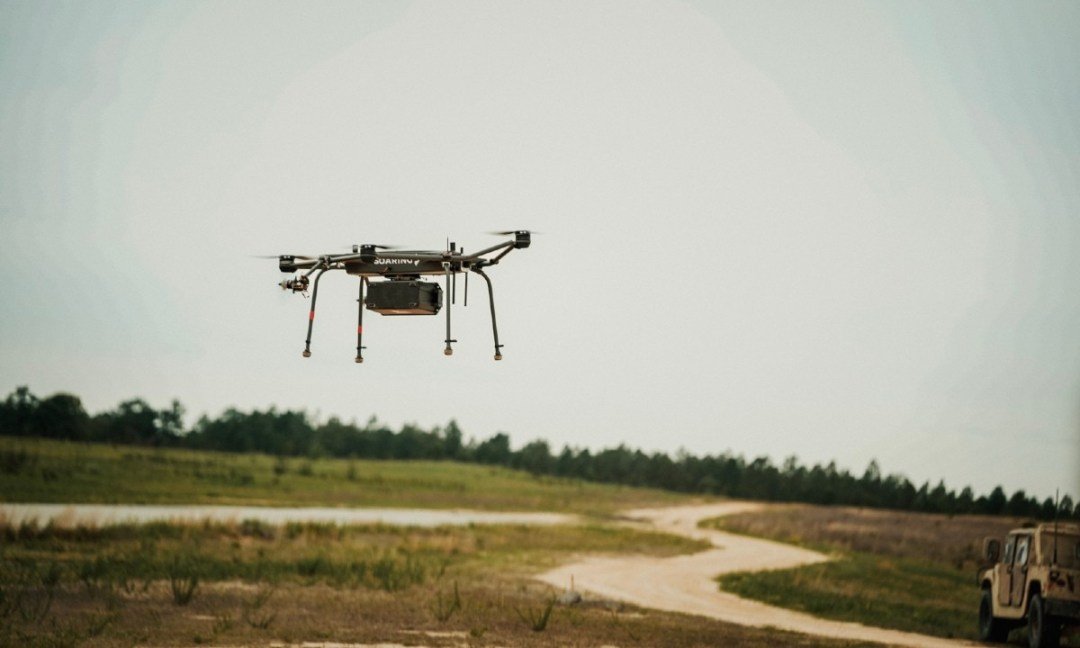
From Ukraine’s battlefields to ongoing conflicts in the Middle East, drones are no longer a novelty—they are a necessity. Rapid adaptation in modern conflict is forcing militaries to rethink how they move, see, and sustain forces. The U.S. Army is no exception. Across formations, units are experimenting, testing, and fielding drones at a pace not seen before.
But within the medical field, a quieter question remains unresolved: What kind of drone do we actually need?
The mission is clear: Class VIII resupply. For medical units, drones are not about sensors or delivering kinetic effects—they are logistical. The challenge lies in defining the requirements. What features must medical resupply drone possess to integrate into existing systems while minimizing operational burden? And what design will meaningfully increase the adaptability of the Class VIII resupply chain in the field?
Without deliberate testing, we are left with educated guesses at best. And industry cannot build what we fail to articulate. If we do not define the problem precisely, we risk acquiring capability without relevance. That was what led the 257th Dental Company Area Support to conduct drone testing during a 44th Medical Brigade field training exercise “Relentless Medic” in April 2026. We set out to answer a focused question: If the Army adopts drones for medical units, what design features will make them operationally useful?
Clarifying that question is the first step toward shaping the right capability—and preserving combat power when it matters most.
During the exercise, the 257th Dental Company Area Support, with support from the 261st Multifunctional Medical Battalion, conducted a deliberate drone-based Class VIII resupply demonstration—Project Hermes—to evaluate drone employment under realistic operational conditions.
Rather than a single flight demonstration, testing was structured as a head-to-head comparison between drone delivery and traditional ground resupply. Identical requests were executed simultaneously from a Role 3 supply node to forward Role 2 elements. (Role 3 denotes a field hospital–level facility providing advanced surgery, comprehensive and specialty care in the operational area, while a Role 2 facility is a mobile, light, and forward-positioned medical unit capable of emergency treatment, limited surgery, and short-term patient holding.) This was not intended as a contest between a drone and a HMMWV. The ground platform provided a realistic baseline; the objective was to identify which design features meaningfully support aerial medical resupply in a contested environment.
Across multiple scenarios, we measured response time, personnel requirements, sustainment throughput, and overall logistical burden. While detailed quantitative data is outside the scope of this article, trends observed across repeated iterations informed the design considerations discussed below. The scenarios progressed in complexity—from single-trip dental surgery resupply to multipayload medical treatment resupply under increased demand, and finally to nonmedical payloads to test broader applicability.
The drone platform was deliberately unpacked, assembled, and operated by soldiers during execution to evaluate system simplicity, reliability, battery management, and redeployment timelines—not just flight performance.
The goal was not to prove that a drone can fly—it was to test whether a drone can sustain.
Rather than present raw data in isolation, the findings are distilled into four essential features that should guide future medical drone selection and development. If a medical drone cannot meet these requirements, it will remain a novelty. If it can, it becomes a sustainment asset.
Feature 1: Vehicle-Transportable, Foldable, and with No Dedicated Launch Platform Requirement
Drones are often evaluated by how they compare to legacy platforms—range, payload, endurance, training cost, and overall expense. That comparison makes sense in offensive roles. To defend against pervasive drone threats, are expensive air defense missiles or relatively inexpensive drones more optimal? Or for certain types of attack missions, how do a helicopter and its pilot compare with a swarm of drones? In these cases, the relationship is competitive—focused on maximizing effects at lower cost.
But medical drones operate under a different design logic. They are not replacements for ground vehicles. They are sustainment multipliers.
A medical drone should not compete with ground vehicles or rotary-wing assets. It should extend them.
Ground platforms such as the HMMWV or Light Medium Tactical Vehicle will always outperform drones in bulk hauling capacity. That is not a limitation—it is a design reality. A drone cannot and should not attempt to replace the payload volume of a ground convoy—that role remains with manned fixed-wing or rotary-wing platforms.
The advantage lies elsewhere. The correct model is integration, not substitution. Ground platforms move mass. Drones move urgency.
For that relationship to work, the drone must integrate into the existing sustainment architecture—not require a new one. If the drone itself consumes massive cargo space, requires additional vehicles, or demands excessive manpower to operate and maintain it, it becomes a burden rather than an asset.
During field testing, drones that could be transported within a HMMWV, assembled rapidly, and operated by two soldiers demonstrated practical viability. Larger platforms, despite increased lift capacity, introduced additional friction—greater footprint, higher manpower demand, and reduced mobility.
In environments that are contested or characterized by difficult terrain, drones extend reach—not replace ground movement. They must launch roadside, recover quickly, and repack within minutes.
If the drone cannot live within the same vehicle that carries supply, it risks becoming a competing requirement instead of a complementary capability. Integration with existing platforms is the standard. This integration must extend to power as well—drone battery systems must be compatible with standard military vehicles to enable on-site charging and continuous operations without additional support requirements.
Feature 2: Precision Payload Design and Drop Survivability
During the exercise, we tested both the drone and the payload concept.
We developed what we called the “Dental Sky Pod,” or DSP—a modular Class VIII payload designed specifically for aerial delivery. Rather than sending a generic resupply package, each DSP was configured around one of three standardized treatment profiles: oral surgery, endodontics, and restorative care. Each pod supported approximately five to seven days of treatment demand for a forward support dental team.
The configuration reflects observed treatment demand—not guesswork.
These categories consistently represent the majority of dental sick call encounters both in garrison and deployed environments. This approach produced three operational advantages:
First, precision prevents waste. In garrison, over-ordering is tolerated. In the field, every pound matters—especially at Role 2 locations where mobility and survivability are tied directly to weight discipline. Delivering unnecessary supplies either creates discard waste or becomes excess cargo that must be carried forward. Excess weight is not a minor inconvenience; it directly impacts maneuver.
Second, precision maximizes limited payload capacity. When operating under a weight cap for aerial delivery, every pound allocated to nonessential items reduces effective throughput. Mission-tailored packaging ensures that payload weight translates directly into clinical capability rather than inefficiency.
Third, standardization increases speed and reliability. Each DSP configuration was built around a fixed packing list. When a request was received, the supply team could execute immediately without redesigning the package. In some scenarios, pods were prepacked prior to forward movement. Standardized packaging allows even a newly assigned 68E dental specialist to execute resupply accurately and efficiently under time pressure. Efficiency in sustainment is not about speed alone—it is about predictable repetition under stress.
In coordination with the 261st Multifunctional Medical Battalion, we extended the concept beyond dental supply and tested a “Medical Sky Pod” (MSP) configuration focused on massive hemorrhage support. The package was designed to support eight to sixteen casualties and included tourniquets, combat gauze, pressure dressings, saline, junctional devices, and adjuncts, with a total estimated weight of approximately thirty pounds.
Although the selected drone platform was rated for a higher maximum payload (thirty pounds), we intentionally capped individual deliveries at fifteen pounds during testing. This was not a technical limitation—it was a deliberate decision to observe how the team responded to multiple sequential flights for a single mission set. As a result, completing the full MSP package required two separate deliveries. This allowed us to evaluate not just lift capability, but operational rhythm: coordination between launch and receiving elements, battery management across repeated missions, and whether aerial resupply retained efficiency advantages even when more than one flight was required.
Payload design alone, however, is insufficient without durability.
We deliberately tested pod integrity through a ten-foot drop test under full cargo load. While controlled landing is ideal, landing and relaunch are the most energy-intensive phases for the drone’s battery and directly reduce operational range. In contested environments or where terrain is too rough, landing may not be feasible at all. A drop-delivery capability preserves battery life, reduces exposure time, and limits interference from vertical obstacles during descent.
If landing is a luxury, dropping becomes a necessity. For that reason, the integrity of the pod under impact is not a convenience feature—it is a design requirement. A medical drone that cannot safely deliver its payload without landing will struggle to sustain operations in realistic conditions.
Feature 3: Low Learning Curve and Organic Operability
Across the Army, drone capability is no longer theoretical—it is operational and expanding. Dedicated military occupational specialties exist to operate larger and more complex unmanned systems in support of maneuver formations and higher-echelon missions. Those platforms and personnel are designed for specific operational roles, and appropriately so.
The question is not whether the Army has drone operators. The question is whether medical formations can realistically integrate aerial resupply into their sustainment model without relying on external aviation assets. Our mission is to preserve combat power—not to compete for aviation assets. It would be unrealistic to assume that dedicated drone operators from aviation formations will be habitually aligned with medical units for aerial medical resupply, particularly when those assets are prioritized for reconnaissance, targeting, and maneuver support at echelon. If medical drones are to become practical tools rather than aspirational concepts, they must be operable by the soldiers already assigned to medical formations.
During our field training exercise, four Soldiers—a 68E dental specialist, two 68W combat medics, and one 68J medical logistics specialists—received a four-day training package on the selected drone platform. None had prior drone experience. By day five, they were able to assemble, operate, recover, and repack the system independently. The learning curve was not zero, and refinements were identified, but a short, focused training model proved viable. After four days of training, soldiers from 44th Medical Brigade with no prior drone experience were able to operate the system—achieving a thirteen-minute setup-to-launch timeline and repack-to-mobility in under ten minutes. A medical drone that requires dedicated aviation personnel will struggle to scale. In contrast, one that can be trained, maintained, and sustained organically across different military occupational specialties has a realistic path to adoption. The limiting factor is not technology—it is usability.
Feature 4: Supply Chain Resilience Through Replaceable Payload Containers
Logistics wins wars. The US Army operates one of the most capable supply systems in the world, but field experience consistently shows that friction appears when specialized components must be sourced through complex procurement channels.
For medical drone employment, one such component is the delivery container itself—in our case, the DSP and MSP.
As discussed earlier, these containers must survive drop delivery while carrying medical payloads. Over time, containers will inevitably be damaged, lost, or abandoned. In practice, they become semiconsumable items.
Our team initially explored 3D printing to produce replacement containers locally. While technically feasible, the production timeline proved impractical. Printing the components for a single container required approximately three days, making it unsuitable for operational sustainment. Testing conducted with the Fort Bragg Airborne Innovation Lab identified a more practical approach: Commercial protective containers demonstrated excellent survivability during drop testing and are widely available through existing supply channels.
The key insight is not the container itself, but the interface between the drone and the container. Specifically, drone platforms should incorporate a universal attachment and release mechanism capable of carrying standardized cargo containers rather than relying on specialized proprietary payload designs. A universal payload interface preserves flexibility in procurement and reduces dependency on specialized container designs tied to a single system.
In contested environments where supply chains may be stressed, systems that depend on specialized components introduce vulnerability. Supply chain resilience must include both replaceable payload containers and reasonable repairability. The platform should be simple and durable enough for soldiers to conduct entry-level maintenance without relying on specialized contractors.
From Concept to Execution: A Realistic Scenario
To illustrate how this concept could be applied, consider the following scenario:
A medical unit is deployed to a South American country in response to a major earthquake. As part of a humanitarian mission, a Role 3 medical facility is established as the central hub, while smaller forward teams are positioned across remote mountain villages to provide care.
One of these teams submits a request for Class VIII resupply. A convoy is dispatched as planned, moving along the only available route toward the village. As the vehicles approach the final stretch, they encounter a mudslide triggered by overnight rain. The only bridge connecting the route has been destroyed.
The convoy halts. The ground route is no longer viable. Communication is established with higher headquarters and the forward team.
At that point, two soldiers dismount and retrieve a compact drone stored alongside the medical supplies in the back of one of the vehicles. Within minutes, the system is assembled and powered. After confirming distance, payload, and drop coordinates, the team begins aerial resupply operations.
The drone conducts multiple flights, delivering medical supplies across the obstructed terrain. Battery swaps are conducted on site using power from the vehicle. The process is slower than a single convoy delivery—but it restores the flow of critical supplies when ground movement is no longer possible.
Once the mission is complete, the system is repacked, and the convoy returns safely.
The route failed. The mission did not.
Conclusion: From Frustration to Definition
Any leader who has signed for equipment understands the quiet frustration of inheriting systems shaped for a different fight. Items that once made sense remain on the books long after their relevance has faded. That reality is not failure—it is the natural result of an institution adapting over time.
But adaptation requires input.
Recent discussions have made it clear that drone warfare is changing the battlefield and placing new demands on medical units. Recognizing the problem is not enough. Without clear articulation from the unit level, solutions risk being developed without the context of how they will actually be used.
Project Hermes was not designed to prove that drones belong in modern warfare. That is already evident. It was designed to define how medical units can realistically employ them—grounded in operational constraints, unit-level capability, and sustainment needs.
At the unit level, failure is not theoretical—it is a missed resupply, a delayed treatment, a preventable loss.
We do not need perfect systems. We need systems that work when the plan breaks. If we test deliberately, define requirements clearly, and communicate those needs early, we can shape future capabilities before they are decided for us.
Because in the next fight, the route may fail again. The mission cannot.
Author’s note: Project Hermes would not have been possible without the support of soldiers from 257th Dental Company Area Support, 261st Multifunctional Medical Battalion, and 44th Medical Brigade Headquarters and Headquarters Company. Special thanks to First Lieutenant Seth Addeo and his team from the Fort Bragg Airborne Innovation Lab for the fabrication of the Dental Sky Pod and Medical Sky Pod.
I also acknowledge Lieutenant Colonel Samuel Teague from the Keller Army Community Hospital. Although he did not directly participate in this project, his earlier work in 2025 exploring medical drone employment helped inspire further testing.
Lieutenant Colonel Yu-Sheng Chen is a board-certified comprehensive dentist (63B) in the US Army and currently serves as the commander of the 257th Dental Company Area Support, 44th Medical Brigade, Fort Bragg, North Carolina.
The views expressed are those of the author and do not reflect the official position of the United States Military Academy, Department of the Army, or Department of Defense.
Image credit: 49th Public Affairs Detachment, Fort Bragg
