

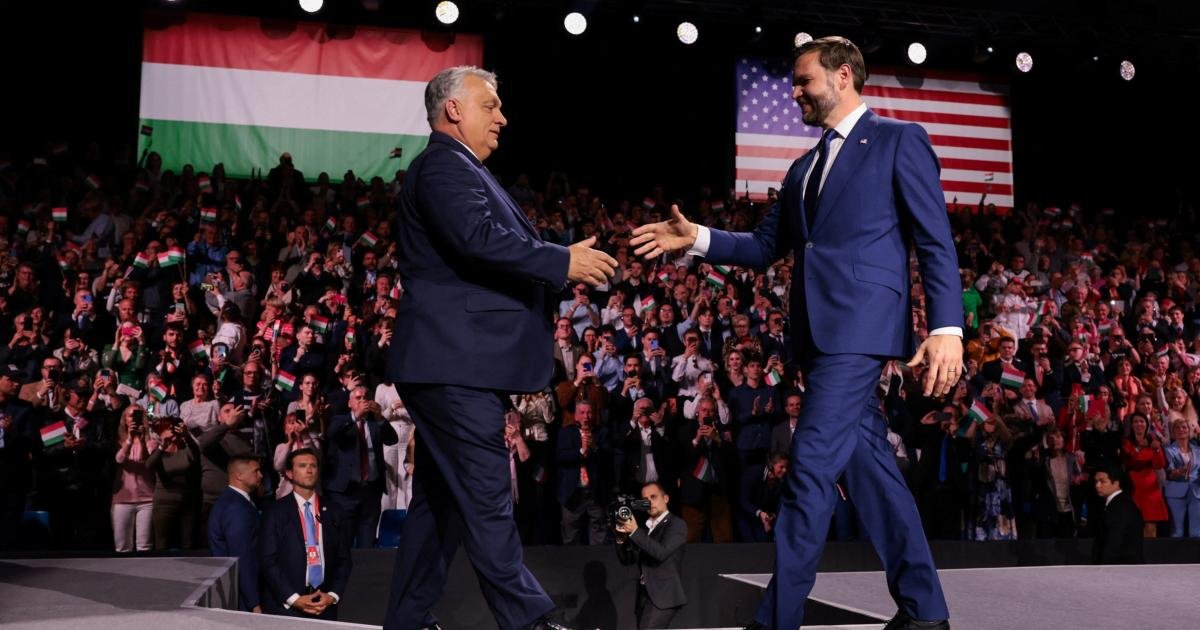
President Donald Trump, who distrusted the transatlantic relationship in his first term, has tried to refashion it in his second. He has exerted extreme pressure on European countries, most conspicuously by threatening to annex Greenland, a territory of Denmark, by force. He has enacted economic policies that disadvantage Europe through his extensive and shifting tariffs. And his administration has interfered in the continent’s domestic politics, criticizing both the European Union and mainstream European parties while promising friendship with Europe’s far-right parties.
An adversarial relationship with Europe may suit the MAGA movement. Trump officials regularly claim that Europe’s core problems are immigration, a loss of national sovereignty to the European Union, and an insufficiently conservative public sphere. This has been most clearly articulated by Vice President JD Vance. “In Britain and across Europe, free speech, I fear, is in retreat,” Vance argued at the 2025 Munich Security Conference, portraying “mass migration” as Europe’s most urgent challenge. After more than a year of trying, the Trump administration has not come close to assembling a coalition of far-right parties in Europe. Nor has it leveraged relationships with such parties to advance U.S. interests in Europe. Even for ideologically aligned far-right parties, Trump’s arbitrary tariffs, verbal attacks, and territorial threats are difficult to stomach. Most ultranationalist parties in Europe also harbor legacies of anti-Americanism, and as Hungarian Prime Minister Viktor Orban’s defeat in Hungary has demonstrated, support from the Trump administration is increasingly a liability for Europe’s far right.
The United States’ war in Iran, which began in February, has illuminated two truths about the contemporary transatlantic relationship. One is that European far-right parties have not been Trump’s wartime allies in Europe. They have rushed to distance themselves from the war, showing that ideological alignment does not automatically translate into political loyalty. The other truth is that the administration’s open support for right-wing European parties and candidates has damaged Washington’s relationship with European leaders who are not on the far right. Had Washington cared more about respecting and preserving these relationships, many European leaders might have offered symbolic support for the Iran war or at least toned down their public criticism. Yet distrust of Washington now prevails across Europe.
The United States would be wise to rethink its approach to Europe, especially in view of Hungary’s election results. Instead of continuing to fan the flames, the Trump administration should step back from Europe’s domestic politics, end its illiberal crusade, and deal judiciously with European leaders across the political spectrum. Such a reversal is not in this administration’s nature. But with the costs of the Iran war growing, it is in the United States’ interest to seek points of cooperation with Europe as a whole.
BUMPS IN THE ROAD
Since its inception in the late 1940s, the transatlantic relationship has had many near-death experiences. During the Suez crisis of 1956, the United States ordered France, Israel, and the United Kingdom to stand down and leave the Suez Canal in Egypt’s hands. The Vietnam War alienated Europe from the United States. Many Europeans criticized it as a brutal neocolonial adventure. In the early 1980s, some Europeans objected to the stationing of U.S. missiles in Europe; they saw the deployment as too provocative toward the Soviet Union. During the Iraq war, the Bush administration divided the continent into “old Europe” (countries such as France, which opposed the war) and “new Europe” (countries such as Poland, which participated in Washington’s “coalition of the willing”). There have long been differences on religion, gun rights, and environmental policy that can make Europe and the United States seem more like separate planets than natural partners. A sober history of transatlantic ties is a history of tension.
The U.S.-European relationship did not survive its many tensions by accident. It was sustained by common interests, including containment of the Soviet Union during the Cold War and the shared prosperity that a good relationship made possible. To preserve these shared interests, leaders across the Atlantic chose to tread carefully around one another’s domestic politics. They did not demand ideological alignment. With George W. Bush’s presidency, a majority of Europeans started to feel alienated from the Republican Party. A preference for the Democratic presidents Barack Obama and Joe Biden was palpable in Europe. In Trump’s first term, these ideological differences did not disrupt Europe’s working relationship with the United States.
U.S. presidents, for their part, were never indifferent to Europe’s domestic politics, but they did try to keep a distance. In 1963, when President John F. Kennedy visited West Germany, he made a point of appearing with Konrad Adenauer, West Germany’s Christian Democratic chancellor, and with Willy Brandt, West Berlin’s Social Democratic mayor. President Ronald Reagan had a close relationship with the conservative British prime minister Margaret Thatcher, but he also worked with European leaders from different parties. Obama’s closest European partner was Chancellor Angela Merkel, a German Christian Democrat; Biden’s was Chancellor Olaf Scholz, a German Social Democrat. Keeping party politics in the background steadied the transatlantic relationship, focusing attention on core economic and security issues. Such pragmatism advanced U.S. interests in Europe and around the world.
ACCEPTING REALITY
The Trump administration’s bid to assemble a network of far-right parties has weakened U.S. influence in Europe. It was never a realistic endeavor: Europe’s far-right parties are now distancing themselves from the MAGA movement, and Trump’s popularity, already low in most European countries, has fallen further since he launched the war in Iran.
According to a Politico poll taken in December 2025, Trump is unpopular among European voters, including far-right voters. In France, only 25 percent of respondents who identified as current supporters of the far-right National Rally had a positive opinion of Trump. In Germany and the United Kingdom, respectively, 32 and 48 percent of current far-right voters shared this positive view. Leaders such as Jordan Bardella, president of the French National Rally, sense that cheerleading for Washington can damage their political prospects. “I’m French, so I’m not happy with vassalage,” Bardella told The Telegraph in December, “and I don’t need a big brother like Trump to consider the fate of my country.” Europeans, including those who are drawn to Trump, do not want the United States to tell them how to vote.
Historically, European far-right parties have resented the United States as a threat to their sovereignty and cultural identity. The Alternative for Germany party (AfD) has traditionally seen the U.S. role in Europe as what the political philosopher Carl Schmitt called a raumfremde Macht, an alien power that should have no say in European affairs. The AfD regards Russia, on the other hand, as a proper European power. This framing goes against Trump’s 2025 National Security Strategy, which upheld the idea of a Europe free from the domination of any adversary of the United States.
The parliamentary election in Hungary this month was not exactly a referendum on Trump. Orban’s defeat was driven by Hungarians’ concerns about government corruption and the economy and by their desire for a less fraught relationship with the European Union. But the Trump administration’s open advocacy for Orban—most conspicuously by Vance, who traveled to Hungary to campaign with Orban—did not help. Indeed, it may well have hurt Orban’s chances. Washington wrongly assumed that Orbanism was the wave of the future and that Brexit, Orban, and the MAGA movement were on a single continuum of popularity and success.
Distrust of Washington now prevails across Europe.
Washington must now accept reality. Absent a significant swing to the right in Europe, the United States will have to deal with Europe as it is. Even a rightward shift in Europe would be of uncertain value to the Trump administration. In power, far-right parties might oppose the global application of American power, possibly by denying the United States access to European airspace or by curtailing the extensive basing rights that Washington currently enjoys in Europe.
Had the second Trump administration concentrated on winding down the war in Ukraine, promoting national “sovereignty” over EU solidarity, and addressing migration issues, Europe’s far-right parties might have overcome their traditional skepticism and rallied behind the United States. But U.S. interventions in Venezuela and Iran have put distance between Washington and its putative counterparts in Europe. In January, on the day after the United States captured Venezuelan President Nicolás Maduro, the leader of France’s National Rally, Marine Le Pen, wrote that there was “one fundamental reason” to oppose the U.S. regime change operation, which was that “sovereignty of states is never negotiable.” Later that month, Nigel Farage, leader of Britain’s Reform UK party, called Trump’s threats against Greenland a “hostile act.” In March, the AfD leader Alice Weidel criticized the United States for its “adventurism” in Iran and told party leaders to limit high-profile visits with MAGA Republicans.
The Trump administration has antagonized centrist European governments at a time when their support for U.S. actions in the Middle East would have been valuable. For now, European countries can still speak the language of partnership. The United States remains the indispensable security provider for Europe, and it continues to provide Ukraine with meaningful intelligence and targeting support. But Washington’s courting of far-right parties, together with Trump’s attempts at bullying on tariffs, Greenland, and defense spending, has eroded trust and hobbled the relationship.
The United States and Europe still share real interests, including the reopening of the Strait of Hormuz, and stand to gain by cooperating on them. But Europe is unlikely to add its assets to any further U.S. and Israeli attacks on Iran or assume responsibility for policing the Strait of Hormuz once the war is over. Had the Trump administration pursued a more temperate, less politicized approach to the continent over the past 14 months, European leaders would surely have been more receptive to U.S. requests.
SUNK COST
An overextended United States, locked into a prolonged war with Iran, should cut its losses in Europe. Ideological alignment is a luxury, not a necessity, for alliances, which arise out of enduring interests. The Trump administration should acknowledge that an illiberal transatlantic order is not in the cards. Leaving European politics to the Europeans, Washington should address a narrow, well-defined set of security interests with key European stakeholders. Such an about-face would be humiliating for Washington, given the actions and messaging of the past year, but Trump has shown a practical willingness to change course when a position becomes untenable. He did so on tariffs and on his threats to annex Greenland, even if these might resurface. His illiberal Europe project may demand a similar reversal.
Europeans have a habit of declaring the transatlantic relationship dead. After more than a year of acrimony between Washington and its European partners, they are right that the alliance is much diminished. Having been reduced to the bare bones of interest, it has lost the veneer of friendship that many European leaders were pretending was still there after Trump’s reelection in 2024. Amid this estrangement, a renewed focus on shared interests and a retreat from ideology are in order. They may be just what the transatlantic relationship needs to survive.
Loading…
