

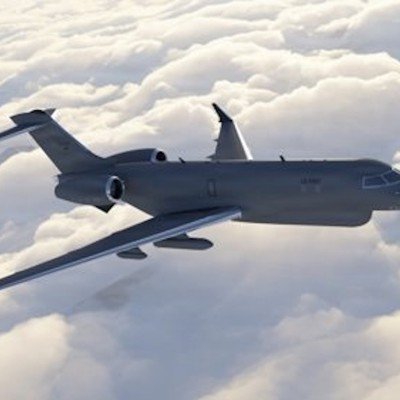
NASHVILLE—The Army’s next-generation spy plane will begin flight tests this summer, then be delivered to the first units later this year—two years after the Army awarded Sierra Nevada Corporation $1 billion to turn its Bombarder 6500 business jet into an intelligence, surveillance, and reconnaissance platform that will replace the Army’s legacy turboprop fleet.
The service wants to combine the inherent range of the High Accuracy Detection and Exploitation System—HADES for short—with launched effects, Andrew Evans, the director of strategy and transformation in the Army’s headquarters intelligence office, told reporters Friday at the Army Aviation Warfighting Summit.
A year ago, he said he wanted 1,000 kilometers of coverage, but after discussing with industry, “we aimed short,” he said, without disclosing precisely how far he thinks HADES will be able to see.
“We are on a campaign now to begin to do some service contracts where companies come in and they show us what they can do,” Evans said, with a demonstration planned for later this year.
HADES’ eventual capabilities will stay open-ended, in line with the Army’s Continuous Transformation acquisition model, which favors getting basic prototypes into soldiers’ hands for feedback on all of the systems and capabilities a platform needs to be most useful.
“What we’re seeking in this portfolio is progress, not perfection. We understand that HADES is going to be an iterative program that over the next number of years will continue to change and evolve, because the threats that it’s addressing are continuing to change and evolve,” Evans said. “So we’re not looking to build a system that gets locked into time. We’re looking to build a system to give us options to scale to the threat as a threat changes.”
HADES will be delivered in three prototypes, Col. Joe Minor, the Army’s fixed-wing project manager, told reporters.
The first will have legacy sensors that have been built into previous ISR planes, and that iteration will be part of the initial testing to start this year. The next prototype will add advanced radar, and then third will be “combat credible,” Evans said, declining to offer details.
“What I think is most important to understand about the HADES sensor strategy is it’s going to be an ever-evolving sensor strategy, right?” Evans said. “So if you come back in three years from now, what does HADES have on it? And I tell you that it has the same thing that I told you right now, then shame on us, because we’re not being resilient enough. So we will be dynamic in the way that we sensor this aircraft out.”
