

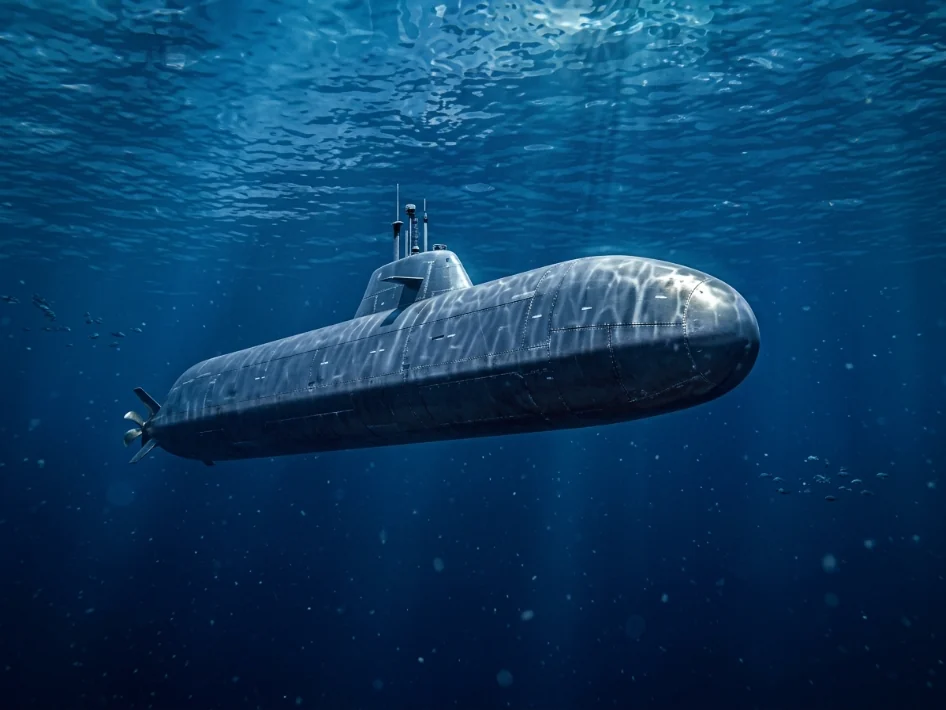
Spain’s Indra equips 6 Type 212CD Submarines with advanced EW radar destined for Germany and Norway. The agreement with Kongsberg Defence & Aerospace (KDA) represents a significant expansion of an existing program already underway, bringing the total number of advanced submarines receiving Indra’s cutting-edge capabilities to twelve.
The Type 212CD submarine is a next-generation platform built on shared design principles for both nations. These are air-independent propulsion (AIP) systems—submarines that can remain submerged without snorkeling for extended periods, a massive tactical advantage in modern naval operations.
The program’s strategic purpose is clear: reinforce NATO’s presence in the North Atlantic and ensure the highest level of operational interoperability between German and Norwegian forces. Indra’s role centers on two critical systems. The company will integrate its advanced electronic warfare suite, built on fully digital architecture, alongside its sophisticated radar capabilities.
These aren’t passive systems—they’re active, layered defense mechanisms designed to detect, identify, and protect against modern threats in contested maritime environments. When submarines operate, they need unprecedented levels of situational awareness without revealing their position. Indra’s Type 212CD submarine EW radar systems do exactly that.
Why This Matters Strategically
The contract signals Europe’s commitment to technological independence in naval defense. Ana Belén Buendía, Indra’s Head of Naval Business Unit, emphasized this directly: “With the signing of this new contract, Indra consolidates its role as a key technology partner in one of the most advanced naval programmes in Europe, which is of strategic importance for Germany, Norway and the European defence industry as a whole.”
Translation: Europe isn’t relying on U.S. or Chinese submarine systems. German-Norwegian collaboration on Type 212CD submarines represents a deliberate push toward European technological sovereignty in the defense domain. When you’re equipping twelve advanced submarines with your own sensors and electronic warfare systems, you’re declaring independence from foreign supply chains.
The North Atlantic is increasingly contested. Russian submarine activity has escalated in recent years. NATO needs credible underwater deterrence, and Germany and Norway—both bordering critical sea lanes—need submarines that can operate with confidence against peer adversaries. The Type 212CD platform, paired with Indra’s Type 212CD submarine EW radar systems, provides exactly that capability.

The Technical Edge
Electronic warfare systems on modern submarines operate in multiple dimensions. Indra’s full-digital architecture means faster threat detection, real-time data processing, and adaptive responses to emerging threats. The radar systems provide persistent surface and air surveillance, critical for submarines operating in their primary hunting ground: the shallow waters of the North Atlantic.
These systems must work seamlessly with the submarine’s fire control architecture, torpedo launch sequences, and tactical data links. Integration complexity is immense, which is why proven partnerships matter.
Indra has been supplying naval systems to submarines worldwide—they understand the engineering challenges, the reliability requirements, and the operational constraints inherent in submarine warfare.
The Type 212CD submarine EW radar systems will give German and Norwegian operators a decisive advantage in detecting surface contacts before they detect the submarine. That’s asymmetric warfare in its purest form.
Program Continuity and Expansion
The fact that Indra already had a contract for six submarines, and now secures an additional six, speaks to program success. Germany and Norway are voting with their budgets, they’re satisfied with performance and moving forward with expansion. This continuity also matters for supply chain stability and operational consistency across the fleet.
Twelve submarines equipped with identical systems means unified training protocols, streamlined logistics, and standardized spare parts management. That’s operational efficiency at scale. The two-country partnership benefits from eliminating system incompatibilities that plague multinational naval coalitions.
This contract represents more than procurement. It’s a statement about Europe’s technological ambitions. As geopolitical competition intensifies with Russia and China, Europe is consciously building indigenous capabilities for advanced naval platforms.
The Type 212CD submarine EW radar systems, supplied by a Spanish company through Kongsberg integration, demonstrate that Europe can design, build, and integrate world-class submarine sensors without foreign dependency. That independence carries strategic weight. It means Germany and Norway control their own upgrade pathways, their own operational doctrine, and their own technological evolution.
