

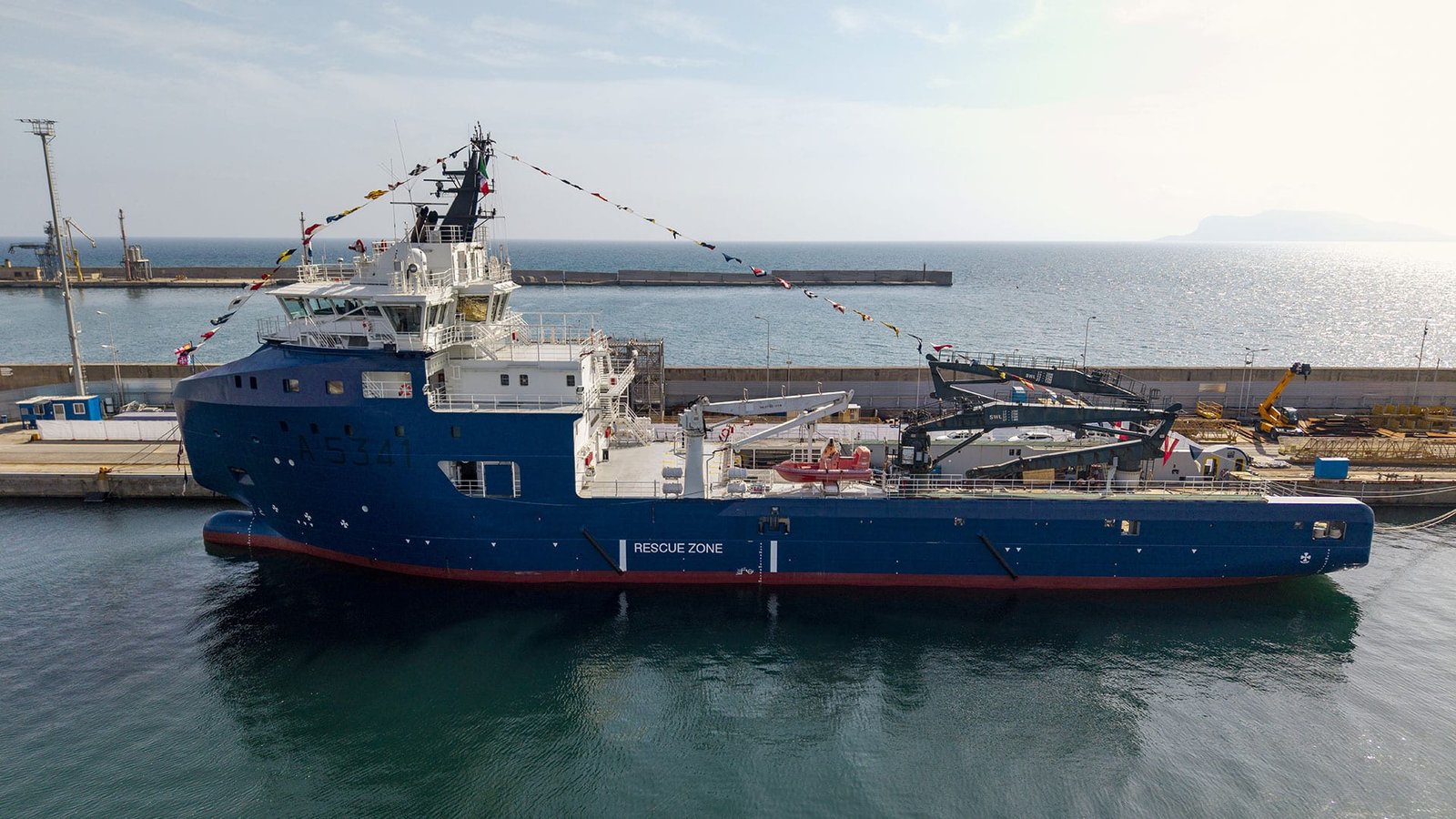
The commissioning of Tritone (A 5341) marks more than the addition of a new multi-purpose support vessel to the Italian Navy’s fleet; it reflects a notable shift in how the service approaches capability acquisition. By sourcing a commercial platform and adapting it rapidly for naval use, Italy is advancing a more flexible model focused on seabed warfare, operational experimentation, and the protection of critical underwater infrastructure (CUI).
With the procurement, customization and delivery through Fincantieri’s Underwater Technology Hub of today Tritone (A 5341) multi-purpose support vessel, the Italian Navy and the Italian MoD Naval Armaments Directorate (NAVARM) have established a new approach to capability acquisition. The ship was delivered by Fincantieri to the Marina Militare on 14 April at Palermo shipyard with a ceremony attended by the new Director of NAVARM, Chief Inspector Admiral Cristiano Nervi, which assumed the command on last 19 March, the head of Italian Navy Logistic Command and Ship Outfitting Inspector Vice Admiral Vincenzo Montanaro, the head of the Fifth Naval Division (COMDINAV 5) and MCM Command to which the ship is assigned, Rear Admiral Cristo Salvatore Traetta, the head of New Construction and Outfitting Centre (MARINALLES) Captain Gennaro Falcone, alongside Gabriele Maria Cafaro, Executive Vice President Underwater Fincantieri.
With a market survey request issued in mid-July 2025 for the procurement of a second-hand Offshore Support Vessel (OSV) to be used as “Multi-purpose vessel for underwater dimension surveillance”, or Unità Polivalente per la Sorveglianza della Dimensione Subacquea (UPSDS), the Italian Navy and NAVARM has launched “a new approach to capability acquisition, with direct action on the market, including the international one, for solutions (in the form of platforms or services, also in leasing/charter) that are up to date and with high turnover, allowing immediate insertion into the operational experimentation cycle and possible integration into the armed force inventory,” according to the press statement accompanying the ceremony.

Built by VARD Vung Tau shipyard in Vietnam as a PSV (Platform Supply Vessel) and acquired by NCT Offshore company in 2022 to be named MV Coco and used by Magellan company on long-term charter for ultra-deep-water operations with a range of underwater vehicles and equipment, the today named Tritone was acquired by Italian Navy with the aim of having a multi-purpose unit, capable of operating effectively both in military and civilian contexts. “It features adequate spaces that can be reconfigured depending on the mission, accommodating, moving, powering, and maintaining a variety of payloads (including unmanned aerial, surface, and underwater systems). This “modular” capability is crucial both for its versatility of use and for the future, allowing it to deploy systems that are always up to date without needing to modernize the entire parent platform,” explains the press statement.
In addition to act as a mothership for ROVs (Remotely Operated Vehicles) and unmanned vehicles (USV, UAV, AUV), the ship can also embark specialized command and control systems for the surveillance of the underwater domain, alongside various deployable assets.
The main missions are surveillance and deterrence in defense of national strategic assets or critical underwater infrastructures (CUI), such as, submarine telecommunication cables, gas pipelines and offshore energy installations, and other submerged infrastructures vital for the economy and national security.
In addition to defense tasks, the unit ensures fundamental capabilities for maritime security: It can transport deployable assets for the rescue of distressed submarines crew, namely the new SAVER suite for the Italian Navy or NATO assets, Naval News understood, and conduct scientific research and experimentation: it acts as a platform for the testing and validation of new underwater technologies that will be introduced in the future.
The deployment of Tritone multi-pupose support vessel “will also be enabling, through the multiple experimentations it will carry out, for the development of requirements and specifications of new units to be designed, namely the future UPSDS, expected to enter service starting from 2031”, affirmed the press statement.
The procurement program, funded with 53.5 M€, was launched in May 2025, followed by the contract signature between NAVARM and Fincantieri on 31 October 2025 and the launch of upgrading activities in December 2025 at Fincantieri’s Palermo shipyard. Here, according to Fincantieri press statement, “the ship underwent an extensive upgrading program to enhance its operational capabilities and strengthened its integration with the Italian Navy’s national command system.” The delivery process was concluded with sea trials in the Gulf of Palermo and the training by the MARINALLES Centre of the first crew headed by Frigate Commander Andrea Grottoli. The vessel, which motto is “Saldo all’Impeto Marino”, entered service under the Fifth Naval Division (COMDINAV 5 – MARICODRAG) of the Fleet Command (CINCNAV), based in La Spezia.

Tritone multi-purpose support vessel first details
With an overall length of 81.7 m (73.9 m between the perpendiculars) and a beam of 18 m, and a full load displacement of 6,600 t, a maximum draught of 6.5 m and a ship construction height of 9 meters, the Tritone is equipped with an integrated full electric propulsion package (IFEP) and a Class II Dynamic Positioning system (DPS) allowing the vessel to maintain its position with extreme precision during the delicate monitoring and recovery operations. The IFEP is based on two Caterpillar 3516TA series C 2.25 MW-each and two Caterpillar C-32 Tier III 0.93 MW-each diesel generator sets plus a Caterpillar C6.6-Acert 0.14 MW emergency generator set and a main propulsion package centred on two Kongsberg Maritime Azipull 85 CP (Controllable Pitch) “pulling” azimuthal thruster of 1.6 MW each with the propeller in the front of the gear housing and three bow-mounted 800 Kw-each tunnel thrusters, according to the latest civil operator’s ship data sheet and information obtained by Naval News.
Although no equipment details were released by NAVARM or Fincantieri, the control and dynamic positioning suite is expected to be based on a Kongsberg K-Pos DP-21 DPS in addition to Kongsberg joystick control and two DGPSs, based on the same data sheet. The latter also specifies a Kongsberg Hi-PAP 502 hydro acoustic positioning system. The IFEP allows for a maximum speed of 14 knots and an endurance of 4,000 nm at 10 knots, while the logistics autonomy is 30 days, according to information obtained by Naval News.
Compliant to MARPOL environmental rules and with accommodations for 60 persons of which a 40 crew core under consolidation, the Tritone features a bow section including the main bridge with 360° coverage, accommodations and living areas (with gym and day room) in addition to the mast with navigation, surveillance and communications equipment. No information were released by NAVARM or Fincantieri about the upgrading activities conducted on the ship and its platform systems but according to ship data released by latest civilian operator, the package includes two different Furuno navigation radars (also visible on the delivery images), Telko TECDIS (ECDIS), Kongsberg PLB system and DGPSs, 3 gyros and Anchutz NP5100 autopilot, Furuno AIS, Doppler log, echo sounder and a communication suite by Sailor Cobham including SATCOMs, UHF, VHF, MF/HF and helo radios alongside direction finder.
Based on information obtained by Naval News, the long flat cargo deck working area behind the bow superstructures section features a circa 620 square meters (with 10t for square meter – 5 t for square meter payload capacity) surface (and an higher and smaller 98 square meter area with 2 t for square meter weight capacity) area with cargo railing on both port and starboard side of main deck, the latter according to the already mentioned documentation, served by a ship stern positioned A-frame with 35 t capacity for lowering and recovering of underwater equipment and vehicles, although the latter is not shown in the delivery ceremony images.
The ship is however equipped with two 4 t (@ 14 m) cranes, one each on the sides of the working deck and an additional unspecified crane on the port side. According to information obtained by Naval News, a 40 t offshore crane with active heave compensation (AHC) system is expected to be installed in the future. The ship is emergency towing capable and equipped with a Harding FRB-650 fast rescue craft to be replaced by Solas RHIB.
The large working deck area allows for embarkation of different containerized payloads, including the SAVER or NATO distressed submarine rescue equipment. The platform working deck length and beam were required to be compatible with the requested footprint of new Italian Navy SAVER suite being provided by Drass and Saipem companies. As anticipated, the multi-purpose support vessel was acquired to embark a wide range of equipment from containerized payload for USVs, UAVs and AUVs alongside various deployable assets and generic payloads. Thanks to the procurement of Tritone multi-purpose support vessel, the Italian Navy will have a second underwater-oriented platform in addition to the Olterra Special & Diving Operations – Submarine Rescue Ship (SDO-SuRS), which will be assigned to the COMSUBIN diving and special operations command naval component.
