

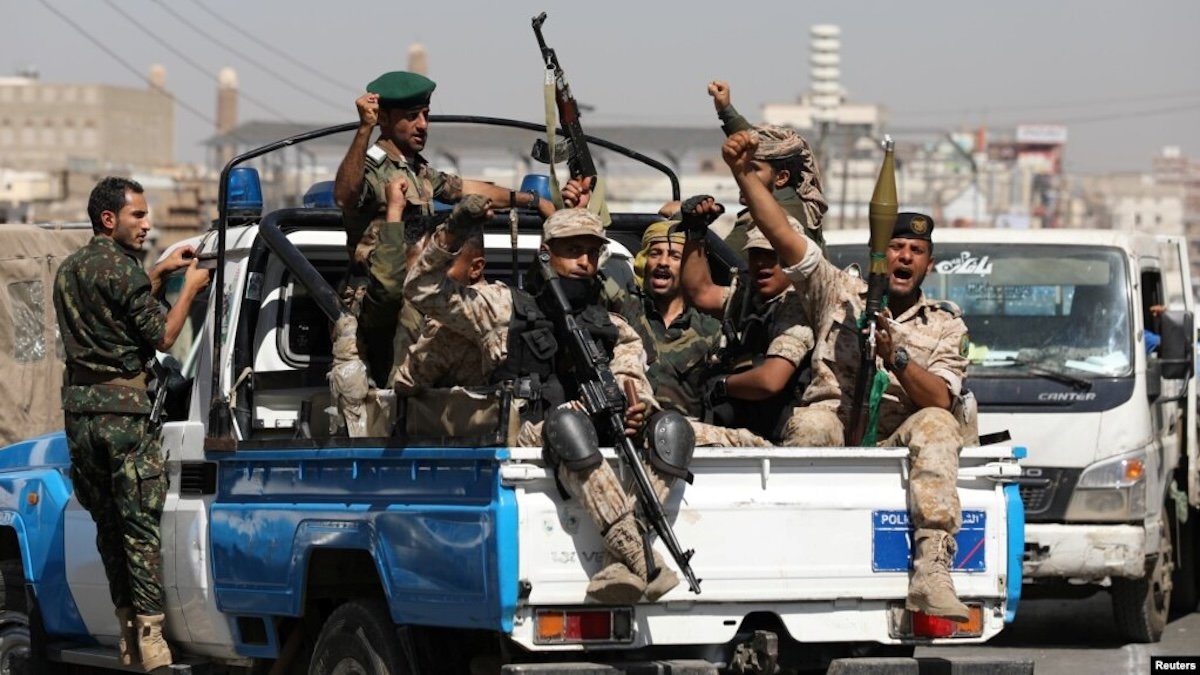
If the United States is drawn into another round of military action in Yemen, it ought to avoid the mistakes of the last decade. From about 2015 to last year, successive administrations backed Saudi‑ and Emirati‑led military campaigns, arms sales, and naval blockades that devastated civilians, deepened Yemen’s fragmentation, and perversely strengthened Houthi power and legitimacy instead of containing it.
Instead, Washington should treat force as one tool within a broader political and economic strategy. Officially known as Ansar Allah (“Partisans of God”) and referred to here as the Houthis for ease of reference, the group is a Zaydi revivalist political-military movement that emerged from a religious reform and protest current in Yemen’s northern highlands. It is distinct from the wider al-Houthi family and from Yemen’s broader Zaydi community — a distinction that is often blurred in public debate but remains politically important. The movement has sustained itself through a pipeline of Iranian-supplied missiles, drones, and targeting support, as well as a steady stream of local recruits. As the regional confrontation with Tehran broadens, the group has emerged as one of Iran’s most consequential asymmetric assets, capable of opening new fronts, stretching Western air defenses, and threatening maritime commerce.
For over a decade, Western policy has reached for kinetic solutions to a crisis that is fundamentally structural. Yet the durability of the movement shows that pressure alone is counterproductive when it reinforces militant legitimacy. A more effective strategy would pair counterattacks to reestablish deterrence with sustained efforts to weaken the Iranian-backed patronage networks that tie Yemeni identity, livelihoods, and local authority to armed power — and to shift those same networks toward alternative tribal and local governance channels.
Yemen’s Escalation Dilemma
External military pressure often strengthens the Houthis by allowing them to present themselves as defenders of national sovereignty rather than an insurgent faction. While the leadership is rooted in a strand of Zaydi religious activism that sought to revive local religious and political traditions, the movement’s broader mobilization is driven by nationalism and opposition to foreign meddling. This creates a self-reinforcing cycle: military strikes reinforce a political narrative of foreign intervention, which in turn sustains recruitment, cohesion, and bargaining power.
Evidence for this shift in sentiment is found in recent field survey data from 12 governorates made available by the Corioli Institute, where we both work. The data comprises 249 face-to-face interviews conducted Feb. 26 to 28, 2026, by a Yemeni research team and focuses on accessible urban centers and surrounding districts, primarily Ta’izz, Sana’a City, and Al Hudaydah. While conflict-related access constraints mean the sample is indicative of reachable urban residents rather than a precise national estimate, these findings provide a critical window into the Yemeni public’s priorities.
The core patterns they reveal—demand for security and salaries over outright victory, exhaustion with “war merchants,” and deep skepticism toward elites—reflect structural grievances that long predate the current escalation and are unlikely to have disappeared in a matter of weeks. The interviews were conducted just before the latest phase of open confrontation between Iran, the United States, and their respective regional partners. Rather than predicting every twist of public opinion in a fast‑moving war, the survey helps identify the bedrock conditions any durable strategy must address: grinding economic precarity and a crisis of political legitimacy.
This does not mean the United States should rule out military action. Rather, it means that if it intervenes again, force should be embedded in a broader strategy that undercuts the “defender of Yemen” narrative instead of feeding it. In practice, that narrative works because it is anchored in material realities that Washington has largely treated as peripheral: who pays salaries, who controls markets, and who can reliably offer protection.
The Economic Engine of Insurgency
If ideology is the movement’s banner, economic desperation is its fuel. The survey data reveal that approximately 47 percent of respondents live in acute financial distress: Nearly one-third say they cannot afford enough food for their families, and another 40 percent report they can afford food but nothing else. The Houthis maintain control by positioning themselves as the gatekeeper of the remaining formal and informal economy, from public-sector salaries to trade route taxation. Supported by Iranian and Islamic Revolutionary Guard Corps-linked networks, the movement converts this scarcity into leverage, while recruitment — shaped by economic need, social pressure, ideological messaging, and occasional coercion by the Houthis — turns that economic control into durable political authority.
Degrading this militant movement’s recruitment base and patronage networks will not, by itself, neutralize the movement’s ability to threaten international shipping. While front‑line manpower can be generated locally, the long‑range strike capabilities that underpin Red Sea and Gulf of Aden operations depend on Iranian‑linked supply chains for missiles, drones, components, and targeting technology. A sustainable strategy, therefore, requires twin lines of effort: economic and governance initiatives that undercut the incentives and narratives drawing Yemenis into the movement, and parallel diplomatic, intelligence, and maritime measures to disrupt Iranian provision, transit, and adaptation of advanced weapons systems. Done well, supply-chain interdiction can reduce the damage the Houthis are able to inflict, while locally grounded economic programming shrinks the pool of Yemenis willing — or compelled — to fight under its banner.
The Fragmented South and the Legitimacy Paradox
The complexity of the Yemeni conflict is deepened by a profound legitimacy paradox. The internationally recognized government, reconstructed as the Presidential Leadership Council, holds formal legal standing but lacks the operational capacity and tribal trust necessary to govern. Conversely, Yemen’s tribal networks possess the ground-level authority required to shift security conditions but lack formal international standing.
This fragmentation was starkly illustrated in December 2025, when the Southern Transitional Council — a secessionist political‑military coalition that claims to represent southern Yemen and has fielded its own security forces with backing from external patrons — launched “Operation Promising Future,” advancing into and claiming control over key areas of the oil‑rich Hadramawt and al‑Mahra governorates. The operation’s rapid collapse and the council’s subsequent contested dissolution in early 2026 (amid rival factions disputing the decision and continuing to claim the mantle of the Southern Transitional Council) reinforced a localized perception that formal institutions and their armed clients are inherently unstable and self-interested.
For the Yemeni public, these short-lived proxy offensives deepen skepticism toward a state already viewed as failed and corrupt. From a security perspective, this infighting creates a strategic vacuum: every round in which southern factions and their external backers turn their guns on one another, rather than on the Houthis, provides the movement with the space to consolidate and regroup. By remaining the only coherent armed actor amid this chaos, the Houthi movement can effectively present its rule as the only viable alternative to perpetual fragmentation. For Washington, this means that backing nominally “state” actors without fixing the legitimacy gap simply deepens the perception that external sponsors are cycling through clients while the group consolidates.
Dual Legitimacy and Economic Stabilization
To break the stalemate, the United States should lead a transition toward a dual legitimacy framework. This approach acknowledges that the government provides the necessary legal legitimacy to satisfy international law, while the tribes provide the operational legitimacy required to govern locally.
The survey responses informing this article suggest Yemenis themselves already think in these terms. When asked who they trust most to work for peace, respondents frequently pointed to local authorities, tribal or community leaders, and neutral external mediators such as Oman or Kuwait, while expressing deep skepticism toward partisan elites and the war profiteers who have benefited from continued fighting.
Building on existing efforts to support the recognized government and counter armed threats and escalation, U.S. policy should concentrate on three strategic pillars: The first step in this transition involves ending the “patriotic justification” often exploited by the Houthis. In responding to the latest Houthi missile attacks, any counterstrikes should be narrowly scoped, clearly tied to specific cross‑border violations, and designed to minimize civilian harm. Then, move quickly to de‑escalate and reopen diplomatic channels. Handled this way, necessary military action restores deterrence against further attacks without handing the Houthis a broad narrative of “foreign aggression” that they can use to rally support at home.
Alongside this diplomatic recalibration, the United States should seek asymmetric economic leverage. Targeted funding can do what additional strike packages cannot: systematically weaken the Houthis’ recruitment base, war economy, and permissive environment for terrorist actors at scale and at lower long‑term cost to the United States.
As counterstrikes restore a narrow deterrent, Washington and its Gulf partners should simultaneously harden key nodes in Yemen’s civilian economy (for example, crop storage, market access roads, and energy for irrigation) so communities are less vulnerable to economic coercion by armed groups and less reliant on Houthi‑controlled middlemen. Channeling support through vetted tribal and municipal structures to keep salaries flowing, stabilize local markets, and prevent price shocks shifts leverage away from the Houthis and constrains space for other violent extremists, while reinforcing — rather than replacing — credible deterrence.
Finally, this strategy culminates in the empowerment of tribal intermediaries to shape conditions on the ground. By directing access to jobs programs and security-sector stipends toward community networks, the U.S. enables these actors to offer credible alternatives to Houthi patronage. Structured carefully, this approach uses targeted economic and security assistance to reduce reliance on such channels and lowers the need for repeated large-scale kinetic operations.
At times, $2 million missiles were sent to defeat one-way attack drones that cost as little as $2,000. This contrast in costs underscores the need for the above approaches. Recent estimates suggest that U.S. operations against the Houthis in the last fiscal year cost between roughly $2.8 and $4.9 billion, with munitions alone consuming close to a billion dollars in the first month of intensive strikes. The war with Iran is even more costly: the Pentagon has reportedly told Congress that the first 12 days of that conflict cost about $16.5 billion, and is preparing a supplemental funding request on the order of $200 billion to sustain operations and replenish stockpiles. Redirecting even a portion of those sums into economic hardening, tribal security partnerships, and financial pressure on Iranian patronage networks would secure more durable reductions in the Houthis and al-Qaeda capabilities in the Arabian Peninsula at far lower long‑term cost. Furthermore, it would make any future counterstrikes more effective by hitting a structurally weaker ecosystem instead of a resilient one.
The Closing Window
The coming months offer an unusually narrow window for meaningful change. After years of attrition and repeated strikes, the Houthis are under pressure at home and more dependent than ever on their Iranian backers — but that vulnerability won’t last. The group’s cautious entry into the war suggests a desire for deterrence over all-out escalation, signaling internal concerns about overstretch and higher-end blowback.
If Washington uses this moment only to add another round of missiles to the ledger, it will merely agitate the movement, encourage it to wait out the bombing, and allow it to regroup while U.S. attention shifts elsewhere. The choice is not between hitting the Houthis or doing nothing, but between another short, expensive round of strikes against a resilient system and a strategy that uses deterrence to buy time for the harder work of rewiring that system from the ground up.
The only way to turn temporary weakness into strategic gain is to ensure that any renewed use of force is tightly embedded in a broader effort of economic hardening, supply‑chain interdiction, and locally rooted governance support. In this way, deterrence underwrites a more durable political order instead of becoming an open‑ended substitute for strategy.
Erin K. McFee, PhD, is the founder and executive director of the Corioli Institute. She is a recognized expert on formerly armed actor reintegration, resilience, and security stabilization, with extensive published research and media appearances covering fragile and conflict-affected contexts in Latin America, the Arab world, and Eastern Europe.
Gillian Gordon is a research analyst at the Corioli Institute. She is a specialist in conflict, development, and policy, with award-winning academic research on gender and war and professional experience spanning the finance and nonprofit sectors. A graduate of the University of Chicago, her work focuses on governance and resilience in conflict-affected contexts.
Image: Wikimedia Commons
