

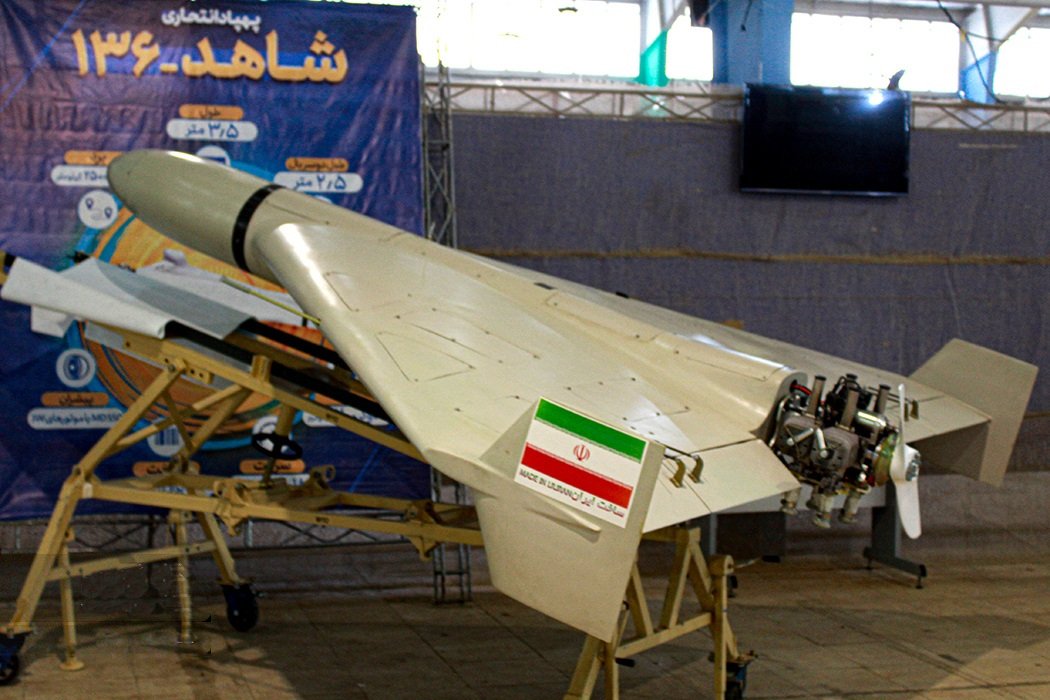
The war that the USA and Israel have waged against Iran offers important lessons for countries in Asia-Pacific, particularly the devastating effectiveness of one-way attack (OWA) drones when used in concert with ballistic and cruise missiles.
While the threat of cruise and ballistic missiles has been around for decades, and many countries have put in place sufficient measures to counter these, OWA drones – or “kamikaze drones” – represent a newer and more difficult challenge.
As demonstrated in the Russia-Ukraine war, low-cost OWA drones such as Iran’s Shahed-136 have gained notoriety as an effective asymmetric tool that is reshaping the battlespace. Their small size and ability to be launched in numbers make them hard to defend against. When deployed alongside cruise and ballistic missiles, conventional air defence systems can be overwhelmed.
Costly losses
Such tactics have resulted in Iranian strikes on US Air Force (USAF) aircraft at deployment sites across the Middle East. Among confirmed losses are force-multiplying capabilities such as KC-135R tankers and an E-3C early warning and control aircraft. These are high-value, low-density assets that few militaries can afford to lose.
Despite lessons from Ukraine, it is peculiar – perhaps due to hubris – that the USAF did not employ its Agile Combat Employment doctrine that calls for dispersal of its aircraft to complicate targeting by an adversary.
Other assets struck include critical enablers of airpower, such as an AN/TPY-2 radar – part of the USA’s Terminal High Altitude Area Defense (THAAD) anti-ballistic missile system – and Qatar’s AN/FPS-132 phased-array early warning radar.
The asymmetric impact of these hits are dramatic: the AN/TPY-2 radar costs around US$300 million, while the Foreign Military Sales package for the AN/FPS-132 system to Qatar in 2013 was listed at US$1.1 billion. In contrast, Iranian missiles and drones cost far less; a Shahed costs between US$20,000 and $60,000.
Taking out these critical, high-value sensor capabilities, which are not easily replaced, would have significant ramifications for the early detection of air threats and the effectiveness of air and missile defence systems.
The cost disparity between advanced interceptors and their Iranian missile and drone targets is stark. They also take longer to produce, and those on the receiving end of the attacks find themselves burning through their stockpiles to counter the threat.

Asia-Pacific concern
For countries in the Asia-Pacific region, especially those that field capable air forces to project combat power, developments observed in Ukraine and reinforced by the conflict in Iran are deeply concerning.
These conflicts highlight how low-cost drones, used in concert with missiles, can challenge traditional airpower assumptions that many regional militaries have long relied upon – particularly the ability to generate airpower from safe-haven airbases with minimal enemy interference.
The impact will be even more acutely felt by smaller countries with limited strategic depth and/or close proximity to potential adversaries, reducing warning time and challenging their ability to absorb such attacks. Countries facing such conditions include South Korea, Singapore and Taiwan. These countries may require expanded sensing capabilities as well as a more robust defensive posture.
The threat of localised attacks by smaller weaponised drones, as demonstrated by Ukraine’s unprecedented covert strikes on multiple Russian airbases last year, could further complicate air defence and force protection efforts.
Countermeasures
Numerous countries across the region have indicated that plans are being developed to mitigate the threat posed by drones, though details remain limited. It is expected that counter-drone efforts will involve at least some of the following measures, depending on each country’s allocated defence resources.
A multi-layered and comprehensive air defence system capable of countering both traditional air threats and drones will be at the forefront of the minds of defence planners.
To start off, a network of radar sensors configured to detect significant numbers of low- and slow-flying drones with reduced radar cross-sections is required. For effectors, a mix of soft-kill and hard-kill systems will allow flexibility in response under different defensive postures.
Such counter-drone effectors should be inexpensive to ensure a reasonable cost exchange. A number of such solutions have been promoted on the market for some time, ranging from radio frequency jamming, gun systems with proximity fused rounds, drone interceptors and laser-guided rockets.
A number of companies have packaged these components into vehicle-mounted counter-unmanned aerial systems (C-UAS), such as the Leonardo DRS Air Defence Light Variant based on the 4×4 Joint Light Tactical Vehicle, and an 8×8 Stryker-based C-UAS Directed Energy vehicle from the same company.

To project counter-drone capabilities farther forward, fighter aircraft equipped with Advanced Precision Kill Weapon System (APKWS) laser-guided rockets, and helicopter gunships with proximity fused rounds, can be employed.
Other measures include enhancing the resilience of airbase infrastructure, including hardened aircraft shelters. While these are used by a number of countries in Asia-Pacific, many were built decades ago and do not provide all-round protection for the aircraft they house.
More widespread dispersal of aircraft across numerous airfields could also help outpace an adversary’s targeting cycle.
Finally, building wider and deeper stockpiles of munitions to counter both missiles and drones may be necessary. The Ukraine war and the conflict in the Middle East have shown that missile and interceptor stocks can burn through faster than anticipated.
Just in March, Taiwan’s state-owned National Chung-Shan Institute of Science and Technology announced plans to develop cost-effective air defence munitions as part of the island’s T-Dome system. By doing so, it aims to build a sizable stockpile and counter attempts by China to use large quantities of inexpensive weapons to deplete Taiwan’s missile inventory.
by Roy Choo
