

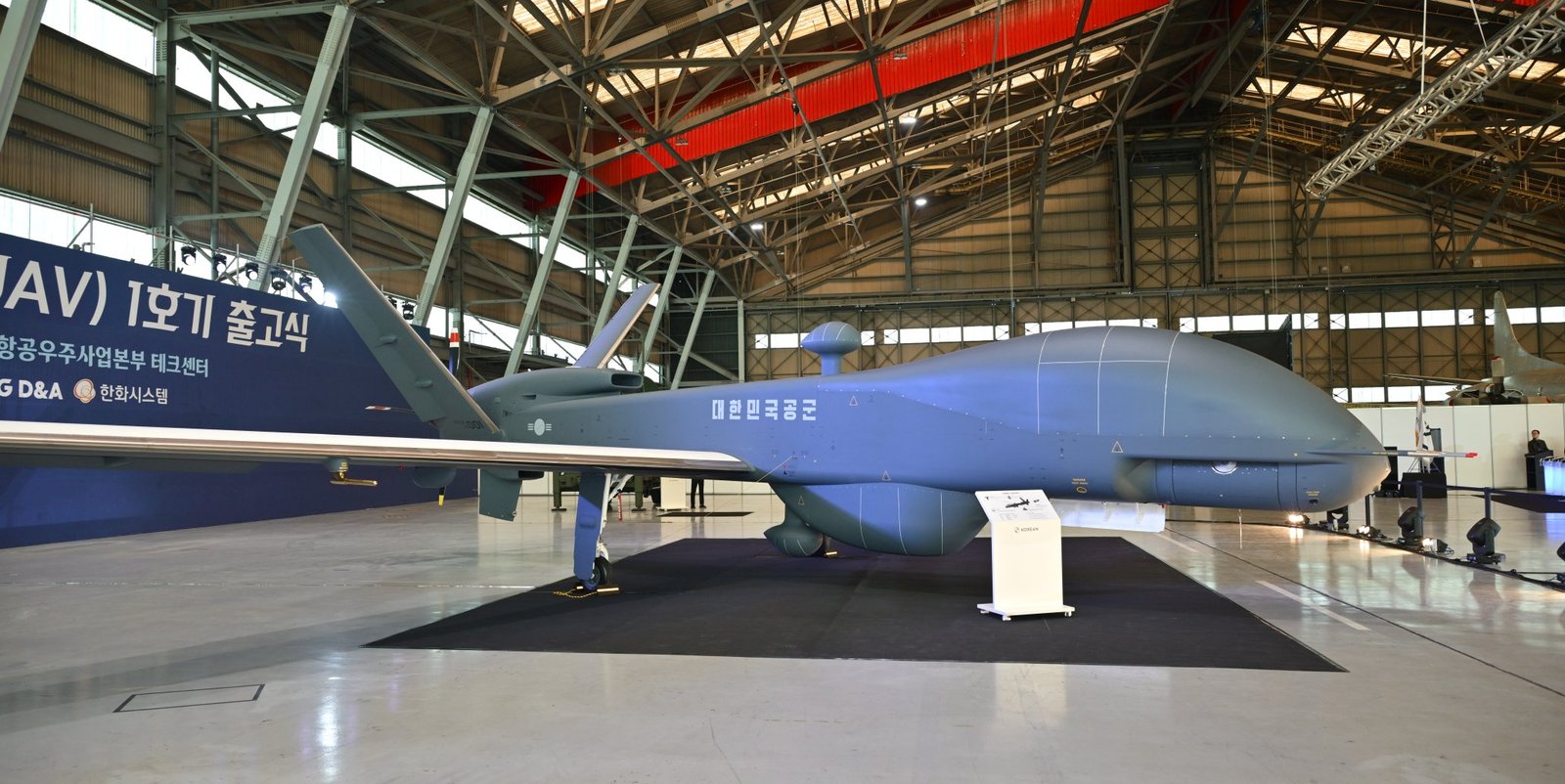
South Korea rolled out its first series-produced Medium-Altitude Unmanned Aerial Vehicle (MUAV) aircraft at the Korean Air Tech Center in Busan on 8 April 2026.
The rollout was attended by more than 300 dignitaries, including General Son Seok-rak, the Republic of Korea Air Force’s (ROKAF) Chief of Staff.
Son said: “As seen in the Russia-Ukraine war and Middle East conflicts, unmanned aerial vehicles are no longer mere auxiliary tools for conventional weapon systems, but have become core forces that determine the outcome of battles. The MUAV is the great first step in the air force’s manned-unmanned composite system.”
Korean Air Aerospace Division (KAL-ASD) completed integration and painting of the MUAV airframe in February 2026, and full-scale flight testing began in March. The ROKAF is expected to take delivery of the initial UAV in 2027 following acceptance tests.
The MUAV, with a 26m wingspan, can operate for extended periods of at least 30 hours. This permits it to maintain persistent surveillance over wide areas, especially the fringes of North Korea. It can fly at an altitude of 10-12km, and its radar has a detection range of approximately 100km.
Lee Yong-cheol, head of the Defense Acquisition Program Administration (DAPA), said, “The MUAV will dramatically improve our military’s surveillance and reconnaissance capabilities, and strengthen the foundation of self-reliant national defence, while also contributing to elevating the Republic of Korea into a major aerospace power.”
Developed and manufactured by Korean Air (which calls it the KUS-FS), with significant technical inputs from LIG Defense & Aerospace (formerly LIG Nex1) and Hanwha Systems, the MUAV is described by the government as “the first strategic-grade unmanned aerial vehicle in Korea”.
Equipped with satellite communications, plus Ku-band and ultra-high-frequency line-of-sight data links, operators control MUAVs from either a fixed-site ground control station or a trailer-mounted, 40-foot container offering greater mobility.
DAPA awarded a KRW980 billion (US$662 million) contract for the series production phase of this MUAV project on 21 December 2023, with production to extend till 2028. The quantity of MUAVs to be manufactured was not disclosed, however.

Production of this first aircraft took around 2.5 years, after manufacture commenced in December 2023. DAPA acknowledged that the MUAV “faced numerous technical challenges, but it was overcome and achieved a high localisation rate of 90%”.
In fact, development of the MUAV actually commenced way back in 2008, and with its maiden flight occurring in 2012. This represents a long gestation period. South Korea deliberately sought to reduce dependence on foreign components too.
One current item to be replaced is the 1,200hp turboprop engine. In mid-2025, Hanwha Aerospace received a contract to develop a new 1,400hp engine for the MUAV by 2028.
On 1 June 2025, Hanwha Aerospace announced the award for this “propeller-driven aircraft engine prototype development and engine certification demonstration technology”. By 2028, the company will achieve engine certification at the instrument flight rules level.
The ROKAF also operates four Northrop Grumman RQ-4 Block 30 Global Hawk high-altitude, long-endurance UAVs, though the MUAV must be considerably cheaper to acquire and operate.
As far as is known, the MUAV does not currently carry weapons, though this could presumably change in the future since the prototype had four underwing hardpoints.
by Gordon Arthur
