

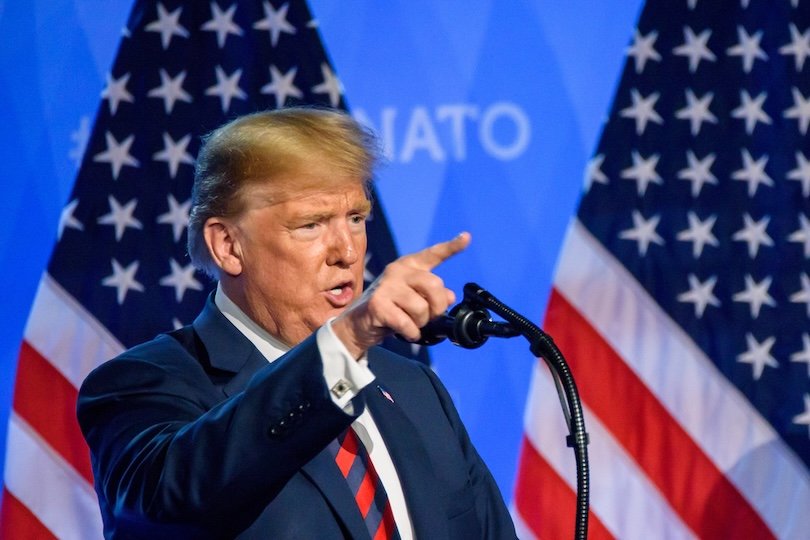
President Trump has said he is reconsidering the US’s position in NATO, because NATO has failed to back his war on Iran – a war in which serious violations of international law have been committed by the US, Israel and Iran. NATO backing for Trump’s war on Iran was never really on the cards, because NATO is a defensive alliance based on at least lip-service to international law. Trump does not understand this because he does not think in terms of formal structures and agreements. He sees relations between nations as emerging from a mix of armed force, personal chemistry between strong leaders, and diktats to client states. Trump’s allies in NATO have had to live with this as best they can, in the hope of keeping the US on their side against Russia, and even, in the case of Canada and Denmark, in the hope of fending off Trump’s ambitions to acquire their territory.
The Iran war has pushed to breaking point the uneasy compromise between Trump and his allies – who in the latter case broadly subscribe to the rules-based international order, whereas Trump does not. In Article 1 of the North Atlantic Treaty, the US and its allies pledge to settle any international dispute in which they may be involved by peaceful means, and to refrain in their international relations from the threat or use of force in any manner inconsistent with the purposes of the United Nations. Article 5 provides that an armed attack against one or more NATO allies in Europe or North America shall be considered an attack against them all. They agree that if such an attack occurs, each of them will come to the aid of those attacked by taking such action as they deem necessary, including the use of armed force. While the Treaty refers to an armed attack, it does not mean that allies must wait to be attacked, as under Article 51 of the United Nations Charter pre-emptive measures of self-defence may be taken if an attack is sufficiently imminent.
A number of NATO allies have been willing to give a wide scope to the notion of an “imminent” armed attack. Most members of the EU, all of them NATO members, and including France, Germany, Italy and the Netherlands, accepted that self-defence could be stretched to justify strikes by Israel and the US in June 2025 on Iran’s nuclear facilities. The UK may have taken a stricter view, since the UK’s Attorney General was reported shortly after the Israeli strikes as having doubts about their consistency with international law.
When the US attacked Iran in company with Israel at the end of February, President Trump accused Iran of building nuclear weapons that could threaten US allies and could “soon” reach the US. There is no evidence that Iran was capable of an attack on the US. In any event, Pentagon briefers had acknowledged that Iran was not planning to strike US forces or bases unless Israel attacked Iran first, which indicated an absence of any “imminent” threat of an armed attack, which would have been necessary to establish a US legal right to self-defence, and the applicability of Article 5 of the NATO treaty. That did not stop Canada and five other members of NATO’s 32 members (Albania, North Macedonia, Lithuania, Latvia, and the Czech Republic) backing the US-Israeli attacks, no doubt in an attempt to keep on good terms with Trump.
In terms of the aims and wording of the NATO Treaty, Trump’s war on Iran was not NATO’s war. In terms of Trump’s view of the world, it was, and he has levelled abuse and mockery at the leaders of NATO countries he blames the most for letting the US down. Three in particular have been singled out; the UK’s Prime Minister Keir Starmer, France’s President Emmanuel Macron, and Spain’s Prime Minister Pedro Sanchez.
Starmer responded to US criticisms of the UK’s refusal to allow the use of British bases for the initial strikes against Iran in language which indicated that Starmer regarded them as illegal. This is ironic, since if press reports are true, Starmer had wanted to allow this, but was blocked by members of his National Security Council. The fact that Starmer allowed “defensive” strikes against Iran as soon as Iran commenced retaliatory strikes against its neighbours has not been good enough for Trump. Starmer has also been criticised for failing to provide warships, in particular minesweepers, to assist in opening the Strait of Hormuz, with Starmer’s position being that no such assistance could be provided until the conflict came to an end. A similar position has been taken by NATO allies France, Germany, and Italy, as well as by Australia and Japan.
In the case of France and Spain, their governments have been more obstructive to the US war effort than the UK. France has refused overflight for planes carrying U.S. military supplies to Israel, and Spain has closed its airspace to US planes involved in strikes against Iran, going further than its earlier refusal to allow the use of jointly operated bases.
One difficulty for NATO leaders in simply going along with Trump, however illegal and illegitimate they believe his actions to be – military force is sometimes regarded as legitimate even if not strictly legal – is that doing so could lead to loss of public support in their home countries. Trump’s war in Iran is unpopular in Spain, as well as in Italy, France, Germany, and the UK. But the coolness of NATO allies to Trump’s war on Iran is only part of the reason for Trump’s waning enthusiasm for NATO. President Trump considered taking the US out of NATO during his first term in office and his former security adviser John Bolton said he would do so if he secured a second term, as of course, he has.
There are legal and political obstacles in the US to Trump withdrawing from NATO, but whether he withdraws the US formally from NATO or not, there is a form of de facto US withdrawal the moment the Kremlin no longer believes that the US would fight for a NATO ally if Russian forces attacked that ally. Perhaps that point had already been reached before the Iran war. It is not self-evident that Trump would ever confront Putin’s Russia, either for the reason given by advisers like Elbridge Colby, who say the US should marshal its resources to face an upcoming confrontation with China, or because Trump sees Putin as a soul mate – or for other reasons. It is also possible that Trump would fight for some allies, but not for others, preferring those allies with far-right governments and/or with US bases which would continue to be of value to the US even if NATO fell apart. All that said, the de facto or de jure withdrawal of the US from NATO would leave European NATO allies with a gap in their defences which could not be plugged simply by increasing the size and capability of their conventional armed forces.
Putin likes to point out that Russia has more nuclear warheads than NATO (including the US), and described this as Russia’s “competitive advantage”. Russia’s arsenal includes both strategic, high-yield nuclear weapons, and lower-yield, tactical nuclear weapons. The latter are designed to destroy military targets of an adversary without triggering a full-scale nuclear war, and Russian doctrine holds that tactical – or battlefield – nuclear weapons are “a controllable part of a framework for achieving both battlefield results and war termination”. NATO’s counterpart to Russia’s nuclear arsenal is provided mainly by the US, which likewise deploys both strategic and tactical nuclear weapons, with some of the latter being shared with NATO allies. Those allies – Belgium, Germany, Italy, the Netherlands, Turkey and the UK – could be authorised to deliver US-owned tactical nuclear warheads in the event of war. The UK and France have strategic nuclear weapons capable of deterring Russia from nuclear attacks on the territory of the UK and France, but it would likely be beyond their capability to provide a credible substitute for the US nuclear umbrella which has shielded NATO in the past. Providing adequate nuclear deterrence vis-à-vis Russia, without the backing of the US, could therefore prove to be a bridge too far for NATO countries.
