

Building a more muscular physique takes regular training, gradual progress, and enough time for your body to adapt. No single exercise can transform your body on its own, but a small group of well chosen movements can train many major muscles without making your workouts complicated.
The squat, bench press, and bent over row make a practical starting point because they cover a lower body movement, an upper body push, and an upper body pull.
These exercises are not the only way to build muscle, and they are not automatically right for every person. You can use dumbbells, a barbell, or a machine, depending on what is available and which version you can perform with control. Research in novice men found that different combinations of machines and free weights could all support progress, so beginners do not need to master barbell lifts before they can start getting stronger.
For muscle growth, the way you train matters as much as the name of the exercise. Choose a load that lets you complete your repetitions with good form while making the last few repetitions challenging. Add repetitions or a small amount of weight over time when you can maintain that form. Research reviews suggest that muscle growth can occur across a range of loads, while multiple sets and a manageable weekly training volume provide a useful basis for progress.
1. Squat
Why beginners should learn it
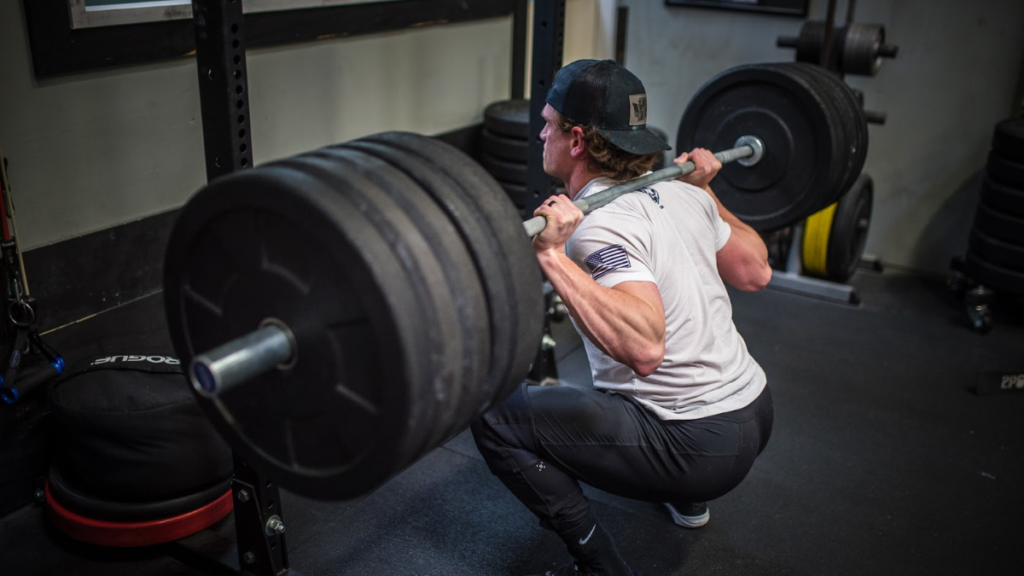
The squat trains the muscles around the hips and knees, including the quadriceps and glutes. It also asks the trunk muscles to help keep the torso steady. This makes it a useful choice for developing the lower body, which contributes a large share of overall muscle mass.
You do not have to start with a barbell on your back. A goblet squat, in which you hold one dumbbell or kettlebell against your chest, gives you a simpler way to practice the movement. A machine based option, such as a leg press, can also train the legs if balancing a free weight feels awkward. The best starting variation is one that you can perform consistently and safely.
How to perform it
Stand with your feet about shoulder width apart, then turn your toes slightly outward if that feels natural. Hold a dumbbell close to your chest for a goblet squat, or use a stable machine according to its instructions. Brace your torso gently, bend your knees and hips, and lower yourself under control. Keep your feet planted and stop at a depth you can reach without pain or losing control of your position.
Press through your feet to stand back up, keeping the movement smooth rather than bouncing out of the bottom. Your knees can travel forward as you descend, provided the movement is comfortable and controlled. You do not need to force your body into a particular depth if your mobility or comfort makes that difficult. Research on range of motion suggests that training through a comfortable, fuller range may support lower body muscle growth better than using a very limited range, though the research base is modest.
Start with two or three sets of about eight to twelve repetitions. Use a load that lets you finish each set with a few good repetitions still possible. Once you can complete the top end of your repetition range with consistent technique, increase the weight slightly or choose a harder variation.
2. Bench Press
Why beginners should learn it
The bench press trains the chest, triceps, and front portion of the shoulders. These muscles contribute to pushing movements and upper body size. The barbell version is popular, but a beginner can make the movement easier to learn with dumbbells or a chest press machine.
A machine can be especially useful if you are training alone and are not yet comfortable handling a barbell. A dumbbell press allows each arm to move independently and may feel more comfortable for some people. Neither option is a requirement for muscle growth. Choose the version that feels stable and lets you train the target muscles with control.
How to perform it
For a barbell bench press, lie on the bench with your eyes under the bar and your feet firmly on the floor. Grip the bar slightly wider than shoulder width, then lift it from the rack with help from a spotter if needed. Lower it toward the middle of your chest while keeping your wrists stacked above your forearms. Press it back up until your arms are extended without forcefully locking your elbows.
For dumbbells, begin with the weights held above your chest and lower them in a controlled path until you feel a comfortable stretch. Press them upward while keeping your shoulders in a stable position against the bench. With a chest press machine, adjust the seat so the handles begin around mid chest height, then press and return slowly.
Aim for two or three sets of eight to twelve controlled repetitions. Avoid bouncing a bar off your chest, shortening the movement to lift more weight, or letting your shoulders roll forward as fatigue builds. If you are unsure how to set up a barbell safely, use dumbbells or a machine while you learn.
3. Bent Over Row
Why beginners should learn it
The bent over row trains the upper back and the muscles that pull the arms toward the torso. The biceps also assist with the movement. Including a pulling exercise alongside a pressing exercise helps your beginner routine train both directions of upper body movement.
A one arm dumbbell row is a straightforward way to begin. It lets you support yourself with a bench and focus on moving one arm at a time. A seated cable row is another useful choice if you prefer a machine. The exercise name matters less than being able to control the weight and feel your upper back working.
How to perform it
For a one arm dumbbell row, place one hand and one knee on a bench, with your other foot planted on the floor. Hold a dumbbell in your free hand and let your arm extend beneath your shoulder. Keep your back steady as you pull the weight toward your hip. Lower it slowly until your arm is extended again, then repeat the movement without twisting your torso.
For a two arm bent over row, hinge at the hips and keep your spine in a comfortable, stable position. Hold dumbbells or a barbell beneath your shoulders, then pull the weight toward your lower ribs. Lower it with control. If keeping the hinge position feels difficult, choose a chest supported row machine or a seated cable row while you build confidence.
3 Best Exercises for Beginners to Get Jacked Arms Quickly
Complete two or three sets of eight to twelve repetitions. If you find yourself jerking the weight, shrugging your shoulders, or rotating your body to finish each repetition, reduce the load. A lighter weight that you can control is a better starting point.
How to Put the Exercises Together
You can train these movements in one full body workout two or three times per week, with at least one day between sessions at first. For example, perform the squat, bench press, and row in that order, completing two or three sets of each. Rest long enough between sets to regain control of your breathing and perform the next set with good technique.
You do not need to train to the point where you cannot complete another repetition on every set. Instead, finish most sets when you believe you could still do one to three clean repetitions. This gives you a challenging workout while leaving room to recover and practice the movements. As your technique and confidence improve, increase the weight gradually or add a repetition before increasing the load.
Training volume is one factor associated with muscle growth, but more is not always better for a beginner. A modest amount of hard, repeatable work is easier to recover from and build upon than a sudden jump in sets. Research syntheses find a relationship between weekly training volume and muscle growth, while broader analyses suggest multiple set programs can be effective. The right amount is the amount you can perform regularly and recover from.
The three exercises here offer a useful start, not a complete long term plan for every muscle. Over time, you may add a hip hinge such as a Romanian deadlift, an overhead press, or a pulldown to address movements and muscles that receive less direct work. If an exercise causes pain, stop and adjust the movement, load, or equipment. A qualified coach or health professional can help you find a suitable alternative when needed.
Key Takeaways
| Exercise | Main training focus | Beginner option |
|---|---|---|
| Squat | Quadriceps, glutes, and trunk stability | Goblet squat or leg press |
| Bench press | Chest, triceps, and front shoulders | Dumbbell press or chest press machine |
| Bent over row | Upper back and biceps | One arm dumbbell row or seated cable row |
References
- Aerenhouts, D. and D’Hondt, E. (2020) ‘Using machines or free weights for resistance training in novice males? A randomized parallel trial’, International Journal of Environmental Research and Public Health, 17(21), 7848.
- Currier, B.S., McLeod, J.C., Banfield, L., Beyene, J., Welton, N.J., D’Souza, A.C., Keogh, J.A.J., Lin, L., Coletta, G., Yang, A., Colenso-Semple, L., Lau, K.J., Verboom, A. and Phillips, S.M. (2023) ‘Resistance training prescription for muscle strength and hypertrophy in healthy adults: a systematic review and Bayesian network meta-analysis’, British Journal of Sports Medicine, 57(18), pp. 1211–1220.
- Schoenfeld, B.J., Grgic, J., Ogborn, D. and Krieger, J.W. (2017) ‘Strength and hypertrophy adaptations between low- vs. high-load resistance training: a systematic review and meta-analysis’, Journal of Strength and Conditioning Research, 31(12), pp. 3508–3523.
- Schoenfeld, B.J., Ogborn, D. and Krieger, J.W. (2017) ‘Dose-response relationship between weekly resistance training volume and increases in muscle mass: a systematic review and meta-analysis’, Journal of Sports Sciences, 35(11), pp. 1073–1082.
- Schoenfeld, B.J. and Grgic, J. (2020) ‘Effects of range of motion on muscle development during resistance training interventions: a systematic review’, SAGE Open Medicine, 8, pp. 1–10.
