

Topline
AI-fueled foreign influence campaigns might foster domestic unrest, collapse public trust, and lead to violence faster than the United States can respond.
Artificial general intelligence (AGI) might arrive before governments are ready for it. Adversaries could exploit public distrust of artificial intelligence (AI) to destabilize the United States from within, blending disinformation, cyber operations, and physical attacks in ways that existing tools were not built to handle.
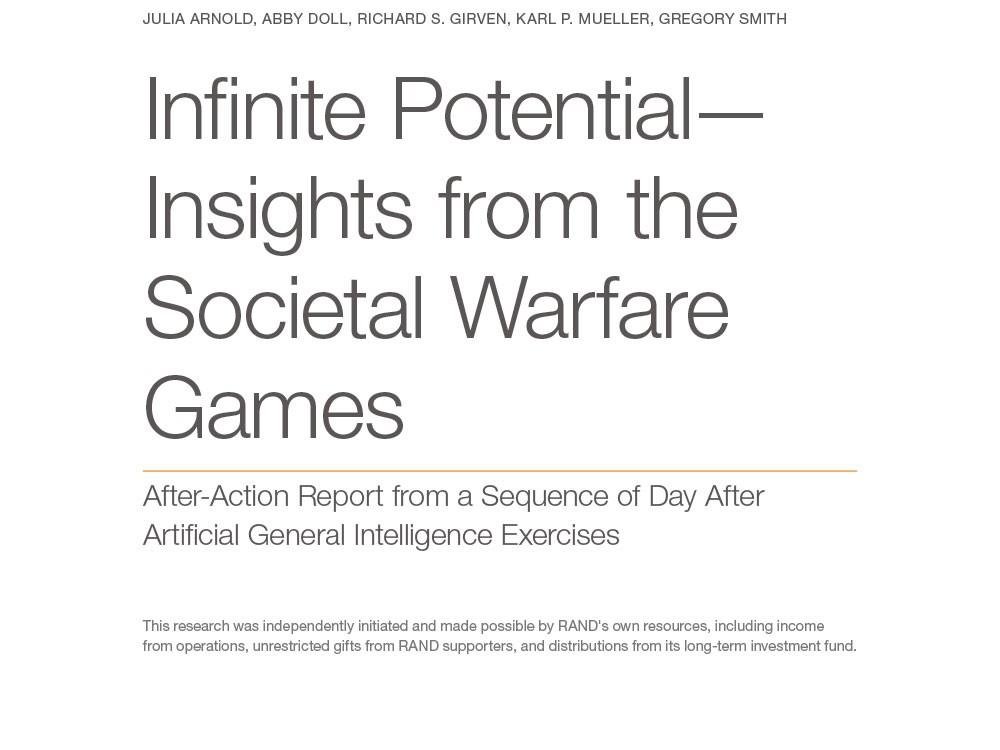
To explore this threat, RAND ran scenario-based games using the Infinite Potential platform. Players acting as government policymakers worked through a scenario in which China ran a coordinated information operations campaign that exploited domestic grievances about AI job displacement and safety before escalating to physical attacks on AI infrastructure.
Key Takeaways
The U.S. response toolkit might be inadequate.
Conventional diplomatic, economic, and cyber responses may be insufficient to counter fast-moving hybrid influence campaigns effectively.
Trust in AI is a national security variable.
Players found that adversary narratives succeed not because they were convincing but because targeted populations were predisposed to distrust government and AI firms.
Attribution of hybrid campaigns is slow.
Blurred lines between protest, foreign influence, cyber intrusion, and physical attack left players struggling to reach attribution and response decisions within useful time frames.
Federal-state coordination has critical gaps.
State and local officials may face hybrid campaigns first and have to respond without clear communication with federal agencies or sufficient understanding of the systems involved.
Allied coordination is essential but underdeveloped.
The United States and its allies could respond more effectively to hybrid campaigns through joint attribution and response, but mechanisms for coordination are still lacking.
Recommendations
To strengthen preparedness for AGI-era threats, the authors recommend
- Enhance government visibility into frontier AI development, supply chains, and critical infrastructure, and develop structured playbooks for risk management and incident response.
- Build rapid attribution and information-sharing capabilities across agencies, and clarify authorities and coordination mechanisms for hybrid foreign influence campaigns.
- Invest in asymmetric response options, precrisis partnerships with AI developers and platforms, and clear escalation strategies.
- Treat public trust as a national security priority by supporting workforce retraining, community resilience, AI literacy, and credible safety commitments from AI firms.
- Improve federal-state coordination and designate clear leads for cross-jurisdictional campaigns.
- Strengthen allied coordination through joint attribution, export controls, supply-chain diversification, and dedicated institutions for collective resilience and response.
Methodology
RAND researchers ran seven two-hour scenario-based games between June 2025 and April 2026 using the Infinite Potential platform, which applies RAND’s “Day After AGI” methodology to AI- and AGI-related crises. Players, including former federal officials, law students, academics, and RAND researchers, assumed the roles of members of the National Security Council Principals Committee and worked through a scenario involving an information operations campaign by China that escalated to physical attacks on AI infrastructure. Dedicated notetakers used a standardized template to capture player discussions, and findings were synthesized across games to identify recurring themes, desired capabilities, and recommended playbooks.
Topics
Citation
RAND Style Manual
Arnold, Julia, Abby Doll, Richard S. Girven, Karl P. Mueller, and Gregory Smith, Infinite Potential—Insights from the Societal Warfare Games: After-Action Report from a Sequence of Day After Artificial General Intelligence Exercises, RAND Corporation, RR-A4626-2, 2026. As of October 13, 2026:
Chicago Manual of Style
Arnold, Julia, Abby Doll, Richard S. Girven, Karl P. Mueller, and Gregory Smith, Infinite Potential—Insights from the Societal Warfare Games: After-Action Report from a Sequence of Day After Artificial General Intelligence Exercises. Santa Monica, CA: RAND Corporation, 2026. .
This publication is part of the RAND research report series. Research reports present research findings and objective analysis that address the challenges facing the public and private sectors. All RAND research reports undergo rigorous peer review to ensure high standards for research quality and objectivity.
This document and trademark(s) contained herein are protected by law. This representation of RAND intellectual property is provided for noncommercial use only. Unauthorized posting of this publication online is prohibited; linking directly to this product page is encouraged. Permission is required from RAND to reproduce, or reuse in another form, any of its research documents for commercial purposes. For information on reprint and reuse permissions, please visit www.rand.org/pubs/permissions.
RAND is a nonprofit institution that helps improve policy and decisionmaking through research and analysis. RAND’s publications do not necessarily reflect the opinions of its research clients and sponsors.
