

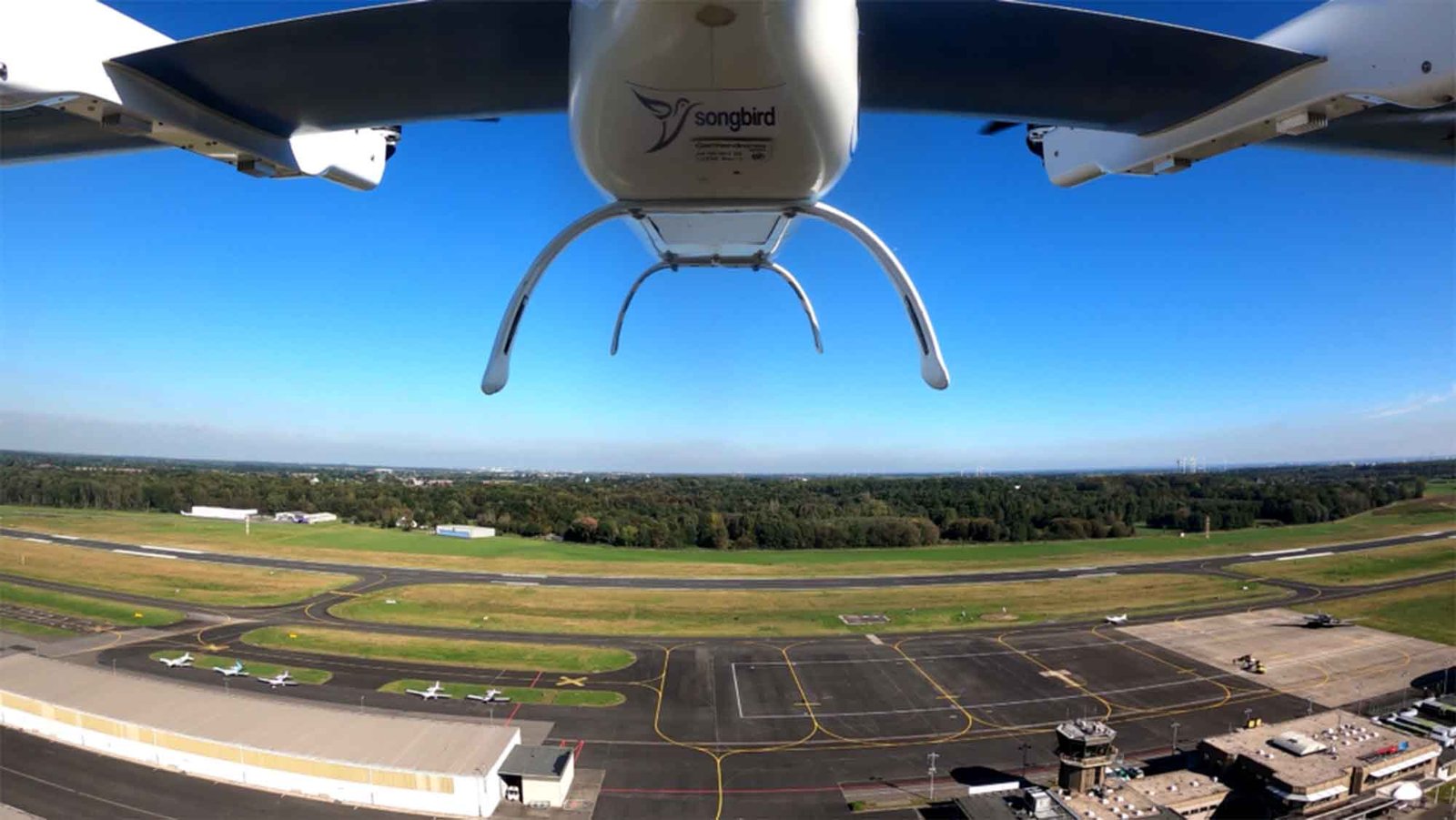
Perimeter protection was long considered a comparatively unspectacular discipline of airport security: fences, cameras, motion detectors and patrols along the outer boundary of the apron. Anyone who gained unauthorized access to the site usually came on foot or by car. But the threat situation has expanded into a third dimension: the lower airspace itself.
The incident at Leipzig/Halle Airport abruptly brought the threat from the lower airspace to the attention of the public and policymakers: For the first time at a German airport, a drone equipped with explosives was deliberately used against aircraft. The debate about securing German airports has been conducted even more intensively since then.
Drone incidents over and at airports – such as Leipzig, Copenhagen, Oslo, Munich and Brussels – repeatedly caused operational interruptions in 2025 and 2026. Danish Prime Minister Mette Frederiksen described the incidents in Copenhagen as one of the most serious attacks on her country’s critical infrastructure. The Leipzig incident was also classified by the Federal Public Prosecutor General as a serious attack on Germany’s transport and logistics infrastructure that could impair the internal and external security of the Federal Republic.’
The threat from above: Counter-UAS becomes mandatory
Incidents involving uncrewed aerial vehicles (UAVs) are no longer unusual. According to the German Aerospace Center (DLR), which opened its own technology center for drone security in August 2026, 116 relevant drone incidents were registered at 25 airports in 2025. Nationwide, the German air traffic control service (DLS) counted 227 drone-related disruptions in German airspace. In the first half of 2026 alone, the number had already reached 166 incidents.
Following the repeated drone incidents at German and European airports, the Conference of Interior Ministers decided to equip eight major German commercial airports with stationary drone detection and countermeasure systems. In parallel, the Federal Police is building up its own counter-drone unit, supplemented by a newly opened counter-drone center.
From a legal perspective, it remains unresolved who may give the order to shoot down a drone over an airport in an emergency and under what conditions. Active countermeasures such as RF jamming, GPS spoofing or the physical neutralization of a drone are reserved exclusively for authorized agencies – the police, the Bundeswehr and intelligence services. Private airport operators can detect drones and alert the responsible authorities, but they cannot actively intervene themselves. This protection gap is currently being addressed through reforms of the Federal Police Act and the Aviation Security Act.
European Security Industry at XPONENTIAL Europe
The close connection between perimeter protection, the security industry, counter-drone capabilities and U-Space was evident at XPONENTIAL Europe 2026, Europe’s leading trade fair for autonomous technologies and robotics, which takes place annually in Düsseldorf. The European Drone Forum is held as part of the trade fair as a leading specialist conference for uncrewed aviation in Europe.

In March 2026, then Federal Minister of Transport Patrick Schnieder served as patron of the trade fair. In his opening speech, he announced that the law introducing U-Space would now be drafted and adopted quickly – with the declared goal that Germany would be the first EU member state to have its own U-Space law. Based on this law, airspaces are to be designated in which crewed and uncrewed air traffic can take place side by side in a coordinated manner.
Schnieder explicitly emphasized that new automated systems for airspace surveillance and stable communication systems are necessary for digitally controlled aircraft – in other words, security as a prerequisite, not as a downstream question. His successor Steffen Bilger also follows this course and announced that he wanted to accelerate the further equipping of airports with detection and countermeasure technology. The U-Space law announced at XPONENTIAL Europe falls under his responsibility and as the Leipzig/Halle incident has shown, it comes amid a security debate that has become noticeably more intense since the spring.
Malte Seifert, Director of XPONENTIAL Europe, also underscores how closely the topics of the XPONENTIAL Europe trade fair and the acute threat situation are connected: “Anyone who wants to understand the technological, regulatory and security policy developments in Europe will find the companies, authorities, regulators, research institutions, armed forces and users discussing these questions at XPONENTIAL Europe in Düsseldorf. This is where the dialogue takes place and this is where solutions are discussed and presented”.
Perimeter Protection Becomes Three-Dimensional
Classic perimeter protection – fences, cameras, security personnel, now supplemented by autonomous ground robots such as those used in Hamburg, for example – remains the basis of airport security. But the real challenge of the coming years lies in the third dimension: controlling the lower airspace. With the U-Space Regulation, its national implementation and the announced German U-Space law, a regulatory framework is also emerging that is intended to systematically bring together digital service providers, aviation security authorities and traditional airport security for the first time.
UAV DACH: Real-Time Situational Picture Required
Dr. Gerald Wissel, Chair of the Board of UAV DACH – European Association for Unmanned Aviation, says the establishment of a uniform situational picture and mandatory electronic identification of all airspace users is essential: “Only if the security authorities know at all times which aircraft systems are legally operating here can adequate countermeasures be taken and safety for crewed and uncrewed airspace users as well as on the ground be ensured.”
