

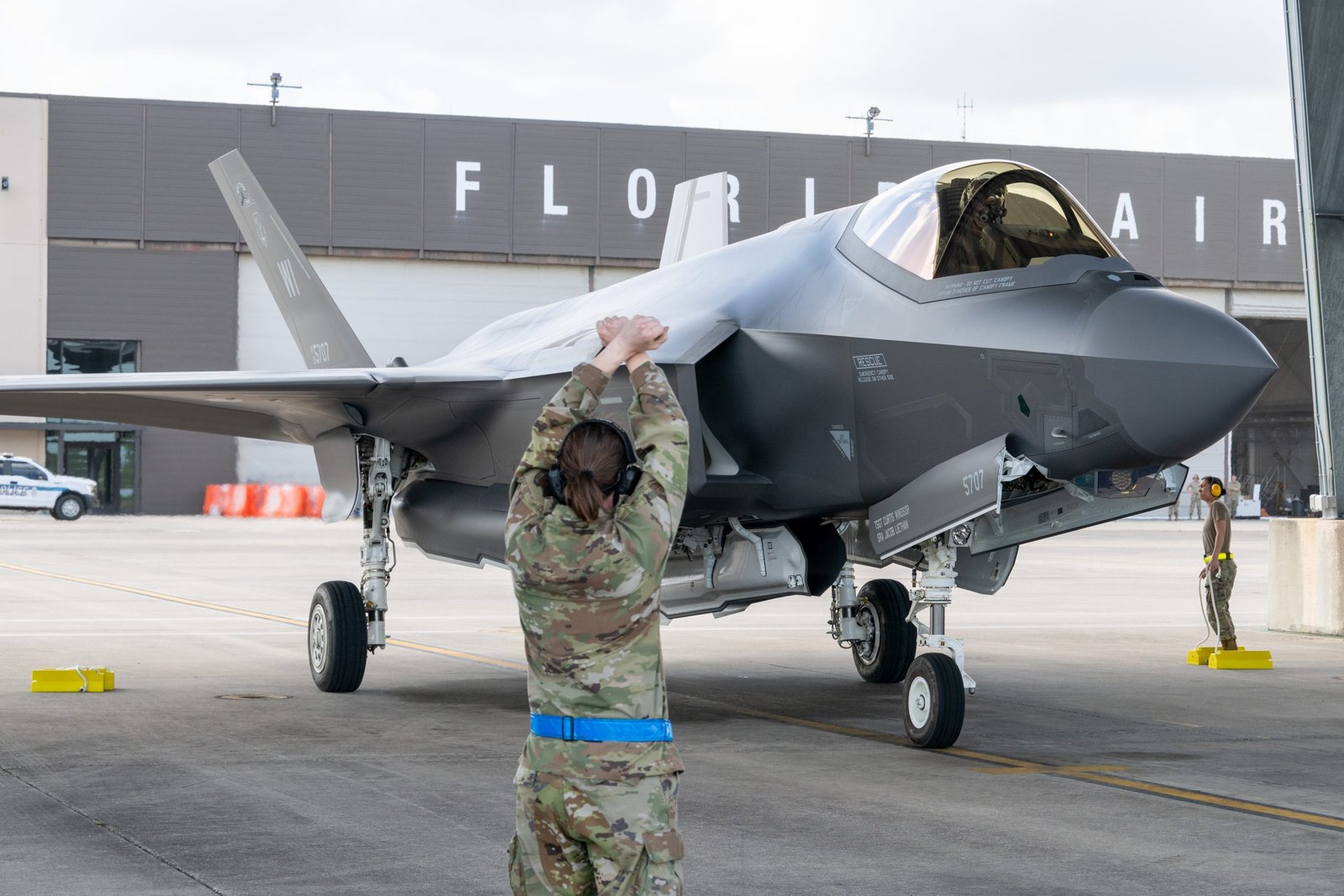
KISSIMMEE, Fla.—Chief Master Sergeant of the Air Force David R. Wolfe recently pledged “a plus-up in manpower” for the maintainer ranks, as the service prepares to launch a major overhaul of its maintenance career field next year.
Wolfe told an audience at the Airlift/Tanker Association’s 2026 symposium that the service realizes it needs “to put a lot more people into the maintenance career field.”
Such a move could be complicated by looming budget uncertainty. Congress increasingly appears unlikely to approve the Pentagon’s full $1.5 trillion budget request for fiscal 2027 in the wake of the midterm elections results. That supersized budget was meant to fund an additional 8,900 Airmen in the ranks.
Regardless, the Air Force is pressing forward with a 2A career field overhaul will condense more than 50 aircraft maintenance specialties field down 14 Air Force Specialty Codes. The service first revealed its plan in January 2025
The idea has drawn criticism from current and former Air Force maintainers that the new design could dilute expertise across the career field amid a shortage in maintenance manning—in response to feedback from the field, officials increased the number of specialties it would have after the transition, from seven up to 14.
The initial strategy called for enlisted Airmen to start out on a generalist track—a single Air Force Specialty Code—where they will focus on applying the most common maintenance skills such as recovering and fueling across multiple airframes. Once Airmen reach the rank of Senior Airman and are preparing to become noncommissioned officers, they would become a specialist in one of six non-aircraft-specific areas:
- Avionics and Electrical, which combines avionics with the electrical side of the Environmental and Electrical (E&E) specialty
- Aerospace Ground Equipment, which will look the same as it does now
- Advanced Mechanical, which combines crew chiefs, fuels, hydraulics, and the flight line side of engine maintenance
- Crew Support Systems, which combines ejection seat systems with the environmental side of E&E
- Fabrication, which combines aircraft structural maintenance, aircraft metals technology, and nondestructive inspection.
- Intermediate-level engines, for maintainers dedicated to intermediate-level engine maintenance.
Under the revised plan, the service will maintainers entering the Air Force as aviation maintenance technicians, or AMTs, for their first 18 months of service, focusing on maintenance fundamentals for multiple airframes. Maintenance Airmen will then transition into a specialty track where they will select from one of 14 different specialties.
The Air Force would not release the new specialty list, but there will be six specialties that are “aircraft-agnostic,” and another eight specialties will be split among three different aircraft groups:
- Fighter/Atack
- Mobility/Strike
- Tactical Lift/Rotary
Eventually, maintainers in the specialty track will have the opportunity to apply for the master aviation technician, or MAT, track—a more specialized pipeline designed to create a smaller force of highly skilled maintainers who will focus on fixing more complex problems on specific aircraft.
But the new strategy will first have to complete an 18-month pilot test scheduled for mid- to late-2027 and will likely be “a yearslong effort,” Lt. Gen. Kenyon K. Bell, deputy chief of staff for logistics, engineering, and force protection, said in late September.
Wolfe seconded this point at Airlift/Tanker, telling an audience,” don’t think we’re just going to, on March 1, flip a switch and all these career fields are going to go away and they’re all going to just shrink down.”
The chief also acknowledged the question many Airmen have raised about the plan: how it will affect manning.
“The other thing that I think you need to know is a commitment from me to the manpower question—if we think we’re just going to let maintenance nation do this with the exact same amount of people that they have now, no way, absolutely not. They’ve got to have a plus-up in manpower to be able to execute any of this,” Wolfe added.
This will likely be no small hurdle since any plans for growing the force will depend on the passage of the $1.5 billion proposed defense budget, Wolfe said.
“We need the entire budget,” Wolfe said. “I can’t stress to you enough how important it is for Congress to pass this budget this year.”
Wolfe said the Air Force “took some risks and we overcommitted on our end strength in hopes that the 8,900-person growth that was in the National Defense Authorization Act actually comes to fruition with a budget.”
Congress authorizes the end strength numbers for the services each year, but if the budget doesn’t get approved on time, the Air Force won’t “get enough money to pay for that end strength,” Wolfe said.
“That’s why you see the kind of yo-yo effect that you do in our personnel programs, because we don’t have a sustainable, predictable budget cycle where they approve the budget on the timeline that they’re supposed to … and they approve something that looks like what the president’s budget request was,” Wolfe added.
Wolfe told Air & Space Forces Magazine he did not know how many additional personnel will be needed to right-size the maintenance career field, but that will be just part of the additional personnel needed over the long-term to solve the Air Force’s overall manning shortfall.
“An 8,900 plus-up is a really modest, nice start to what we actually need over time, which is probably something in the tens of thousands of more people to be able to do the missions” the Air Force is currently tasked to perform, Wolve told the audience at Airlift/Tanker.
Part of the push will depend on Air Force strengthening its narrative for this growth in end strength, Lt. Gen. Jefferson O’Donnell, deputy chief of staff for manpower, personnel, and services, said in September at AFA’s 2026 Air, Space and Cyber symposium.
“Our Air Force has been doing, and our Airmen have been doing all of the missions with an arm tied behind their back, and that is in the manpower piece of this, where we’ve been carrying essentially a negative wedge, and the manpower we need, and the Airmen we need to be able to do the mission, we haven’t had all of them,” O’Donnell said.
“And so, to a significant extent, this growth that we’re calling growth is actually restoring some of that which we’ve been missing in our team, and so for that reason, it’s very important that we are very surgical and very careful about what we bring in on top of our current strength, so that we are meeting our wartime requirements, that we are focused on making sure that we are prioritizing those things like maintenance and logistics and security forces to fill in those spots where we have been taking significant risk across our service.”
