

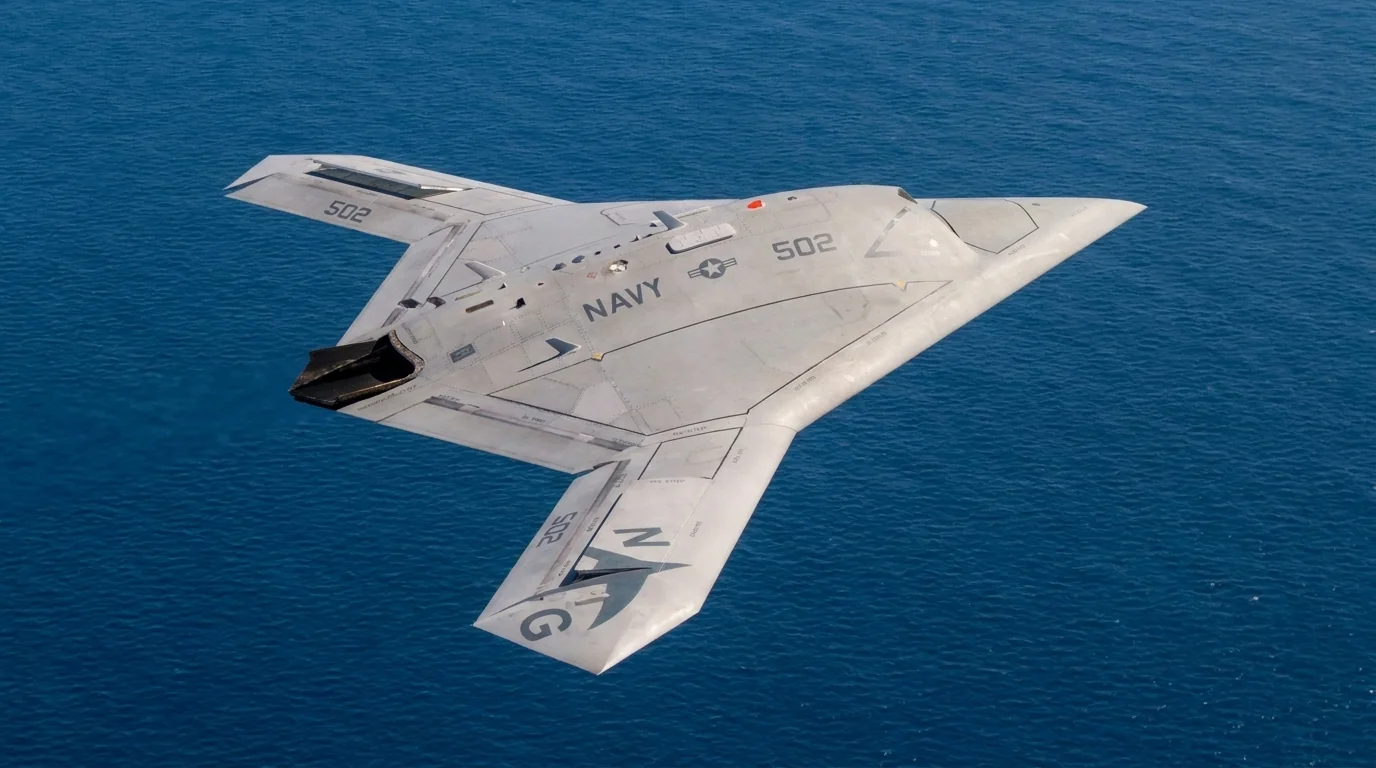
The US Navy built a stealth drone that took off from an aircraft carrier, landed back on its deck without a pilot, and refueled itself in midair. Then it never entered operational service.
That sounds like a military project gone wrong. It wasn’t that simple.
The X-47B Drone proved that an unmanned aircraft could handle some of the hardest jobs in naval aviation. In July 2013, it made a historic arrested landing aboard the USS George H.W. Bush. Two years later, it completed an autonomous aerial refueling test, showing that a drone could take fuel from a tanker while flying.
These weren’t small steps. Landing on a moving carrier deck demands precise timing, steady control, and close coordination with the ship. The X-47B managed it without a pilot sitting in the cockpit. In fact, it had no cockpit at all.
So why didn’t the Navy turn this aircraft into a fleet-ready combat drone?
The answer lies in the gap between proving that technology works and deciding what the military should buy. The X-47B was built to test ideas, not to serve as a finished combat aircraft. By the time its key tests were complete, the Navy’s plans for carrier-based drones had shifted toward different needs.
Cost, mission priorities, and the demands of building an operational aircraft all played a part. The story isn’t that the X-47B failed. It’s that technical success didn’t lead to a production order.
Understanding that difference explains why one of the most impressive unmanned aircraft projects in US Navy history ended without becoming a regular part of the carrier air wing.
What Was the US Navy X-47B Drone?
The X-47B Drone was built to answer a question that had troubled naval planners for years: could an unmanned aircraft operate from an aircraft carrier without a pilot controlling every move?
Northrop Grumman developed the aircraft under the Navy’s Unmanned Combat Air System Demonstration (UCAS-D) program. The goal wasn’t to build a drone for immediate combat use. It was to test the technology needed to bring autonomous aircraft onto carrier decks, where space is tight and mistakes can be costly.

The design looked nothing like a standard fighter. The X-47B had a tailless, flying-wing shape, with swept edges and no cockpit. Its low-observable design helped reduce its radar signature, while its compact form suited the demands of carrier operations.
The aircraft measured about 38 feet long and had a wingspan of roughly 62 feet when unfolded. Its wings could fold to save space aboard a carrier, where aircraft compete for every available inch. Powered by a single Pratt & Whitney F100-PW-220U turbofan, it could reach high subsonic speeds.
But its most important feature wasn’t its shape or engine. It was the way the aircraft handled flight.
The X-47B used onboard systems to follow planned routes, manage flight controls, and carry out precise approaches. Human operators still supervised the mission and could intervene when needed. Autonomous flight didn’t mean the drone made every decision on its own.
That distinction matters. The Navy wasn’t trying to remove people from the process entirely. It wanted to prove that a carrier-based aircraft could perform complex tasks with far less direct control from a pilot.
The program used two X-47B aircraft, known as AV-1 and AV-2, for its flight tests. Neither was intended to become a standard fleet aircraft straight off the production line.
That was the point. The Navy needed evidence that the technology worked before deciding what an operational unmanned aircraft should look like.
How the X-47B Proved It Could Operate From an Aircraft Carrier
The X-47B Drone crossed a barrier that had kept carrier-based unmanned aviation out of reach for decades. It showed that a computer-guided aircraft could launch from a carrier, return to its deck, and land without a pilot in the cockpit.
The biggest test came on July 10, 2013, aboard the USS George H.W. Bush. The X-47B approached the carrier and caught an arresting wire, bringing itself to a stop on the flight deck. This was the first time an unmanned aircraft had completed an arrested landing on a US Navy aircraft carrier.

That achievement mattered because carrier landings leave little room for error. The flight deck moves with the sea, the ship creates shifting air currents, and the landing area is short. A pilot must line up with the deck and catch one of the arresting wires at just the right point.
The X-47B had to handle those demands using its flight-control systems and data from the carrier’s landing aids. The result proved that unmanned aircraft could take part in one of naval aviation’s hardest routines.
The tests had started earlier. On May 14, 2013, the X-47B made its first catapult launch from the USS George H.W. Bush. A steam-powered catapult sent the aircraft off the deck, just as it does with a piloted Navy jet. The drone then flew its planned route and returned to land at a shore base.
The carrier landing in July was the harder milestone. A launch sends an aircraft away from the ship. A landing demands that it return and meet a small, moving target with great accuracy.
The X-47B also showed that it could work alongside piloted aircraft. During carrier trials, it shared the flight deck with manned Navy jets, giving the service a chance to study how unmanned aircraft might fit into normal carrier routines.

Then came another major test. In April 2015, the X-47B completed an autonomous aerial refueling demonstration, receiving fuel from a tanker aircraft while in flight. This mattered because a drone that can refuel in the air has more options for longer missions.
By then, the X-47B had answered several hard technical questions. It could launch from a carrier, land on one, and take fuel in flight. But proving those tasks was only the first step. The Navy still had to decide what kind of unmanned aircraft it actually wanted to buy.
Why the Navy Ended the X-47B Demonstration Program
The X-47B Drone didn’t need to fail for the Navy to stop flying it. The program had a different purpose from the start: prove that autonomous aircraft could handle carrier operations, then use what the Navy learned to guide future designs.
That distinction explains much of the aircraft’s fate.
The Navy launched the Unmanned Combat Air System Demonstration program to test technologies that had never been used together in this way. The team needed to show that an unmanned aircraft could launch from a carrier, land safely, operate around other aircraft, and refuel in flight. Each test reduced a major risk for future programs.

By 2015, the X-47B had reached several of those goals. Its autonomous carrier landing in 2013 had already made history. The aerial refueling demonstration in April 2015 added another key result, showing that an unmanned aircraft could receive fuel from a tanker without a pilot manually flying it through the hookup.
So what was left to prove?
The Navy could have kept testing the X-47B, but more flight hours wouldn’t automatically turn it into a combat-ready aircraft. An operational system would need its own weapons integration, secure communications, mission planning tools, maintenance plans, training, and support equipment. It would also need to fit the Navy’s wider carrier air wing.
Those steps cost money, and they require decisions about what missions the aircraft must perform. The X-47B was never designed as a finished answer to every one of those questions.
There’s another common mistake in this story. People often describe the end of the demonstration program as the cancellation of a drone that was ready to enter service.
The public record doesn’t support that simple version. The Navy completed a technology demonstration, but it never approved the X-47B as a production aircraft for regular fleet operations.
That doesn’t mean every question had been solved. The tests showed that autonomous carrier flight was possible, not that every future mission would be safe, affordable, or effective.
The next step depended on what the Navy wanted from unmanned aviation. And that goal was changing.
Rather than simply ordering more X-47Bs, the service began weighing different roles for its future carrier-based drones. The debate moved beyond whether a drone could land on a carrier. It became a question of what the Navy needed that drone to do, and how much it was willing to spend to get there.
How Changing Navy Requirements Shifted the Program’s Direction
The Navy’s biggest problem wasn’t getting an unmanned aircraft onto a carrier. The X-47B had already proved that was possible. The harder question was deciding what the aircraft should do once it joined the fleet.
That debate shaped the future of the Navy’s Unmanned Carrier-Launched Airborne Surveillance and Strike program, better known as UCLASS. The original idea pointed toward an unmanned aircraft that could conduct surveillance and carry out strike missions from an aircraft carrier. The X-47B seemed like a natural starting point, given its stealth features and successful flight tests.
But the Navy’s priorities shifted.

Military planners faced pressure to improve surveillance over long distances, keep carrier aircraft useful during extended missions, and manage the cost of new combat systems. A stealthy strike drone was attractive, but it also brought difficult questions about weapons, mission control, communications, and how much autonomy the Navy could safely allow.
The UCLASS effort gradually moved toward a less ambitious, surveillance-focused aircraft concept. That change created a problem for anyone expecting the X-47B to become an operational combat drone. The aircraft had been built to demonstrate advanced unmanned flight, not to serve as a ready-made solution for every revised requirement.
Consider the difference between testing an aircraft’s ability to land on a carrier and building one for regular surveillance missions. The second job demands more than reliable flight controls. The Navy must decide how sensors will work, how crews will use the information, how the aircraft will communicate, and how it will fit into the carrier’s daily operations.
Changing the mission can force changes to the aircraft itself. Range, payload, onboard systems, maintenance needs, and operating costs all affect the final design. Even a successful demonstrator can become a poor fit when the service changes what it expects from the production aircraft.
The X-47B’s stealthy shape and autonomous flight systems remained valuable achievements. But those features alone couldn’t settle the Navy’s acquisition debate.
There is no need to assume that officials simply lost interest in the aircraft or that a secret flaw doomed the project. The documented shift in requirements offers a more useful explanation. The Navy was deciding which unmanned capabilities it needed first, not just which aircraft had produced the most impressive test footage.
That decision moved the service away from turning the X-47B directly into a fleet combat drone. The next challenge was finding a design that matched its revised goals and budget.
Was the X-47B Too Expensive or Too Advanced to Field?
The X-47B Drone proved that advanced autonomous flight worked, but that didn’t make it affordable to buy and operate as a combat aircraft. Turning a test aircraft into a fleet system would have required more development, more testing, and a clear mission worth the cost.
That’s where the project became complicated.
The X-47B was designed to test new technology, not to meet every requirement of a production aircraft. Its low-observable shape, autonomous flight controls, and carrier landing systems showed what unmanned naval aviation could achieve.
Yet a fleet aircraft would need more than those capabilities. It would require mission systems, secure data links, weapons integration, maintenance support, and procedures that crews could use during real deployments.
Each addition brings costs and risks. Integrating a weapon, for example, isn’t just a matter of fitting it under the wing. Engineers must test how the aircraft carries and releases it, how mission software controls the attack, and how operators approve the engagement. The Navy would also need to assess how the system performs under demanding conditions, not just during carefully planned demonstrations.
The carrier adds another layer. Space aboard a ship is limited, and every aircraft must fit into the air wing’s storage, maintenance, launch, and recovery routines. A drone that performs well during a test may still need changes before sailors can support it during months at sea.
There’s no solid basis for claiming that the X-47B was simply too advanced to work. Its major demonstrations showed that its core technologies could perform as intended. The more useful question is whether developing that design into an operational combat aircraft made sense under the Navy’s changing requirements.
Cost was part of the debate, particularly because the service was reconsidering what it wanted from UCLASS. Modifying the X-47B to meet a new mission could mean paying for changes that a different design might handle more efficiently.

The Navy had to weigh the value of a stealthy strike drone against other demands on its budget. Carrier aircraft, weapons, ship upgrades, and support systems all compete for funding.
That doesn’t mean the X-47B was a waste of money. Its test flights produced knowledge the Navy could use in later programs. The real lesson is that technical success and good procurement decisions are different things. An aircraft can prove a new idea works and still fail to become the best choice for the next stage.
What Replaced the X-47B? The UCLASS and MQ-25 Stingray
The Navy didn’t abandon unmanned carrier aviation when the X-47B program ended. It changed direction, moving toward a drone that could solve a more immediate problem: keeping carrier aircraft in the air for longer.
That shift helps explain the rise of the MQ-25 Stingray.
After the Navy’s plans for UCLASS changed, the service placed greater emphasis on unmanned aerial refueling. Rather than pushing straight toward a stealthy drone built for deep-strike missions, the Navy pursued an aircraft that could transfer fuel to other carrier-based aircraft. Boeing won the MQ-25 contract in 2018, setting the program on a path toward fleet integration.
The difference between the two aircraft is easy to miss. Both are unmanned and designed for carrier operations, but they serve different roles.
The X-47B tested whether an autonomous aircraft could launch from a carrier, land on its deck, and refuel in flight. Its flying-wing design also explored low-observable features suited to future combat missions.
The MQ-25, by contrast, is designed mainly to act as an aerial tanker, giving manned aircraft more reach without forcing them to rely entirely on their own fuel capacity.
Why focus on refueling?
Because fuel limits how far a carrier air wing can operate and how long its aircraft can remain on station. A tanker drone can take over some refueling work that would otherwise fall to fighter aircraft adapted for that task. Those fighters can then spend more time on their main missions.
The MQ-25’s first flight took place on September 19, 2019. The program moved from flight testing toward the more complex work of integrating an unmanned tanker into carrier operations. That includes proving it can work safely with other aircraft and support crews aboard a ship.
The MQ-25 isn’t a production version of the X-47B. Its shape, mission, and development goals differ. The X-47B helped prove the technical case for autonomous carrier aviation, while the MQ-25 applies unmanned technology to a specific fleet need.
There’s a practical lesson here. A new aircraft doesn’t have to perform the most dramatic mission to make a real difference. Refueling may lack the appeal of a stealth strike, but extending the reach of a carrier air wing can have a direct effect on how the Navy plans its operations.
The X-47B helped make that future more realistic. It just wasn’t the aircraft the Navy chose to field first.
