

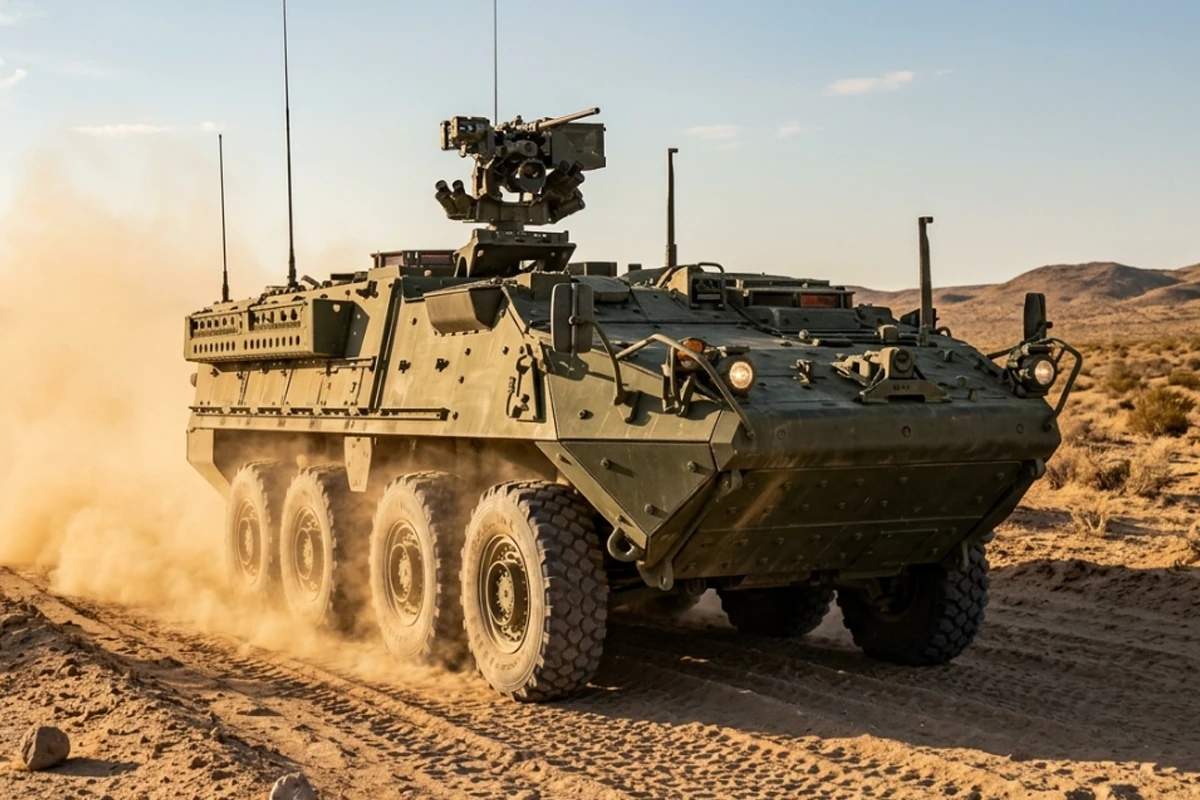
The Stryker Armored Vehicle is getting better just as the U.S. Army is becoming less certain about where it belongs.
That is the paradox.
The Army has spent years improving the Stryker Armored Vehicle fleet with better protection, more power, upgraded electronics and 30mm firepower.
The latest Stryker configurations are far removed from the original vehicle that entered service in the early 2000s. The Army’s FY2026 budget still funds hardware upgrades and fielding support for the Stryker family.
Yet at the same time, the Army is reshaping some of the brigades built around the Stryker concept, raising a bigger question than whether the vehicle itself is good enough.
Does the Army still need the kind of medium-weight force the Stryker was created to provide?
The Stryker Armored Vehicle was designed to occupy an awkward but useful middle ground: more protected and mobile than light infantry, but considerably easier to deploy than heavy tracked formations. Today, however, drones, precision weapons and battlefield surveillance are making that middle ground harder to define.
That doesn’t make the Stryker Armored Vehicle obsolete. Far from it.
The vehicle remains a remarkably adaptable family, with 24 platforms in the FY2026 Army configuration, ranging from infantry carriers and reconnaissance vehicles to medical evacuation, mortar, anti-tank and air-defense variants.
So the real Stryker Armored Vehicle story in 2026 isn’t simply about armor, wheels or weapons.
It’s about whether a vehicle can remain relevant when the military concept built around it is changing.
What Are the Stryker Armored Vehicle’s Specifications?
The Stryker Armored Vehicle is a family of eight-wheeled combat vehicles weighing roughly 19–20 tonnes, built around a central idea: give infantry protected mobility and useful firepower without the weight and logistical demands of a tracked heavy vehicle.
The standard Stryker Infantry Carrier Vehicle (ICV) carries a crew of two and an infantry squad, with different variants designed around the same basic chassis. Its wheeled configuration gives it strong road mobility and makes strategic deployment considerably easier than moving a fleet of heavy tracked vehicles.
But don’t think of the Stryker Armored Vehicle as one machine. The U.S. Army’s current Stryker family includes 24 different platforms, covering missions from infantry transport and reconnaissance to command, mortar, medical evacuation and anti-tank operations.
| Specification | Stryker |
| Configuration | 8×8 wheeled |
| Weight | Approx. 19–20 tonnes |
| Crew | Typically 2 |
| Main role | Armored infantry transport |
| Engine | Caterpillar 3126 diesel |
| Power | 350 hp |
| Road speed | About 97 km/h |
| Main armament | Typically .50-cal M2 or 40mm Mk 19 |
| Strategic transport | C-17 compatible |
One of the Stryker Armored Vehicle’s defining characteristics is its family architecture. A medical vehicle and an infantry carrier may look quite different in equipment, yet they share the same underlying mobility and logistics ecosystem.
The newer Stryker A1 takes that philosophy further with increased electrical power, improved suspension and other upgrades. The Double-V Hull configuration also adds improved protection against underbody blasts.
Then there is the firepower question. Newer Stryker Armored Vehicle variants equipped with a 30mm cannon represent a significant shift from the lightly armed original ICV.
So, the important specification isn’t just the Stryker Armored Vehicle’s speed or weight. It’s the fact that one wheeled chassis has become the foundation for an entire family of battlefield vehicles.
Why Was the Stryker Armored Vehicle Developed?
The Stryker Armored Vehicle was developed to give the U.S. Army a medium-weight force that could deploy faster than heavy formations while offering more protection than light infantry. In simple terms, it was designed to occupy the space between Humvees and Abrams tanks.
That gap became increasingly important after the Cold War.
The Army needed forces that could move quickly between conflicts without the enormous logistical burden associated with heavy tracked formations. A Stryker Armored Vehicle brigade could travel rapidly on roads, deploy by strategic airlift and move infantry with greater protection than unarmored tactical vehicles.
This concept became the Stryker Armored Vehicle Brigade Combat Team (SBCT). Instead of building a brigade around tanks and heavy tracked vehicles, the Army built it around a family of common eight-wheeled platforms. That gave commanders a force that could arrive relatively quickly while still bringing substantial armored mobility.
The original Stryker Armored Vehicle wasn’t designed to fight an Abrams or Bradley head-on. That’s the wrong benchmark.
Its real value was operational flexibility.

The Stryker Armored Vehicle could move infantry, scout ahead, carry mortars, evacuate casualties and provide command-and-control capabilities while sharing a common vehicle architecture. The Army was effectively betting that speed and versatility could compensate for having less armor than a heavy formation.
The idea made particular sense during the wars of the early 2000s, when rapid deployment, urban operations and expeditionary missions dominated military planning.
But warfare has a habit of changing the questions.
The Stryker Armored Vehicle entered service in 2002 and went on to serve extensively in Iraq and Afghanistan. Those conflicts exposed vulnerabilities that led to major improvements in protection, mobility and firepower.
That history explains today’s paradox.
The Army is still modernizing the Stryker Armored Vehicle, but the strategic problem it was created to solve has changed.
The question now isn’t simply whether the Stryker Armored Vehicle can keep up.
It’s whether the Army still needs the middle ground it was built to occupy.
How Has the Stryker Armored Vehicle Been Modernized?
The Stryker Armored Vehicle has been modernized mainly through better protection, mobility, electrical power and firepower, while keeping the basic eight-wheeled design intact.
Combat experience in Iraq and Afghanistan exposed a major weakness in the original Stryker Armored Vehicle: vulnerability to underbody explosions. The Army responded with the Double-V Hull (DVH), which uses a V-shaped lower hull to improve protection against mines and improvised explosive devices.
The Stryker A1 introduced further improvements, including upgraded suspension and greater electrical capacity. That extra power is increasingly important because modern Stryker Armored Vehicle carry more radios, sensors, computers and other electronic systems than the original vehicle.
The biggest visible change, however, is firepower.
Newer Stryker Armored Vehicle are being equipped with a 30mm cannon, giving them substantially greater direct-fire capability than the original Stryker Infantry Carrier Vehicle.
The Army plans to field 269 30mm Strykers across three of its seven Stryker brigade combat teams, according to the Director, Operational Test and Evaluation.

But modernization comes with a catch.
More armor, electronics and equipment add weight and complexity. That can affect the very mobility and deployability that made the Stryker attractive in the first place.
So the Stryker Armored Vehicle’s modernization story isn’t simply about making an old vehicle better. It’s about adding capability without losing the characteristics that justified the vehicle’s existence.
And that balance becomes even more important when considering the Army’s decision to give some Strykers significantly more firepower.
What Does the Stryker Armored Vehicle 30mm Upgrade Change?
The Stryker 30mm upgrade gives the vehicle significantly more direct-fire power, allowing it to engage a wider range of battlefield targets than the original Stryker Infantry Carrier Vehicle.
The original Stryker Armored Vehicle typically carried an M2 .50-caliber machine gun or Mk 19 grenade launcher. Those weapons remain useful against infantry and lightly protected targets, but they are limited when a Stryker needs to provide heavier fire support.
The move to the 30mm Medium Caliber Weapon System (MCWS) changes that equation. Mounted in an unmanned turret, the cannon gives Stryker units a much stronger weapon for engaging enemy positions, light armored vehicles and other targets at greater distances.
The Army plans to field 269 30mm-equipped Strykers across three of its seven Stryker Brigade Combat Teams, according to the Director, Operational Test and Evaluation.

That number is revealing. The Army isn’t converting every Stryker into a 30mm gun vehicle. Instead, it is selectively increasing the firepower of part of the fleet.
The newer M1304 Infantry Carrier Vehicle-30mm builds on this approach, combining the 30mm weapon system with the Double-V Hull A1 configuration. The FY2026 budget identifies the M1304 as replacing the earlier M1296 Dragoon in the Stryker family.
This creates a more capable vehicle—but it also subtly changes what commanders can expect from it.
A Stryker with a 30mm cannon isn’t suddenly a tank or a Bradley replacement. Its wheels, armor and overall design remain fundamentally different.
What it does gain is a more credible medium-caliber punch, allowing the Stryker Armored Vehicle formation to bring more firepower without abandoning the mobility that defines the platform.
And that may be exactly what the Army wants: not a new fighting vehicle, but a Stryker that can do more when the shooting starts.
What Has the Ukraine War Revealed About the Stryker Armored Vehicle?
The Ukraine war has highlighted both the strengths and vulnerabilities of the Stryker Armoured Vehicle, particularly the growing difficulty of keeping armored vehicles concealed and protected on a battlefield crowded with drones.
Stryker Armored Vehicle have been used by Ukrainian forces after receiving vehicles from the United States, giving the platform a combat environment very different from the counterinsurgency campaigns that shaped many of its earlier upgrades.
The biggest change is visibility.
Small drones can constantly search for vehicles, while FPV drones and artillery can exploit targets once they are detected. That creates a difficult problem for any armored vehicle. Even adding more armor doesn’t solve the basic issue if the vehicle can be located before it reaches its objective.
Yet this doesn’t mean the Stryker Armored Vehicle has suddenly become obsolete.

Its eight-wheel configuration still offers useful road mobility, while its relatively lighter weight compared with tracked heavy armor can make movement and deployment easier. The vehicle also benefits from a large family of variants and an established logistical ecosystem.
What Ukraine changes is the balance of advantages.
The Stryker Armored Vehicle was conceived partly around the idea that mobility could give a medium-weight force operational flexibility. On today’s transparent battlefield, mobility still matters, but so do concealment, dispersion, electronic warfare and protection against threats arriving from above.
That is a much harder equation.
The lesson isn’t that wheeled armored vehicles cannot survive modern war. Ukraine has shown that no armored vehicle can rely on armor alone.
For the Stryker Armored Vehicle, the bigger question is whether its mobility remains valuable enough to justify the protection gap between it and heavier platforms.
And while the Army continues upgrading individual Strykers, it is simultaneously making a much bigger change: reconsidering the brigades and force structure built around the vehicle in the first place.
Why Is the U.S. Army Changing Its Stryker Armored Vehicle Brigades?
The U.S. Army is changing some Stryker brigades because its force structure is being reshaped around new ideas about mobility, survivability and future warfare, not because the Stryker itself has suddenly become useless.
The clearest example is the 56th Stryker Brigade Combat Team, which became the 56th Mobile Brigade Combat Team in March 2026. Its Stryker Armored Vehicle are being replaced with lighter vehicles and other capabilities as the Army experiments with a more mobile formation.
That decision creates the central Stryker Armored Vehicle paradox.
The Army is spending money to make individual Strykers better while simultaneously deciding that some units don’t need Strykers at all.
The reason goes beyond the vehicle’s specifications. Modern warfare has made signature, dispersion and strategic mobility increasingly important. A large wheeled armored vehicle provides useful protection and transport capacity, but it is also a substantial object that needs fuel, maintenance and logistical support.

A lighter formation can potentially move with a smaller footprint and be easier to deploy, particularly for missions where heavy armored protection isn’t the priority.
The Washington National Guard’s 81st Stryker Brigade has also been undergoing transformation, with Stryker Armored Vehicles being replaced by lighter vehicles. Some of its surplus Strykers were subsequently transferred to Bulgaria, showing that retirement from one U.S. formation doesn’t necessarily mean the vehicle itself is disappearing.
This is an important distinction.
The Army isn’t making a simple choice between “Stryker good” and “Stryker bad.” It’s asking whether every mission still requires the medium-weight package the Stryker represents.
And that may ultimately determine the vehicle’s future more than any armor upgrade or new weapon.
Where Does the Stryker Armored Vehicle Fit Between Light and Heavy Forces?
The Stryker Armored Vehicle occupies the middle ground between light infantry and heavy armored forces, offering more protected mobility than a light formation while avoiding the weight and logistical demands of tanks and tracked IFVs.
That middle ground was the whole reason the Stryker Armored Vehicle concept existed.
Light forces can deploy quickly and operate with a relatively small logistical footprint, but they have limited protection and organic firepower. Heavy formations offer the opposite trade: Abrams tanks and Bradley-class vehicles bring substantial protection and combat power, but moving them across long distances requires considerable transport capacity, fuel and maintenance support.
The Stryker Armored Vehicle sits between those extremes.

Its wheels give it strong road mobility, while its armored hull allows infantry to move with greater protection than they would have in unarmored vehicles. Add specialized variants and the formation gains reconnaissance, medical, mortar and command capabilities without relying entirely on separate vehicle families.
But the middle ground is also where the Stryker Armored Vehicle faces its biggest question.
Modern warfare increasingly rewards both extreme mobility and extreme protection, depending on the mission. A lightweight formation can be easier to move and disperse, while a heavy formation can absorb threats that a Stryker Armored Vehicle. simply cannot.
The Stryker Armored Vehicle has to justify everything in between.
That doesn’t make the concept irrelevant. In fact, a medium force can still be valuable when commanders need protected mobility without committing the resources required for a heavy armored brigade.
The problem is that the answer isn’t universal anymore.
A Stryker brigade preparing for a European ground war may have very different requirements from one preparing for rapid deployment elsewhere. That is why the Army’s current transformation is so significant: it is testing whether the medium-weight model itself still deserves a permanent place in the force.
The Stryker Armored Vehicle may survive, not because the middle ground is easy, but because sometimes it’s exactly where an army needs to be.
