

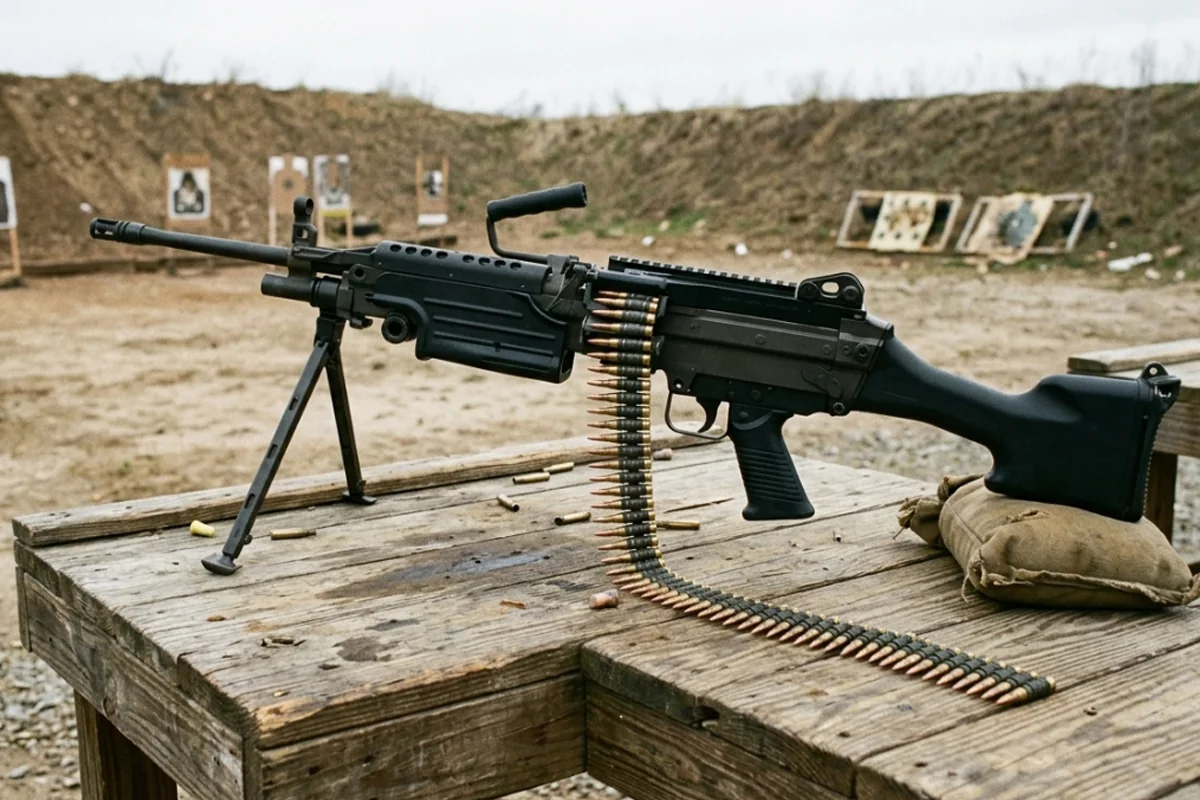
A machine gun introduced during the 1980s should, by all logic, be yesterday’s technology. Yet the M249 SAW machine gun has spent more than four decades doing something surprisingly difficult: remaining useful while generations of newer infantry weapons have come and gone.
That longevity is more interesting than simply calling the M249 “old but reliable.” The weapon was built around a straightforward battlefield problem: how can a small infantry squad carry enough firepower to pin down an enemy without dragging along a much heavier machine gun?
The answer was the M249 Squad Automatic Weapon, derived from Belgium’s FN Minimi. Chambered for the ubiquitous 5.56×45mm NATO cartridge, it gave an infantry squad something an ordinary rifle could not easily provide; a sustained stream of automatic fire from a relatively compact weapon.
The numbers tell part of the story. The U.S. Army lists the standard M249 SAW machine gun at about 18 pounds (8.2 kg), with a listed cyclic rate of roughly 750–850 rounds per minute. It can feed from linked ammunition or standard rifle magazines, giving the gunner some flexibility when circumstances get messy.
But specifications don’t explain why soldiers kept carrying it through Panama, the Gulf War, Somalia, Afghanistan and Iraq.
The real story is about firepower versus mobility, and that trade-off hasn’t disappeared.
Even now, as the U.S. Army moves toward newer squad weapons, the M249 SAW machine gun remains an important reference point for understanding modern infantry firepower. So, what made this 1980s design last so long and why hasn’t the battlefield completely left it behind?
How Did the M249 SAW Machine Gun Become the U.S. Army’s Squad Automatic Weapon?
The M249 SAW machine gun became the U.S. Army’s standard squad automatic weapon after the military selected a version of FN’s Minimi in the early 1980s, giving infantry squads a compact, belt-fed weapon that could deliver sustained automatic fire without the weight of a conventional general-purpose machine gun.
The story began with a problem that sounds simple on paper but is surprisingly difficult to solve: an infantry squad needed more firepower than its rifles could provide, but not so much weapon that the gunner became a burden to the squad.
During the Cold War, NATO armies were increasingly interested in lightweight machine guns capable of using the same 5.56mm ammunition carried by ordinary infantry rifles. Belgium’s Fabrique Nationale developed the Minimi around this concept. Rather than simply making a heavier rifle, FN created a purpose-built light machine gun with belt feeding, a quick-change barrel and an open-bolt firing system.

The U.S. eventually selected the design and adapted it for American requirements. The resulting weapon was designated the M249 Squad Automatic Weapon.
According to U.S. Army historical documentation, the M249 SAW machine gun fielding began in fiscal year 1984. That timing is significant. The weapon arrived when the American infantry was still heavily focused on the possibility of a large-scale conventional war in Europe, where suppressive fire and ammunition capacity could matter enormously.
The M249 SAW machine gun also represented a shift in thinking. Instead of treating the automatic rifle as simply a rifle capable of firing continuously, the Army was giving the squad a dedicated light machine gun.
That distinction shaped the weapon’s career.
The M249 SAW machine gun was never designed to replace every rifle in an infantry squad. Its job was more specific: be the squad’s portable source of sustained firepower. Four decades later, that basic idea still explains much of its staying power.
Read also: M60 Machine Gun: Why It Was Iconic And Controversial
What Are the M249 SAW Machine Gun’s Specifications?
The M249 SAW machine gun is an 18-pound, 5.56×45mm NATO light machine gun designed to provide squad-level automatic fire. Its combination of belt feeding, a relatively high rate of fire and a quick-change barrel gives it considerably more sustained firepower than a standard infantry rifle.
Here are the key specifications of the standard M249 SAW machine gun:
| Specification | M249 SAW |
| Type | Squad Automatic Weapon / light machine gun |
| Caliber | 5.56×45mm NATO |
| Weight | 18 lb (8.2 kg) |
| Overall length | 40.75 in (1,035 mm) |
| Barrel length | 20.5 in (521 mm) |
| Cyclic rate | 750–850 rounds/min |
| Point-target range | 600 m |
| Area-target range | 800 m |
| Suppressive-fire range | Up to 1,000 m |
| Feeding | Linked ammunition or magazines |
| Barrel | Quick-change |
The numbers reveal an interesting compromise. At 18 pounds, the M249 SAW machine gun is far heavier than an assault rifle, but it remains substantially more portable than a heavier general-purpose machine gun. That extra mass buys the gunner a weapon built around sustained automatic fire rather than short bursts from a rifle.
Its 5.56mm chambering was another deliberate choice. The M249 SAW machine gun could use the same basic ammunition family carried by other U.S. infantry weapons, simplifying ammunition compatibility at squad level. Belt-fed ammunition could be carried in 100- or 200-round configurations, while magazines provided another feeding option when necessary.

The Army lists a 750–850 rounds-per-minute cyclic rate, although that figure shouldn’t be mistaken for how much ammunition a gunner actually fires in combat. Sustained firing depends on barrel changes, ammunition supply, target engagement and fire discipline.
And that distinction matters. A machine gun isn’t valuable because it can empty ammunition quickly. It’s valuable because it can put controlled, sustained fire exactly where the squad needs it.
Where Has the M249 SAW Machine Gun Been Used in Combat?
The M249 SAW machine gun has accompanied U.S. troops through conflicts ranging from the late Cold War to the wars in Afghanistan and Iraq, giving the weapon an unusually long combat résumé for a squad-level infantry system. Its battlefield career also shows why a lightweight machine gun can remain useful even when the technology around it changes.
The M249 SAW machine gun entered service during the final decade of the Cold War, but its combat story quickly moved beyond the European battlefield it was originally designed with in mind.
Read also: M240 Machine Gun: Key Features That Make It So Powerful
Panama and the Gulf War
The weapon saw early operational use during Operation Just Cause in Panama in 1989. Only a few years later, M249s were carried by American forces during Operation Desert Storm in 1991.
The Gulf War offered a very different environment from the dense urban and mountainous fighting that would come later. Yet the basic job remained familiar: provide infantry units with a portable source of sustained automatic fire when individual rifles were not enough.
Somalia and the Balkans
The M249 also became associated with American deployments during the 1990s, including Somalia and the Balkans. These missions exposed troops to a mixture of urban terrain, peacekeeping operations and conventional combat conditions.
That variety mattered. A weapon designed around squad-level fire support had to function whether soldiers were moving through open terrain, defending positions or fighting in confined spaces.

Afghanistan and Iraq
Its longest and most visible combat chapter came after 2001.
American troops carried the M249 SAW machine gun throughout Afghanistan and Iraq, where the weapon became a familiar part of infantry patrols and defensive positions. In Afghanistan’s mountains and valleys, its ability to sustain fire could help cover movement across exposed ground. In Iraq, it was employed across a much wider mix of urban, rural and security missions.
But two decades of war also exposed the weapon’s drawbacks, especially its weight and ammunition burden.
That combat experience would eventually influence the debate over what an infantry squad actually needs from its automatic weapon.
Why Did Soldiers Value the M249 SAW Machine Gun?
The M249 SAW machine gun earned its reputation because it gave a small infantry squad something difficult to get from a standard rifle: sustained, portable firepower. When a squad needed to keep an enemy’s head down while other soldiers moved, the M249 SAW machine gun was often the weapon doing the talking.
Think of it less as a “bigger rifle” and more as the squad’s portable base of fire.
Its biggest advantage was the belt-fed ammunition system. A standard infantry rifle is generally limited by the capacity of its magazine. The M249 SAW machine gun could instead carry linked ammunition in larger quantities, allowing the gunner to maintain automatic fire for longer periods before reloading.
That mattered during defensive engagements, ambushes and movements across exposed terrain. The gunner didn’t necessarily need to destroy an enemy target. Sometimes the more important job was to make sure the enemy couldn’t effectively return fire.

The weapon’s quick-change barrel was another important feature. Sustained automatic fire generates enormous heat, and a replaceable barrel allows the weapon to continue operating without relying on a single barrel indefinitely.
The M249 SAW machine gun also used the same basic 5.56×45mm NATO ammunition family as U.S. service rifles. That didn’t eliminate the logistical burden of carrying large quantities of ammunition, but it meant squads weren’t dependent on an entirely separate rifle-caliber supply chain.
There was also a less glamorous advantage: familiarity.
By the time the wars in Afghanistan and Iraq were well underway, generations of American soldiers had trained with the M249 SAW machine gun. Gunners, team leaders and armorers understood its strengths, weaknesses and maintenance requirements. That institutional knowledge has real value in combat.
Still, the M249 SAW machine gun demanded a price for all that firepower. At around 18 pounds before ammunition, it was a serious load to carry.
And once the belts, spare barrel and other equipment were added, the gunner’s combat load could become very heavy indeed.
What Were the M249 SAW Machine Gun’s Main Problems?
The M249 SAW machine gun’s biggest weaknesses were its weight, ammunition burden, maintenance demands and the difficulty of carrying a belt-fed weapon during long infantry operations. Its firepower was useful, but soldiers had to physically carry the price of that firepower.
At roughly 18 pounds (8.2 kg) unloaded, the M249 SAW machine gun is considerably heavier than the M4-family rifles used alongside it. Add a 200-round ammunition box, spare barrel and other equipment, and the gunner’s load grows quickly.
That became particularly noticeable during long patrols in Afghanistan. A machine gunner wasn’t carrying just the weapon. He was carrying the ammunition needed to make it useful.
And ammunition is where the M249 SAW machine gun’s appetite becomes obvious. A 200-round box of linked 5.56mm ammunition weighs several kilograms by itself. Carry multiple boxes and the weight starts adding up fast, especially when the soldier is already carrying body armor, water, communications equipment and other mission gear.

Heat was another unavoidable issue. Automatic fire produces substantial barrel heat, which is why the M249 SAW machine gun uses a quick-change barrel. The feature helps sustain operations, but it also means the gunner and squad have to manage barrel changes and carry additional equipment.
Maintenance could become another headache. The M249 operates in environments filled with dust, dirt, mud and debris, all of which can challenge any automatic weapon. Keeping the weapon clean and properly lubricated was therefore an important part of keeping it reliable.
There was also a more fundamental issue: the M249 SAW machine gun asks the soldier to sacrifice mobility for firepower.
That trade-off can make sense when a squad needs sustained suppression. But modern infantry operations increasingly place a premium on speed, maneuverability and reducing individual load.
So the M249 SAW machine gun’s biggest problem wasn’t that it lacked firepower.
It was that firepower has weight. And soldiers have to carry every ounce of it.
How Is the M249 SAW Machine Gun Connected to the FN Minimi Family?
The M249 SAW machine gun is the U.S. military version of the Belgian FN Minimi light machine gun, a design that became one of the most widely recognized 5.56mm belt-fed weapons in the world. Understanding that connection explains why the M249 has remained relevant even as individual U.S. variants have changed.
Belgian manufacturer FN Herstal developed the Minimi around the idea of giving infantry a lightweight machine gun capable of using 5.56mm ammunition. The concept was relatively radical at the time: instead of making soldiers choose between a rifle and a heavy machine gun, the Minimi aimed to occupy the space between them.
The design eventually attracted international attention, and the United States adopted its own version as the M249 Squad Automatic Weapon.
The American weapon retained the fundamental Minimi concept: Belt-fed ammunition, a quick-change barrel and a compact machine-gun layout, but incorporated modifications for U.S. military requirements and manufacturing.

That distinction is worth remembering because “M249” and “Minimi” aren’t simply two names for exactly the same weapon. The M249 SAW machine gun represents the U.S. implementation of the broader Minimi family.
Over the years, FN continued developing the platform. Later Minimi variants introduced changes aimed at reducing weight, improving ergonomics and adapting the weapon to modern infantry requirements.
And that’s perhaps the most interesting part of the Minimi story.
The underlying concept has survived even when armies have changed their rifles, optics, body armor and communications equipment. A lightweight belt-fed weapon still offers something difficult to reproduce with a conventional magazine-fed rifle: sustained squad-level automatic fire.
The M249 SAW machine gun is therefore better understood as one branch of a much larger family rather than an isolated 1980s weapon.
Its longevity isn’t purely an American phenomenon. The broader FN Minimi family has remained in service with armed forces around the world, showing that the basic light-machine-gun concept still has a place on modern battlefields.
Is the M249 SAW Machine Gun Still Used in 2025–2026, and Why Has It Survived?
Yes, the M249 SAW machine gun remains in military inventories in 2025–2026, although its role in the U.S. Army is gradually changing as newer infantry weapons enter service. The Army is transitioning toward the XM250, but replacing a weapon with four decades of logistics, training and combat experience is not something that happens overnight.
The M249 SAW machine gun’s longevity starts with a simple advantage: it works within an infantry squad’s existing system.
For decades, American forces have built training programs, maintenance procedures, spare-parts stocks and ammunition logistics around the weapon. Soldiers and armorers already understand how to operate and maintain it. That institutional familiarity has real value, particularly when units need equipment that can be supported immediately rather than waiting for an entirely new ecosystem to mature.

The weapon also continues to fill a specific tactical niche. An infantry squad may need more sustained automatic fire than a conventional rifle can provide, but carrying a heavier general-purpose machine gun isn’t always practical. At around 18 pounds unloaded, the M249 SAW machine gun is certainly not light, yet its belt-fed design gives the squad considerably more sustained firepower than a standard magazine-fed rifle.
The U.S. Army’s adoption of the XM250 shows that this balance is changing. The newer weapon uses 6.8mm ammunition and is intended to provide greater range and lethality, making it the future automatic weapon for Army close-combat formations.
Still, the arrival of a successor doesn’t instantly make the M249 SAW machine gun irrelevant.
Existing weapons remain usable, international forces continue operating members of the FN Minimi family, and the underlying requirement for portable squad-level automatic fire has not disappeared.
That’s why the M249 SAW machine gun ‘s story is less about an old machine gun refusing to die and more about how difficult it is to replace a weapon that has become deeply embedded in a military’s way of fighting.
