

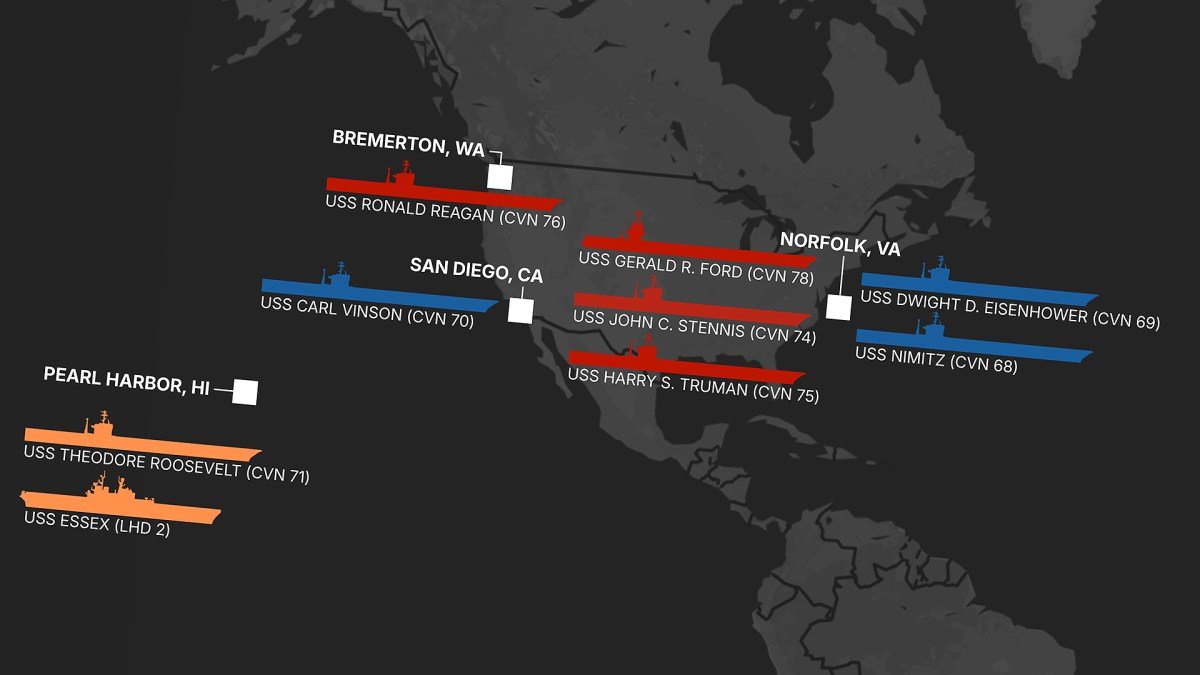
Here’s TWZ’s weekly carrier tracker monitoring America’s flattop fleet, including deployed Carrier Strike Groups (CSG) and Amphibious Ready Groups (ARG), using publicly available open-source information. Check out last week’s report here.
U.S. Central Command (CENTCOM) announced the end of a weekend wave of air strikes yesterday, the ninth consecutive night of precision strikes “further degrading Iranian military capabilities,” and the beginning of a new, tenth round today. As the blockade approaches the one-week mark, CENTCOM forces have redirected seven commercial vessels and disabled one kinetically, firing AGM-114 Hellfire missiles into the smokestack of an unladen oil tanker heading toward Kharg Island, since reinstating the blockade on July 14.
Over 20 U.S. Navy warships are operating in the Arabian Sea and broader Indian Ocean, which we covered extensively last week, and naval force posture has not changed since. Two CSGs, led by USS Abraham Lincoln and USS George H.W. Bush, plus an ARG, centered on USS Boxer, are the primary naval assets supporting Blockade 2.0 and the renewed strike campaign, alongside some 14 guided-missile destroyers and a mix of other surface ships. The video below released by CENTCOM shows F/A-18 Super Hornets armed with AIM-9X, GBU-31, and GBU-54 launching during the campaign.
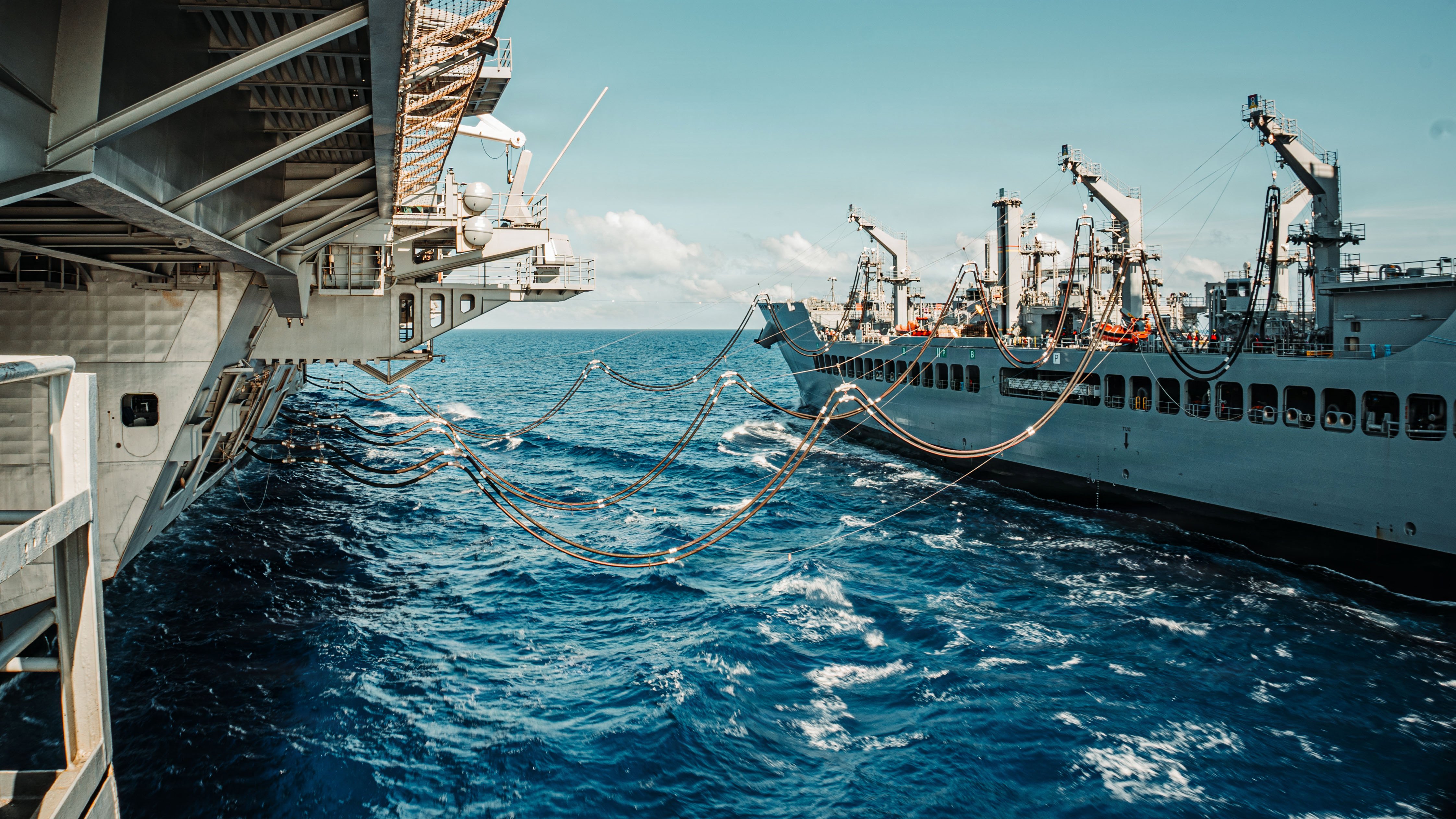
Moving east, USS George Washington is operating in the Western Pacific. The flattop was spotted conducting a fueling-at-sea with USNS Earl Warren and a replenishment-at-sea with USNS Charles Drew last week in the Philippine Sea. Lt. Arren Halfacre, serving aboard Washington, said the complex operation with Warren, which involved three fuel lines simultaneously, was a “rarely done evolution” that included roughly 150 Sailors and Merchant Mariners.
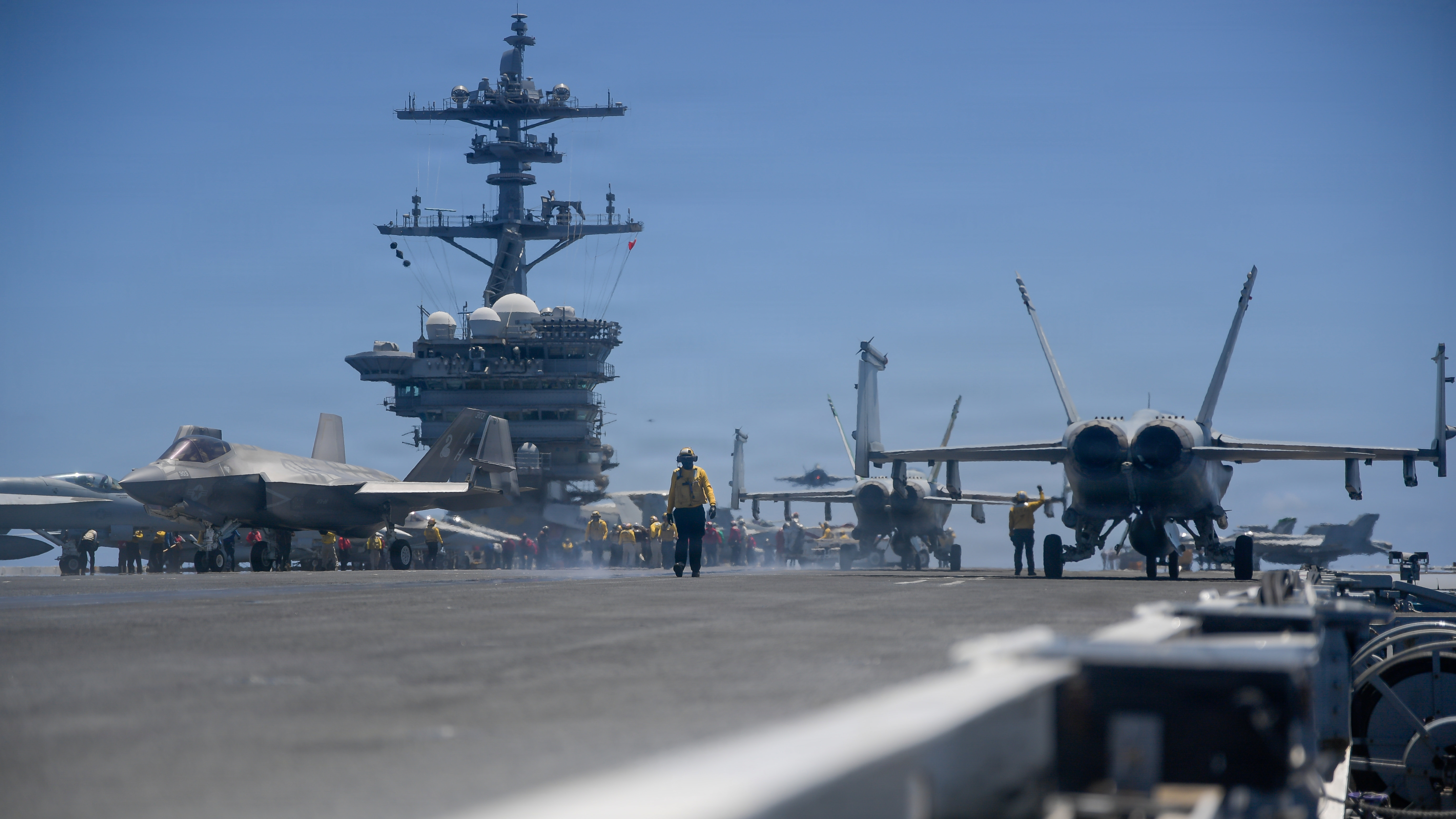
Also in the Pacific, USS Theodore Roosevelt is well into the sea phase of exercise Rim of the Pacific (RIMPAC) 2026 and underway in the Hawaiian Islands Operating Area. RIMPAC 2026 is the world’s largest international maritime exercise and the 30th iteration in a series that started in the early 1970s. Participating units have been operating over the past week south of Oahu, to the west of the Big Island, with AIS transponders broadcasting publicly. Roosevelt welcomed the acting Secretary of the Navy, Hung Cao, who observed flight operations, met with senior brass, and took photos with the crew on July 18.
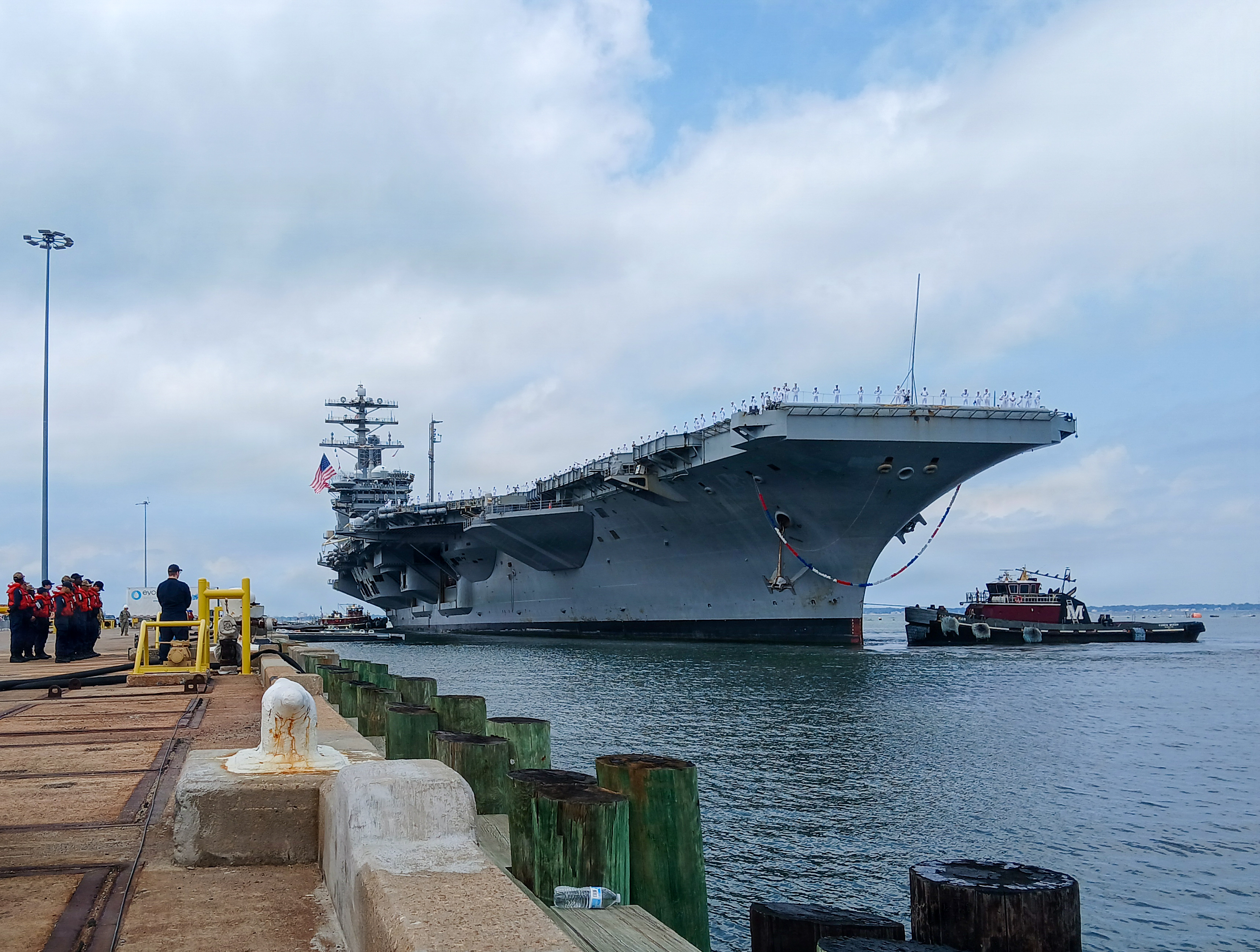
Back in the continental United States, USS Nimitz is at Naval Station Norfolk, her final homeport before a deactivation that was delayed until next year, moored at Pier 14N. A couple of piers down, USS Dwight D. Eisenhower is berthed at Pier 11S. And, further south along the Elizabeth River, USS Gerald R. Ford moved to Pier 5N at Norfolk Naval Shipyard in advance of her first Planned Incremental Availability. On the west coast, USS Carl Vinson, the only carrier currently in San Diego, moored at Kilo Pier on July 17 after a weeklong underway completing flight deck certifications and carrier qualifications with Carrier Air Wing (CVW) 2.
Overall, three U.S. carriers are deployed, three are training or in port in various states of readiness, four are in maintenance, and one is being used primarily for training. Two amphibious ready groups are deployed, four are training or in port, and three are in maintenance.
Note: Positions are general approximations. Non-deployed LHA/LHD amphibious warships are not shown.
Contact the author: ian.ellis-jones@teamrecurrent.io
