Every now and then, I take a critical look at my blog. This time, I let Claude analyze it and it gave me many insights on how this place has grown and evolved. But also how it might confuse first-time readers. I need to address that and that starts with this post.
Let’s dig in.
What’s this blog actually about?
I started a martial arts and self-defense website in 1999 when the internet became mainstream. I wanted to try it out. I wrote articles, did book and video reviews, etc. Due to technical problems I eventually stopped. Fast forward to 2009 when blogging and WordPress became popular. I picked up where I left off and started this blog, imported some of my old articles, and never stopped. However, a lot has changed since those early days.
One insight is the different phases my blog went through:
The nature of a blog is that you don’t know where visitors first come in. This can be eminently confusing:
If you first read How to visit another martial arts school from 2009 and you found that useful, you might check out more recent posts, like How to live a long and healthy life: four fundamental tips. Talk about a big jump in topic…
Not having followed my work over the years (which is entirely reasonable) means you missed how I got from writing the one to the other. So this post aims to clarify the purpose of my blog.
Here goes.
Discuss violence, in all its forms and all its causes
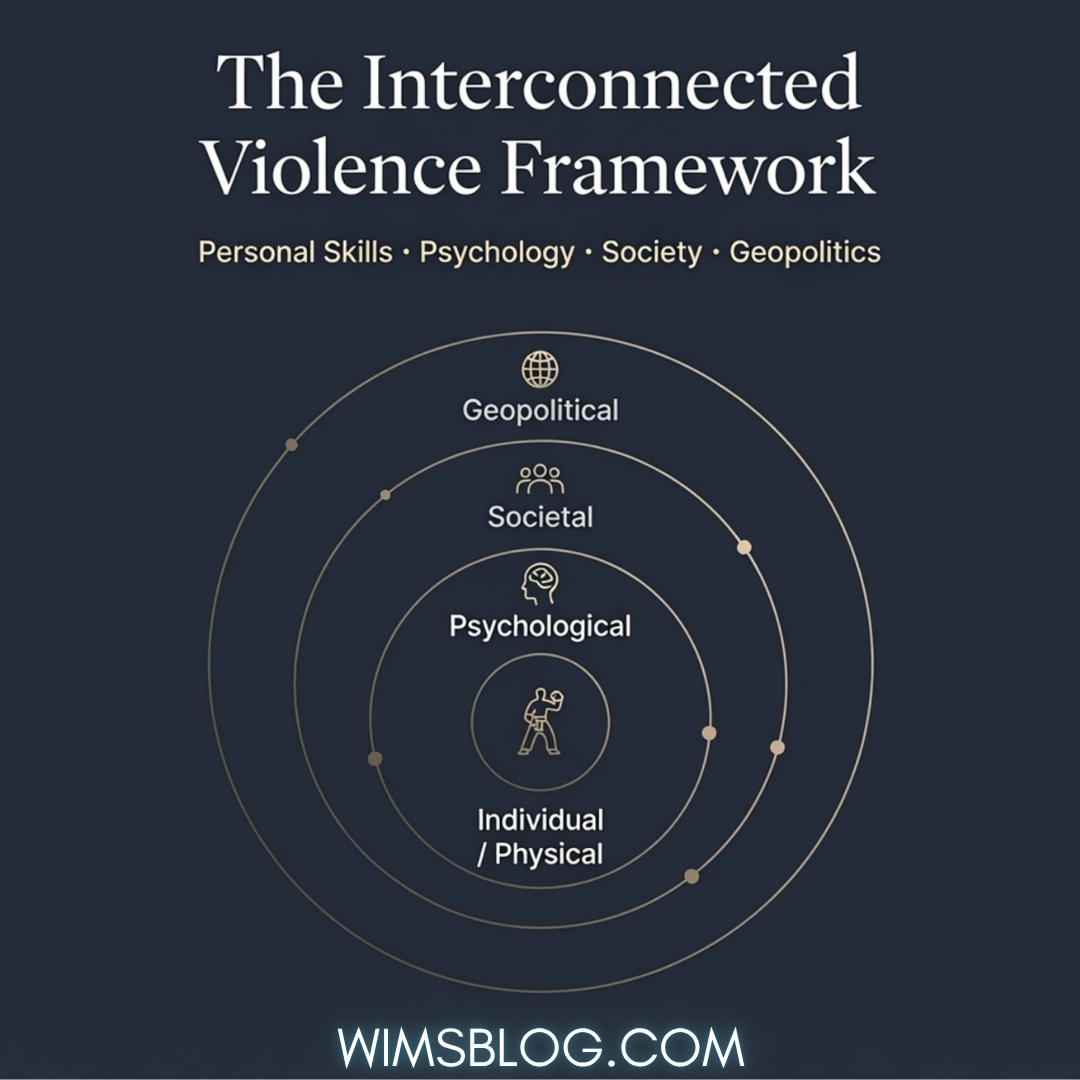
Over the decades, my writing expanded in scope to see violence as more than just punching and kicking. For me, it now all ties together; every part links to the others. I’ll explain more below, but first an overview:
- The early blog posts were mostly technical, focused on martial arts and self-defense techniques and training methods:
- Later, I moved out of the purely physical realm and wrote more about theory, physiology, psychology, etc. About the why things are a certain way regarding violence, as opposed to how to do them:
- This in turn led to another expansion, to how violence works on a societal level:
- Eventually, we got to geopolitics and how they influence societies
Each of these phases covers different layers of violence. Each layer influences all others: starting from you as an individual and then gradually expanding outward towards the entire world. For instance:
- Conflicts on a geopolitical scale can create tension and polarization within societies, leading to violence.
- Not understanding the psychological aspects of violence can lead to your physical techniques failing under stress.
- If you use physical techniques that are acceptable in a tribal society, but you live in a post-industrial one, society/government will condemn and punish you for it.
- Etc.
Let’s call this the Interconnected Violence Framework.

On this blog, you find information covering all aspects of this framework. For effective self-defense, you need an understanding of all its levels..
I still write about techniques like I did twenty years ago. For instance, How to train with edged weapons primarily covers the technical aspects of training with knives. Or Podcast episode 143 – Ares: How to not go too far? which is also more of a “how to” than anything else. I’ve also spent the last nine years releasing instructional videos on Patreon (more on Patreon below.) So I didn’t abandon this topic; I just began covering a lot of other aspects of violence as well.
To get things out of my head.
Writing is an exercise in thinking. It forces you to formulate your thoughts and ideas, create structure, test them, see how far you can take them before they break, etc. I write about what’s on my mind and share that with you, the reader. But it is also a way of learning, as my teacher explained long ago: at one point, you have to teach to still make personal progress. Writing is my way of “teaching” in that I hope it adds value to your training. For that, I have to think, investigate, research, test, etc., before I get to a finished post. Writing moves me through that process and hopefully helps grow my own understanding.
This is particularly true when I get questions, mostly in the short- and long-form monthly Q&A video on my Patreon. My Patrons ask questions I wouldn’t think of, or make me revisit what I (think) I already know. Invariably, that leads to personal growth. I can then also let go of that question after spending a fair amount of time in my head thinking about it.
My interests run wide and deep.
Musashi has even more comparisons in his Book of Five Rings, well worth reading (affiliate link), but here’s the key one.
The Way of the warrior does not include other Ways, such as Confucianism, Buddhism, certain traditions, artistic accomplishments and dancing. But even though these are not part of the Way, if you know the Way broadly you will see it in everything. Men must polish their particular Way.
I’ve always had a wide and eclectic range of interests, ever since I was a child reading dictionaries and encyclopedias. This means I tend to see similarities and connections you might find strange at first: I have guests on the podcast, like a visual effects specialist or a fiction author. Or you can read a post about What I learned from Carl Sagan. I usually tie it all in with the martial arts or self-defense world. These connections and similarities are fascinating to me and I share them here.
Why so much content on Patreon?
In the top picture, you see phase 4 and the shift to Patreon. Here’s why:
In 2017, I started my Patreon on a whim and, to my surprise, it was a resounding success from the get-go. Their support allows me to keep the blog and podcast completely free by financing the hosting of this site and podcast. In return, they get multiple exclusive videos every month, standalone videos and courses, bonus podcast episodes. There are now almost 1400 posts, hundreds of videos and dozens of bonus episodes and the library grows every month.
This is the only way I’ve found to consistently create high-quality content on violence that doesn’t get censored by social media. So I put a lot of time and effort into giving exclusive, in-depth content to my Patrons. I’m extremely grateful for their support throughout the years. Without them, I couldn’t do all this, nor deliver the quality of work I want to.
Conclusion
This blog has changed over time. So have I. So has the world around me. The cliché of change being the only constant is true. Hopefully the above gives you a clearer picture of what I do here and why.
A final insight I got is how my blog posts are much less frequent. That hurts the blog and creates a viscious circle as it is usually the first introduction people have to my Patreon. So I aim to rectify that as well, along with a bunch more things I won’t go into right now.
Stay tuned.