

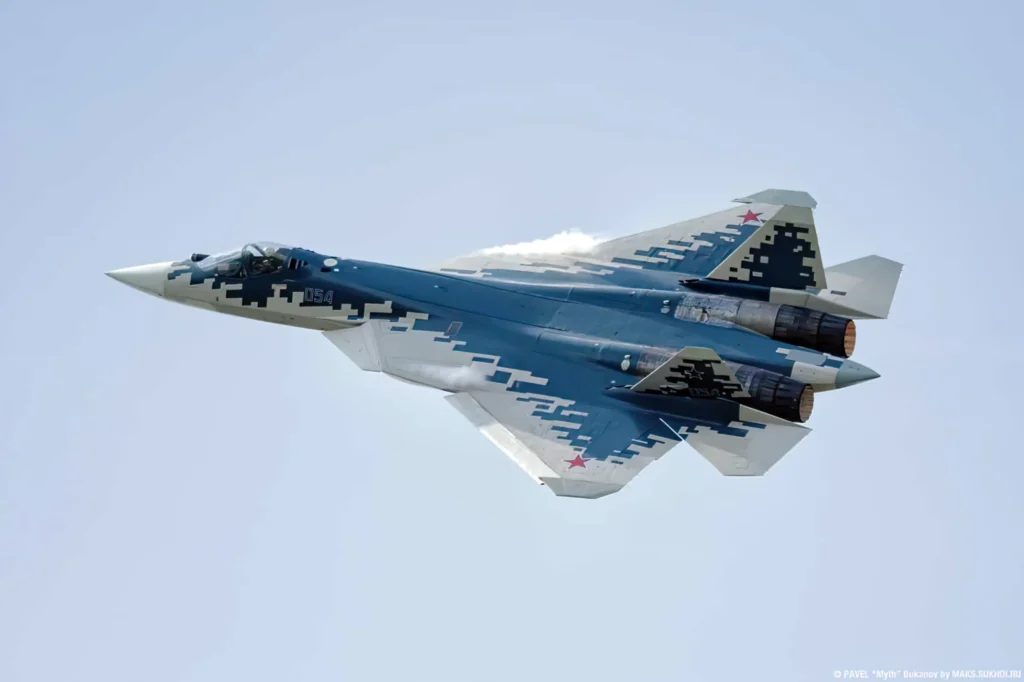
The Sukhoi Su-57 looks like a stealth fighter, but that description misses the most interesting part.
Russia did not build the Sukhoi Su-57 Felon around stealth alone. Its designers wanted an aircraft that could hide from radar, turn hard at high angles of attack, carry long-range weapons, and attack targets far beyond visual range. Those goals pull in different directions. The Su-57 is the result of trying to make them coexist in one airframe.
That makes the aircraft unusual.
Take its shape. The Sukhoi Su-57 uses internal weapon bays, carefully aligned edges, radar-absorbing materials, and other measures to reduce its radar signature.
Yet its design also leaves room for large control surfaces and thrust-vectoring engines. The result is a fighter that puts more weight on aerodynamic agility than the F-35 does.
Then there is the sensor setup. The Su-57’s N036 Byelka radar is not just a single nose-mounted AESA array. Its design includes side-looking arrays and lower-frequency L-band elements, giving the aircraft several ways to search for and track targets. That matters because finding a low-observable aircraft is not the same problem as guiding a missile onto it.
The common shortcut is to call the Su-57 a Russian answer to the F-22. I don’t think that comparison goes far enough.
Read also: Su-57 vs F-22 Battle Analysis: Which Fighter Has the Edge?
The better question is why Russia chose this particular mix of stealth, speed, sensors, weapons, and maneuverability. Once you look at those choices together, the Su-57 starts to make much more sense.
And some of its most interesting features are easy to miss in photographs.
What Is the Sukhoi Su-57 Felon?
The Su-57 makes more sense when you stop treating it as a replacement for one older fighter.
Russia designed it as a new kind of multirole aircraft, built to handle air combat and precision attack while surviving in an environment filled with modern radar and surface-to-air missiles. That sounds familiar until you look at where the project came from.
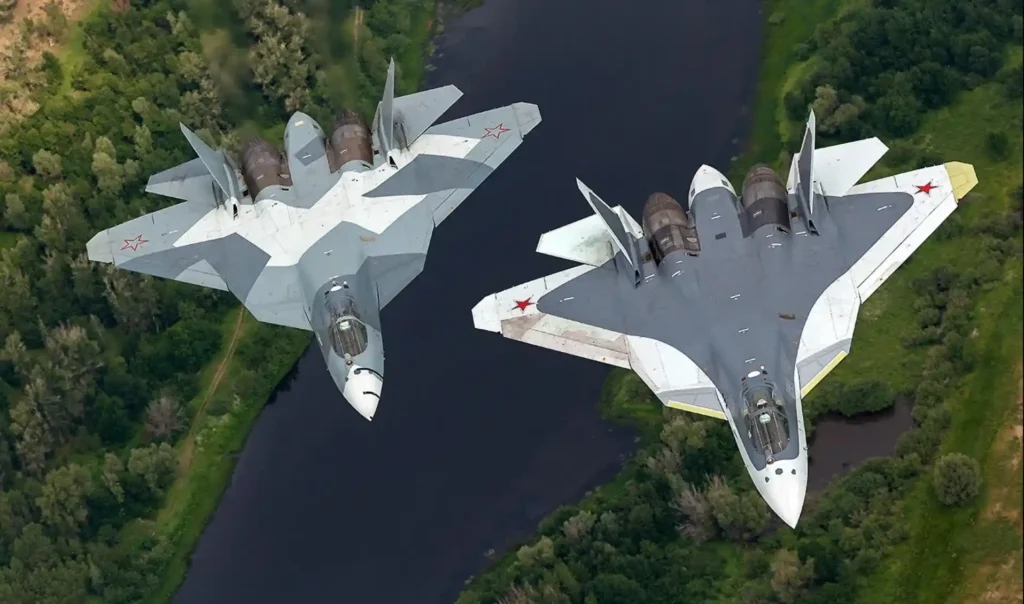
The aircraft began as the PAK FA program, with the first T-50 prototype taking flight in January 2010. Sukhoi was starting from scratch rather than simply adding new avionics to a Flanker airframe. That distinction matters.
The Su-27 family was built around range, speed, and maneuverability. The Sukhoi Su-57 had to keep much of that character while adding low observability.
It was a tough design problem.
The first production aircraft entered Russian service in 2020, a long way from the original PAK FA plans. Development stretched for years, with engine work, testing, funding, and changes to the aircraft all slowing the program. The fighter eventually received the Su-57 name, while NATO assigned it the reporting name “Felon.”
Its basic job is broad. The aircraft can carry air-to-air missiles for fighter combat and internal or external air-to-surface weapons for strike missions. It also has a 30 mm GSh-30-1 cannon, giving it a close-range option that rarely gets much attention in stealth-fighter discussions.
That multirole focus explains part of the aircraft’s size and layout.
A common mistake is to judge the Su-57 by asking whether it is as stealthy as an F-35. That’s too narrow. Russia wanted a fighter that could combine reduced radar visibility with the speed, range, weapon load, and handling expected from a large Sukhoi.
The tradeoff is written into the airframe itself. And you can see it before the radar or weapons are even switched on.
How Does the Su-57 Use Stealth Technology?
The Sukhoi Su-57 is stealthy by design, but it was never built around the idea of becoming invisible.
That distinction matters. Stealth does not switch radar detection off. It reduces the range and quality of the return an enemy radar can get, giving the fighter more room to detect, decide, and act before the other side can build a useful track.
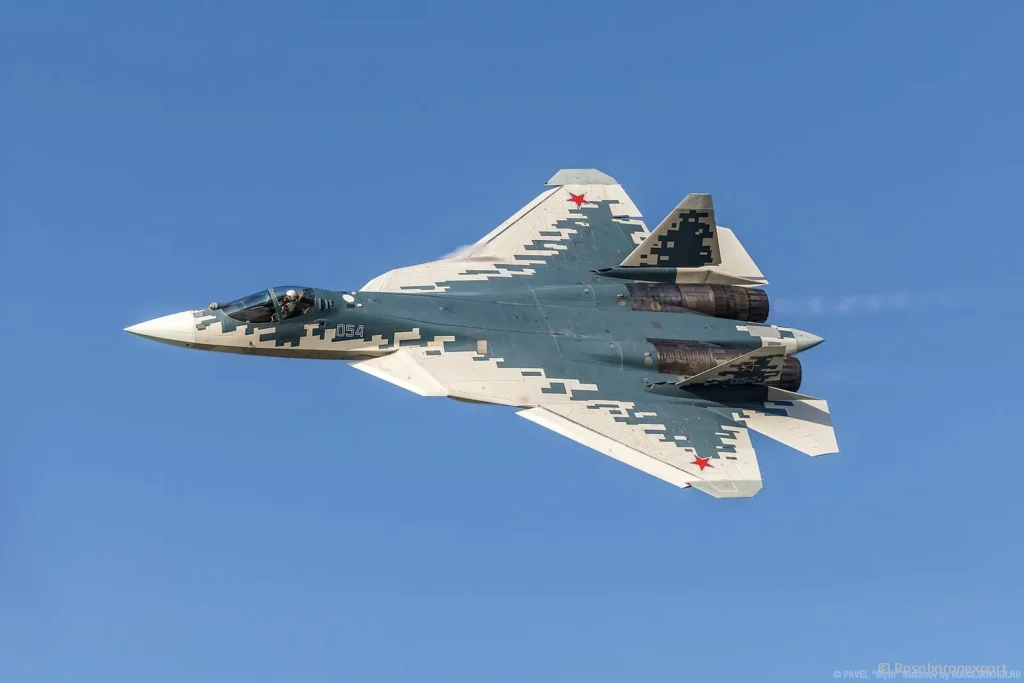
The Su-57 attacks that problem from several angles.
Its leading and trailing edges are arranged to control where radar energy reflects. Weapons can be carried inside the fuselage instead of hanging from pylons, and parts of the aircraft that could create strong radar returns are covered or shaped to reduce them. The engine inlets also use design features intended to keep the compressor faces from presenting an easy radar target.
That last point is easy to overlook.
A fighter can have a clean outer shape and still create a large radar return if its engine fan is exposed to incoming radar waves. The Su-57 uses curved inlet ducts and other measures to reduce that exposure. Radar-absorbent material then helps deal with energy that the shaping cannot redirect.
But the aircraft gives away some clues about its priorities.
Its rear fuselage and engine area are not as tightly hidden as those of the F-35, and the Su-57’s external surfaces include several features that invite debate over just how low its radar signature really is.
Read also: Sukhoi Su-57 vs F-35 Comparison: 10 Facts You Should Know
Public sources do not provide a trustworthy combat-grade radar cross-section figure, so claims that assign the aircraft an exact RCS should be treated with suspicion.
The textbook answer is simple: the Su-57 uses stealth shaping, internal weapons, and radar-absorbing materials.
The real answer is more useful. Russia appears to have accepted a higher signature in some aspects of the design to preserve speed, maneuverability, engine access, and weapon flexibility.
That makes the Sukhoi Su-57 less like a flying black hole and more like a fighter trying to be hard to find without giving up everything else.
And that tradeoff becomes even clearer when the aircraft starts turning.
What Makes the Su-57 So Maneuverable?
The Sukhoi Su-57’s party trick is not just turning tightly. It is staying controllable when the aircraft is pushed far beyond the angles where a normal fighter starts losing authority.
That comes from the whole airframe, not one magic feature.
The Su-57 uses twin engines with thrust-vectoring nozzles that can alter the direction of engine thrust. When the aircraft pitches or yaws aggressively, the engines can help the flight-control system keep the nose pointed where the pilot needs it. The effect becomes most useful at high angles of attack, when the airflow over the wings and control surfaces gets messy.
Sukhoi also fitted the fighter with leading-edge root extensions known as LEVCONs. These surfaces can change the airflow over the wing and help control the aircraft during demanding maneuvers. They are one reason the Su-57 can perform dramatic nose-pointing moves that would be difficult for a less agile design.
But here’s the catch.
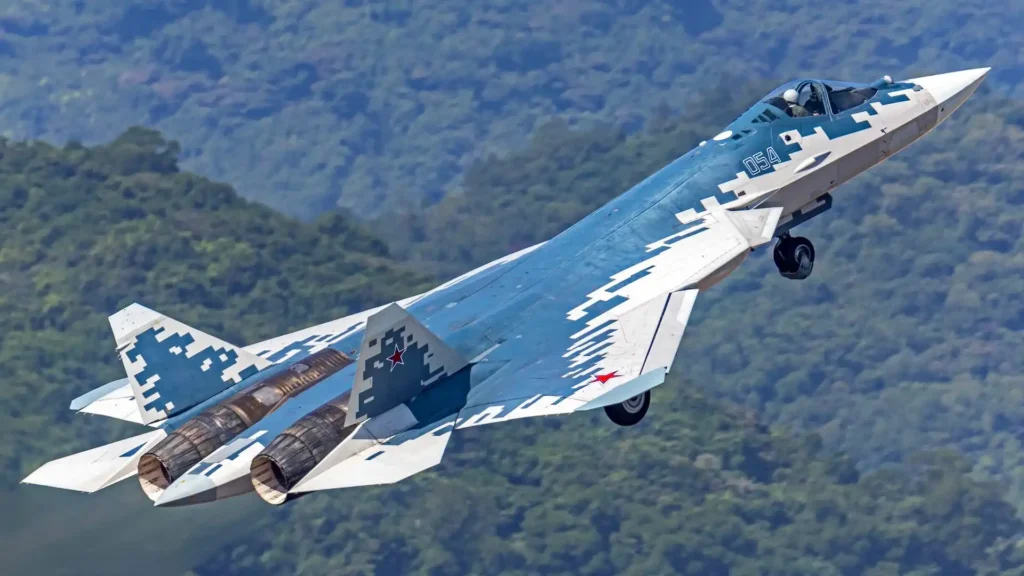
A spectacular airshow maneuver does not prove that the Su-57 will win a modern dogfight. At long range, the fighter that sees first and launches first has a huge advantage. A high-alpha maneuver can also bleed energy quickly, leaving an aircraft slow and exposed if the fight continues.
That’s why I would not call maneuverability the Sukhoi Su-57’s secret weapon. It’s better viewed as insurance.
If a fight collapses into close range, the Su-57 has more options than a fighter designed almost entirely around low observability and sensor advantage. Its control system, aerodynamic layout, and thrust vectoring give the pilot serious authority over the aircraft even at extreme attitudes.
The numbers also tell part of the story. The Su-57 is a large twin-engine fighter, with a maximum speed commonly listed around Mach 2 and a substantial internal fuel load. It was not designed to trade all of that for the smallest possible radar signature.
That is the recurring theme with this aircraft.
Russia wanted stealth, but it refused to let stealth dictate every design choice. The next question is whether the Su-57’s sensors can make that compromise pay off.
How Advanced Are the Su-57’s Radar and Sensors?
The Sukhoi Su-57’s sensor suite may be more interesting than its stealth shaping.
Why? Because a low radar signature only helps if the fighter can find threats early enough to use it. Russia approached that problem with a distributed sensor setup rather than relying on one powerful radar hidden behind the nose.
At the center is the N036 Byelka radar family, built around active electronically scanned arrays, or AESA. Unlike an older mechanically steered radar, an AESA can shift its beam electronically and manage several tasks much faster. The Su-57 takes that idea further by spreading radar elements around the aircraft.

Its main nose array handles the forward sector. Additional arrays are placed along the sides of the fuselage, giving the aircraft a wider field of view than a single forward-facing antenna could provide. There are also lower-frequency L-band arrays integrated into parts of the wing structure.
That L-band feature gets a lot of attention, sometimes too much.
Lower-frequency radar can help with detection of low-observable targets because stealth shaping is harder to optimize across every wavelength. But detecting something is not the same as generating a precise weapons-quality track. A fighter still needs accurate range, speed, and position data before a missile can be guided effectively.
The Su-57 also carries the 101KS electro-optical system, including infrared search and track functions. That gives the aircraft another way to detect heat-producing targets without relying entirely on active radar emissions. Against an aircraft trying to minimize its own radar exposure, that matters.
Then there is electronic warfare.
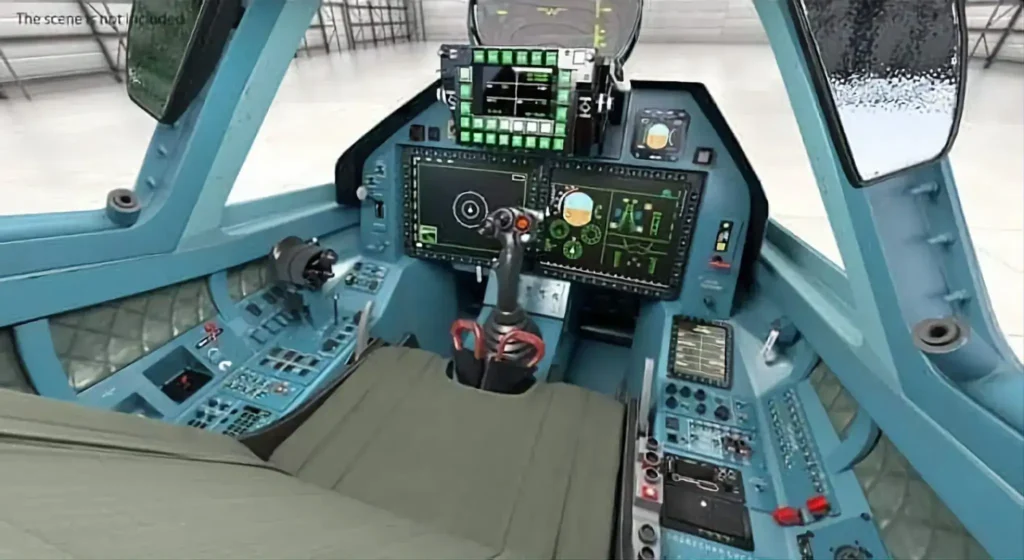
The Su-57 combines radar, infrared, warning sensors, and electronic countermeasures into a broader sensor picture. The goal is simple: find the threat without giving away more information than necessary.
I think that’s where the aircraft’s design becomes genuinely clever. Its sensor advantage is not one secret radar mode. It’s the attempt to make several imperfect sensors useful together.
But seeing the target is only half the problem.
The missile bay decides what happens next.
What Weapons Can the Su-57 Carry?
A stealth fighter’s weapons are only useful if carrying them does not ruin the reason the aircraft was made stealthy in the first place.
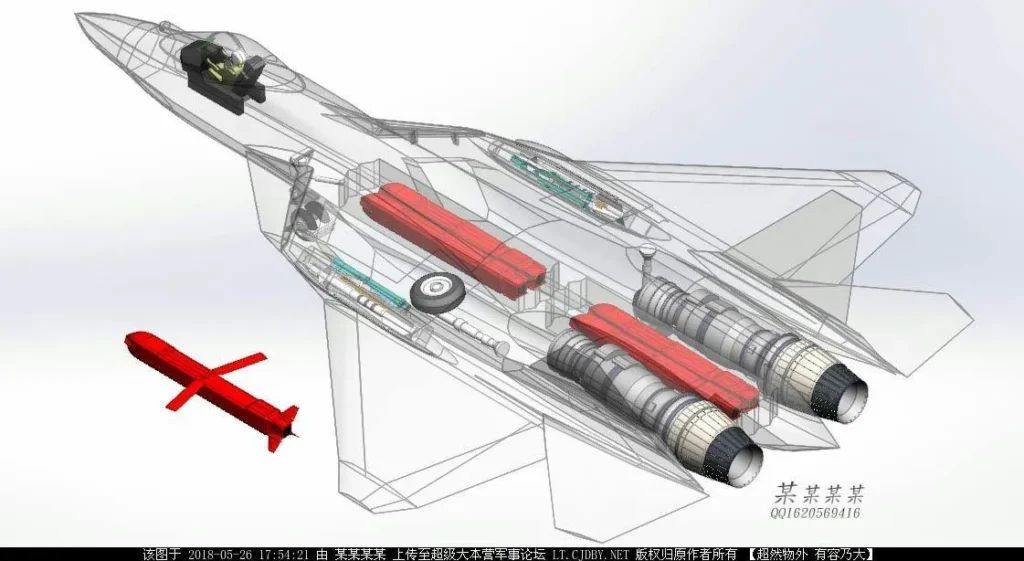
That’s why the Sukhoi Su-57 has internal weapons bays. They let the fighter carry missiles and bombs without leaving a forest of external pylons in the airflow and radar picture.
The main internal bays sit between the engines, with smaller bays located along the sides of the fuselage. Those side bays are particularly interesting because they can house short-range air-to-air missiles while keeping them out of the direct airflow. That arrangement gives the Su-57 a way to carry close-combat weapons without opening its larger central bays.
For air combat, the aircraft has been associated with Russia’s R-77 family of medium-range missiles and the short-range R-74M-series weapon. Russia has also developed newer weapons intended for internal carriage, including the compact izdeliye 760 missile family.

The fighter can carry much larger weapons externally when stealth is less important.
That’s a useful distinction. A Su-57 flying with external missiles can carry more ordnance, but those weapons add radar reflections and drag. A clean internal load is better when penetrating defended airspace matters more than maximum payload.
The aircraft also carries a 30 mm GSh-30-1 cannon. That may sound old-fashioned beside AESA radar and infrared sensors, but the gun still gives the pilot a close-range option when missile employment becomes difficult.
Its strike role is broader. The Su-57 has been associated with guided bombs and air-to-surface missiles, while Russia has also used the fighter to launch stand-off weapons in combat. External carriage gives the aircraft considerably more freedom here, especially when it does not need to preserve the lowest possible radar signature.
That creates a practical two-mode fighter.
Clean and internal for missions where detection risk matters most. Heavily loaded when weapon volume matters more.
There is no free lunch. The more weapons the Su-57 hangs outside its body, the less useful its low-observable design becomes.
And that leads to the comparison people inevitably make: how does this Russian approach stack up against the F-22, F-35, and China’s J-20?
What Are the Su-57’s Biggest Strengths and Limitations?
The Su-57’s strongest feature may also be its biggest weakness: Russia tried to make it do a lot.
On paper, the fighter has an impressive mix of range, speed, maneuverability, stealth features, sensors, and weapons. A large twin-engine airframe gives it more room for fuel, radar equipment, cooling systems, and internal weapons than a smaller fighter. The distributed radar layout is unusual, while thrust vectoring gives it a level of control that many fighters simply do not have.
But capability on paper is not the same as capability at scale.
The Su-57 entered service in 2020 after a development program that had already been running for a decade. Production has also remained far smaller than the F-35 fleet. That matters because modern air combat is rarely about one aircraft. Training, spare parts, software updates, maintenance, weapons stocks, and pilot hours can matter just as much as the jet’s design.
The engine story is another example.
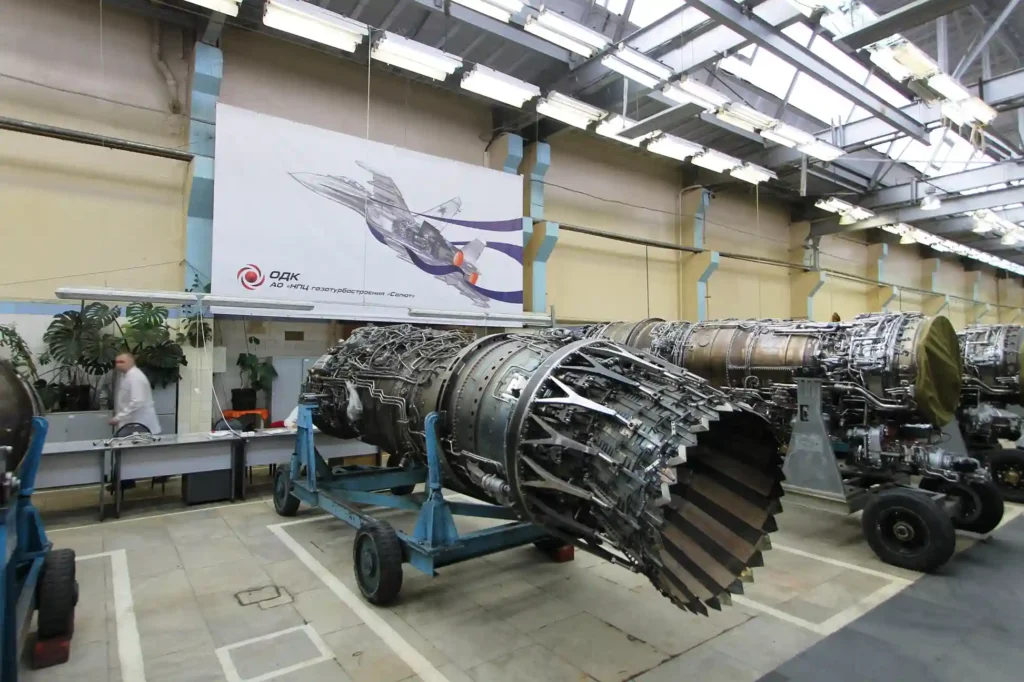
Early Sukhoi Su-57 aircraft used the AL-41F1 engine, while Russia has been working toward the newer Product 177 powerplant for later aircraft. The newer engine is meant to improve thrust and other performance factors, but the transition also shows how the fighter’s final configuration has taken years to settle.
Then comes stealth.
The Su-57 clearly incorporates low-observable design, but there is no reliable public figure that lets anyone calculate its exact radar cross-section in combat conditions. Weather, radar frequency, aspect angle, external stores, and the aircraft’s configuration all change the result.
So be skeptical when you see an exact RCS number presented as fact.
The aircraft’s combat record also needs context. Russia has used Su-57s in the Ukraine war, including for stand-off weapon employment, but open reporting does not provide enough verified data to measure how often the aircraft has conducted high-risk air-to-air missions against comparable fighters.
That leaves a fighter with real strengths and real unanswered questions.
The Sukhoi Su-57 is not a paper aircraft anymore. But neither is it a machine whose full combat value can be judged from a specification sheet.
Why Is the Sukhoi Su-57 Still Important to Russia?
Russia does not need the Sukhoi Su-57 to be the world’s most advanced fighter to justify building it. It needs the aircraft to give its air force capabilities that older Flanker-family fighters cannot provide.
That starts with survivability.
A modern air campaign puts aircraft against dense radar networks, long-range surface-to-air missiles, electronic warfare, and fighters carrying their own advanced sensors. A fourth-generation Su-30 or Su-35 can still be dangerous in that environment, but the Su-57 adds low-observable features and a sensor architecture designed for a much harder fight.
Russia is also pushing the design beyond the original single-seat fighter.

The Su-57D two-seat variant is a sign that Moscow sees value in giving the platform more crew capacity for complex missions. A second crew member could help manage sensors, weapons, electronic warfare, or future unmanned systems, although the exact operational role of the aircraft remains a developing story.
Then there is the S-70 Okhotnik.
The idea of pairing a Su-57 with an unmanned combat aircraft is more interesting than another small increase in top speed. A manned fighter could act as the decision-maker while an unmanned aircraft extends the sensor and weapon reach of the formation. Russia has tested the two platforms together, showing where the broader concept is heading.
Engine development matters too. The newer Product 177 engine is intended to replace the earlier AL-41F1 on future aircraft, giving later Su-57s a cleaner path toward higher performance without redesigning the whole fighter.
That tells me where the program is going.
The Su-57 is no longer just an attempt to build Russia’s answer to the F-22. It is becoming a platform around which Russia can build a wider combat system, including new engines, weapons, sensors, and unmanned aircraft.
The aircraft’s biggest question is no longer whether it looks like a fifth-generation fighter.
It does.
The useful question is how much of its promised advantage Russia can turn into trained crews, reliable aircraft, modern weapons, and sustained operations. That’s where the Sukhoi Su-57’s real value will be decided, not at an airshow or on a specification sheet.
