

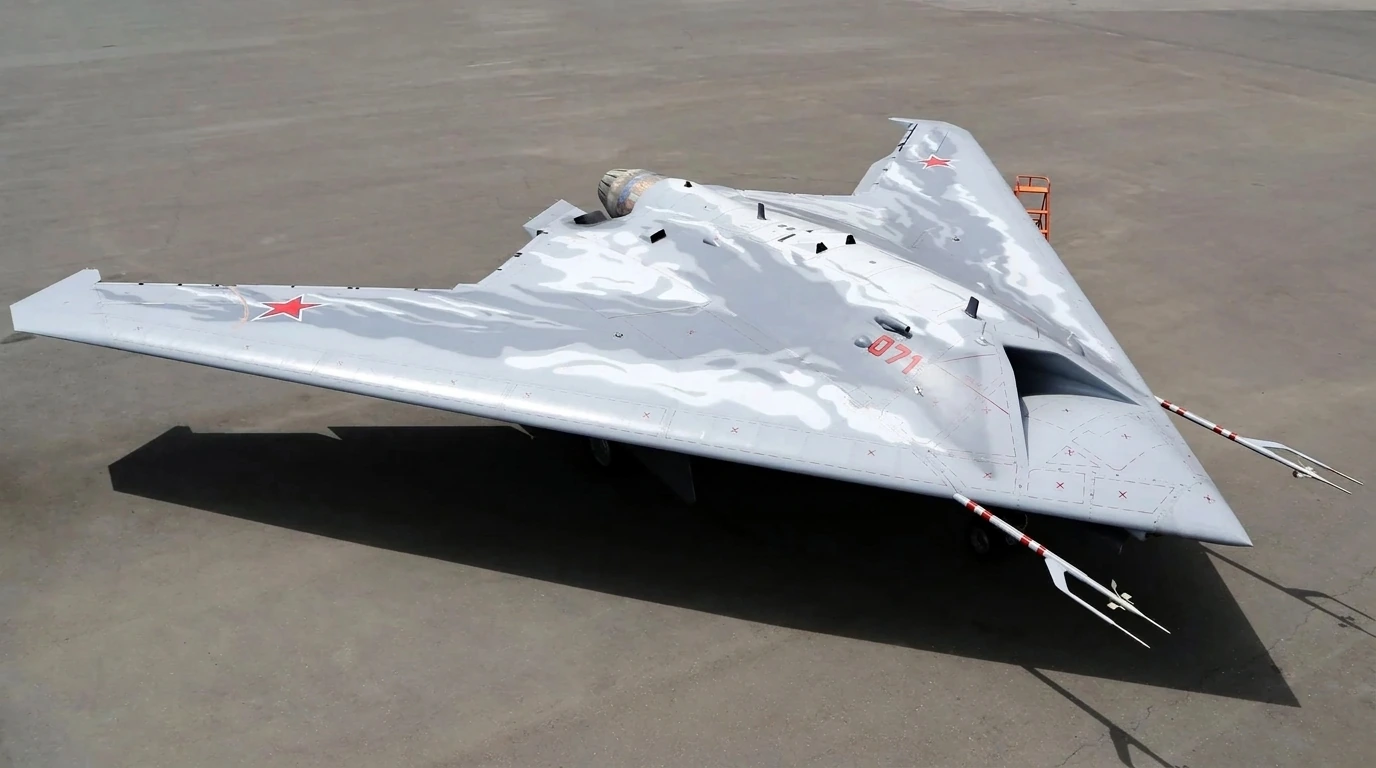
Russia’s S-70 Okhotnik-B looks like a flying wing pulled straight from a stealth aircraft designer’s notebook. But its most interesting feature isn’t its shape. It’s the idea behind it: send an uncrewed jet into dangerous airspace, then use it to support a manned fighter such as the Su-57.
That plan could change how Russia uses its most advanced combat aircraft.
A fighter pilot might gain an extra sensor platform, a strike asset, or an uncrewed partner capable of taking risks that would be harder to justify with a human onboard.
The trouble is that building a stealth drone is one thing. Making it useful in a real war is another.
The S-70 Okhotnik-B, also known as the Hunter-B, first flew in August 2019. Since then, it has drawn attention for its large flying-wing design, jet engine, internal weapons bay, and planned link to Russia’s Su-57 fighter. Russian officials have presented it as a major step toward a new kind of air combat.
Yet public evidence leaves key questions unanswered. How well does its stealth design work? Can it share data with a fighter under enemy jamming? And has Russia solved the hard task of turning a complex prototype into a reliable combat system?
Those questions matter more than the drone’s sleek outline. The S-70’s real value will depend on what it can do in contested airspace, not what its shape suggests it might do. To see why, start with the design itself and the job Russia expects it to perform.
What Is the S-70 Okhotnik-B?
The S-70 Okhotnik-B was built around a simple idea: Russia needs an uncrewed aircraft that can do more than watch a battlefield. It needs one that can enter hostile airspace and support combat missions alongside its advanced fighters.
Sukhoi developed the aircraft under a program led by Russia’s United Aircraft Corporation. Its name, Okhotnik, means “Hunter.” That fits the role Russia has in mind, although the drone’s actual combat record remains limited in public view.

The aircraft first flew in August 2019. Early flight tests focused on basic handling and the systems needed to control such a large uncrewed jet. In September that year, Russia released footage of the S-70 flying alongside a Su-57 fighter. The flight offered a public glimpse of the planned partnership between the two aircraft.
That pairing is the key to understanding the program.
A small quadcopter can spot a target for troops on the ground. A larger combat drone can carry heavier sensors and weapons, travel farther, and potentially operate with fast jets. The S-70 belongs to the second group. Its size and jet propulsion suggest missions that demand more range and speed than a small propeller-driven UAV can offer.
But there’s a catch. A large aircraft costs more to build, maintain, and test. It also needs secure control links, reliable software, and a way to share useful data with other aircraft. Losing one could mean losing far more than a cheap camera drone.
Russia is trying to bridge the gap between an experimental aircraft and a practical combat tool. The S-70’s design shows how ambitious that goal is. Its development record, however, doesn’t yet prove that every part of the plan works in battle.
How Does the S-70’s Stealth Flying-Wing Design Work?
The S-70’s flying-wing shape is more than a visual choice. It helps reduce features that radar can detect, giving the aircraft a better chance of approaching a defended area without being tracked as easily.
Unlike a conventional fighter, the S-70 has no separate tail assembly. Its broad wing and blended body form one main structure. This can reduce sharp edges and gaps that reflect radar energy back toward a radar receiver. The aircraft also has an internal weapons bay, so it can carry weapons without hanging them beneath its wings.
That matters because external weapons can spoil a stealth aircraft’s carefully shaped outline.
Think of the difference between a clean aircraft profile and one covered with missiles, bombs, and bulky fuel tanks. Those extra parts create surfaces that may reflect radar energy. Keeping weapons inside the airframe helps avoid that problem, though it limits the size and number of weapons the aircraft can carry.

The S-70’s engine arrangement also matters. Early images showed a more exposed exhaust area, while later footage revealed a redesigned rear section with changes intended to reduce the engine’s visibility. The exhaust is a difficult part of any stealth aircraft because it can produce both radar returns and heat that infrared sensors may detect.
Still, a flying wing doesn’t make an aircraft invisible.
Radar performance depends on the viewing angle, radar frequency, materials, and the design of individual parts. A shape that reduces returns from one direction may be less effective from another. Ground-based radar, airborne sensors, and infrared systems also look for different clues.
I find this distinction gets lost in many discussions of stealth aircraft. People see a smooth, tailless shape and assume it must be hard to detect from every direction. That’s not how stealth works.
The S-70’s design gives Russia a useful starting point. Its actual radar signature, however, hasn’t been established through enough public evidence to support precise claims about how far away an enemy could detect it.
S-70 Okhotnik-B Specifications, Speed and Payload
The S-70 Okhotnik-B stands out because Russia is trying to combine the size and speed of a jet with the low-observable design of a stealth aircraft. That combination could let it carry out missions that smaller drones simply can’t handle.
But the numbers need careful reading. Public sources often repeat estimates as if they were confirmed test results. They aren’t all supported by the same level of evidence.
| Specification | Publicly reported figure |
| Length | About 14 meters |
| Wingspan | About 19 meters |
| Maximum takeoff weight | Around 20 tonnes |
| Powerplant | One jet engine |
| Maximum speed | Often reported near 1,000 km/h |
| Intended payload | Internal weapons, including air-to-ground munitions |
| First flight | August 2019 |
These figures are commonly reported estimates, not a complete set of verified performance data. Russia hasn’t released enough independently confirmed test results to establish the aircraft’s full speed, range, payload, or endurance under combat conditions.
Its size still tells us something useful. With a wingspan of roughly 19 meters, the S-70 is much larger than the small drones used for close-range scouting. It needs substantial ground support, suitable runways, and more maintenance than a lightweight tactical UAV.
The jet engine also shapes its intended role. A fast aircraft can cover distance more quickly than a propeller-driven drone, which may matter when supporting fighters or reaching a target within a limited window.

Speed alone, however, doesn’t tell us how far the S-70 can fly while carrying weapons. Fuel load, flight profile, altitude, and payload all affect that figure.
The internal weapons bay is just as significant. It allows the aircraft to carry weapons without exposing them beneath the wings, helping preserve its intended stealth profile. The trade-off is space. A large bomb or missile takes up room that could otherwise hold other weapons or equipment.
Russia has shown the S-70 carrying out test flights and has presented it as a strike platform. Yet public footage doesn’t establish its full weapons clearance or the accuracy of its targeting systems.
The practical question isn’t whether the drone can carry a weapon. It’s whether it can find the right target, survive the trip, and deliver that weapon when enemy defenses are active.
What Combat Missions Could the Okhotnik-B Perform?
The S-70 Okhotnik-B is designed to do more than scout from a safe distance. Its size, jet engine, and internal weapons bay point toward strike missions in which Russia wants an uncrewed aircraft to reach defended areas and attack selected targets.
Ground attack is one likely role. The S-70 could carry guided weapons inside its airframe, allowing it to attack targets while keeping its external shape relatively clean. Possible targets could include command posts, radar sites, or other military assets. However, the exact weapons cleared for operational use remain unclear from public evidence.

Reconnaissance is another potential mission. An aircraft operating ahead of a Su-57 could gather information about enemy positions and help the fighter’s pilot understand what lies beyond the aircraft’s own sensors. That information would be useful only if the S-70 could collect it, process it, and pass it back quickly enough to affect decisions.
The drone might also serve as an additional weapons carrier. Instead of asking a fighter to carry every missile or bomb itself, Russia could assign some weapons to the uncrewed aircraft. In theory, that gives the crewed aircraft more options during a mission.
But this is where the concept meets its hardest test.
A stealth aircraft still faces air-defense systems, infrared sensors, electronic warfare, and the risk of losing communications. If the S-70 must stay far from a target to protect itself, its usefulness may fall. If it flies closer, it risks being detected and destroyed. Stealth can reduce that risk, but it can’t remove it.
The October 2024 loss of an S-70 identified by multiple reports over Ukraine brought these issues into sharper focus. Reports indicated that a Russian fighter shot down the damaged drone after it entered Ukrainian-held airspace. The exact sequence of events and the reasons for the loss were not fully established in public reporting.
That episode doesn’t prove the aircraft is ineffective. Test aircraft are sometimes lost during development. But it does show why claims about combat readiness need evidence beyond flight demonstrations.
The S-70 could eventually offer Russia a useful mix of strike power and reconnaissance. For now, its intended missions tell us more about Russian ambitions than its proven performance in combat.
How Does the S-70 Compare With Other Stealth Combat Drones?
The S-70 Okhotnik-B isn’t the only country’s attempt to build an uncrewed aircraft that can work with crewed fighters. The United States and Australia have pursued related ideas, but their programs reveal an important point: not every combat drone is built for the same job.
The US Navy’s X-47B is a useful comparison. It was a technology demonstrator designed to test autonomous carrier operations, including takeoff, landing, and aerial refueling.
In 2013, it made history by landing on an aircraft carrier. Its main purpose was to prove that an uncrewed jet could handle demanding flight operations at sea, not to become a direct equivalent of the S-70.
Australia’s MQ-28 Ghost Bat takes a different approach. Developed with Boeing Australia, it is intended to operate alongside crewed aircraft and provide additional mission capabilities. Its modular design and focus on teaming make it a useful comparison with Russia’s planned Su-57 partnership.
| Aircraft | Main focus | Key distinction |
| S-70 Okhotnik-B | Stealth strike and cooperation with the Su-57 | Large flying-wing design and internal weapons carriage |
| US X-47B | Autonomous carrier operations | Demonstrator that proved demanding carrier-flight tasks |
| Australian MQ-28 Ghost Bat | Teaming with crewed aircraft | Designed around a modular, collaborative combat role |
The comparison has limits. The X-47B was a demonstrator, while the MQ-28 follows a different development path and mission plan. Treating all three as operational stealth combat drones would blur meaningful differences.
The S-70’s large airframe suggests an emphasis on carrying substantial fuel, sensors, and weapons. Yet size brings costs, from maintenance needs to the challenge of producing enough aircraft for useful operations. A smaller uncrewed aircraft may offer less payload but could be easier to deploy in larger numbers.

That’s why I wouldn’t rank these programs by speed or wingspan alone. The better question is whether each aircraft can deliver useful combat effects at an acceptable cost, while communicating reliably with the rest of its force.
Russia has built an ambitious design. Whether it can turn that design into a reliable and affordable combat partner is the more important test.
What Are the S-70 Okhotnik-B’s Biggest Challenges?
The S-70 Okhotnik-B faces a problem that no sleek airframe can solve: Russia must prove that its stealth drone can survive real combat, work with other aircraft, and be produced in useful numbers. Building a prototype is only the first step.
The October 2024 loss over Ukraine offered a harsh reminder. An S-70 was reported damaged or out of control over Ukrainian-held territory near Kostyantynivka. A Russian fighter then shot it down. Reports suggested the decision was made to prevent the aircraft from falling intact into Ukrainian hands, though the full sequence of events remains uncertain.
The incident raised questions about control links, aircraft reliability, and how operators respond when a test or combat mission goes wrong. It didn’t reveal every weakness in the S-70, but it showed that the aircraft wasn’t immune to the problems faced by other uncrewed systems.
Electronic warfare presents another challenge. An enemy may try to jam communications or disrupt satellite navigation. The drone needs ways to maintain safe flight and follow its mission when signals become unreliable. Autonomy can help, but it doesn’t automatically solve problems involving target identification, changing orders, or unexpected threats.
Production is just as important. A complex stealth aircraft needs advanced materials, careful manufacturing, specialist maintenance, and reliable engines. If those needs make each aircraft costly or slow to build, Russia may struggle to field enough S-70s to change how its air force operates.
There is also a question of proof. Public demonstrations show that the aircraft can fly, but they don’t establish its radar signature, combat endurance, resistance to jamming, or accuracy with operational weapons. Those details matter far more than a polished promotional video.
Russia’s defense industry has experience building advanced combat aircraft, but an uncrewed stealth jet adds another layer of difficulty. The aircraft must function as a flying machine and as part of a wider network of sensors, weapons, and human decisions.
The best measure of progress won’t be another dramatic flight video. It will be clear evidence of reliable testing, repeatable production, and successful missions under realistic conditions.
The S-70 Okhotnik-B’s Real Significance
The S-70 Okhotnik-B matters because it shows where Russia wants its air force to go. Rather than relying only on crewed fighters, Russia is trying to develop an uncrewed aircraft that can carry weapons, gather information, and support a pilot in dangerous airspace.

Its flying-wing design gives it a plausible basis for reduced radar visibility. Its size offers room for fuel, sensors, and internal weapons. And its planned partnership with the Su-57 could give Russian pilots another way to extend their reach without putting another person in the cockpit.
But these advantages remain conditional. A stealth shape doesn’t guarantee survival, and a drone that flies beside a fighter isn’t automatically a capable combat partner. The system needs dependable communications, useful autonomy, tested weapons, and a production line that can deliver aircraft in meaningful numbers.
That’s the distinction worth keeping in mind when reading claims about the S-70. Russia has demonstrated an ambitious aircraft, but public evidence doesn’t yet establish the full extent of its operational capabilities.
For readers tracking the program, the most useful next step is to watch for concrete milestones rather than fresh claims about its potential. Look for verified weapons tests, evidence of reliable Su-57 integration, confirmed production figures, and credible reporting on operational deployment.
Those details will reveal far more about the S-70 Okhotnik-B’s future than its striking silhouette ever could.
