

JUST IN
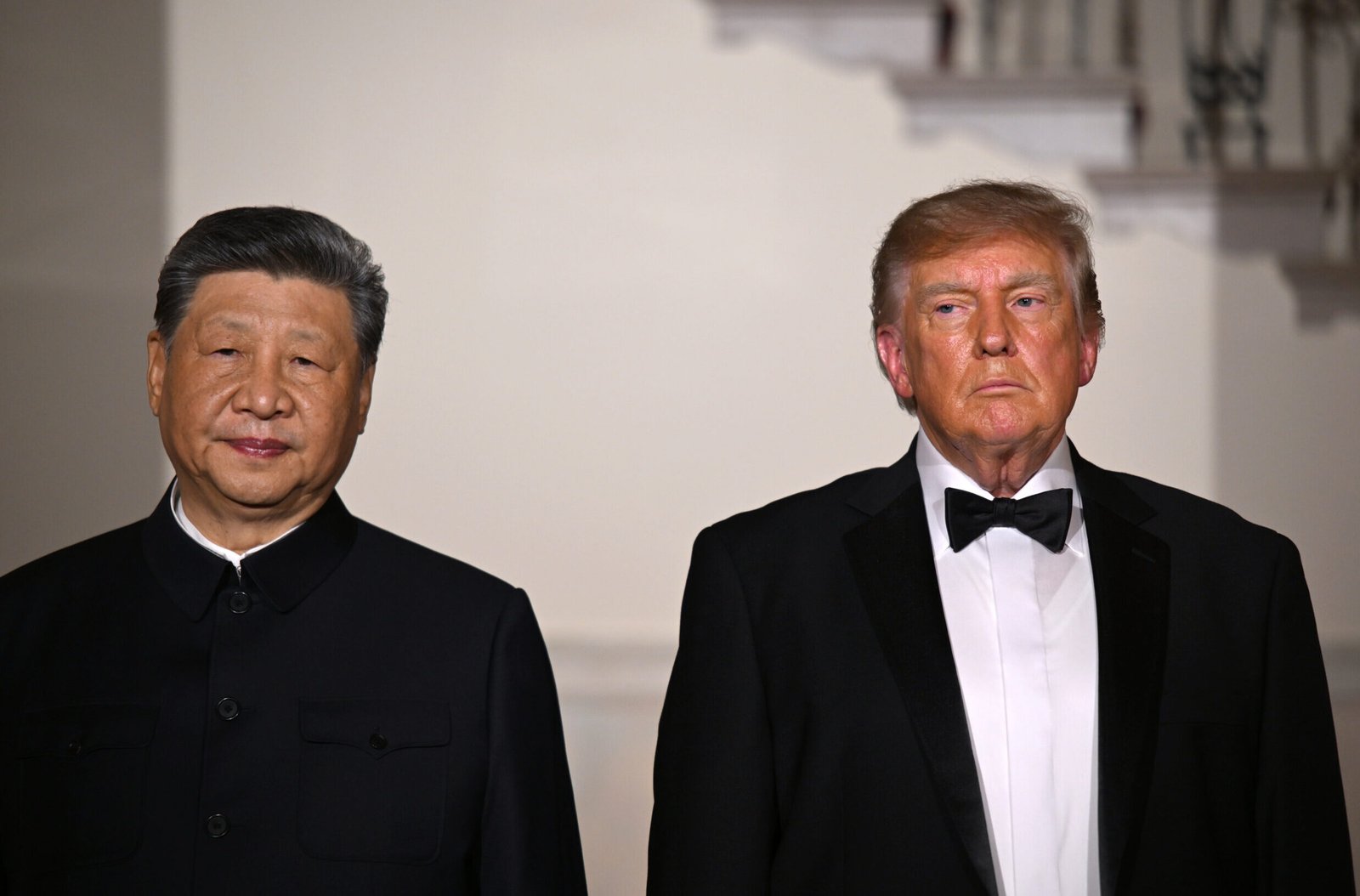
Once the trade truce was extended and the vanilla crémeux cleared, nearly everything else was left on the table. US President Donald Trump and Chinese President Xi Jinping wrapped up their second summit of the year today, a get-together that included a state dinner teeming with tech billionaires and powerbrokers but little in the way of new agreements. With the two slated to meet again in November, our experts parse what moved, what didn’t, and what might come next.
TODAY’S EXPERT REACTION BROUGHT TO YOU BY
- Melanie Hart: Senior director of the Global China Hub and former senior advisor for China at the US State Department
- Josh Lipsky (@joshualipsky): Vice president and chair of international economics at the Atlantic Council and former International Monetary Fund advisor
- Markus Garlauskas (@Mister_G_2): Director of the Indo-Pacific Security Initiative at the Scowcroft Center for Strategy and Security and former national intelligence officer for North Korea
- Kenton Thibaut (@kentonthibaut): Senior resident China fellow at the Digital Forensic Research Lab
The optics
- Melanie sees the pageantry, which included Trump welcoming Xi at the airport, as part of Trump’s bid for a stronger personal relationship with Xi. “President Trump appears to be seeking a grand bromance with President Xi,” she says. But Xi, she argues, is “a master negotiator” who responds to strategy, not flattery.
- Josh sees a broader optics win for Beijing. As the world gathered for the UN General Assembly in New York, Washington presented the United States and China as near equals, a “G2” rather than G7 or G20. “In a G2 world, the US pushes aside one of its greatest assets—its allies—and stands toe to toe with China,” Josh tells us. “That’s the kind of comparison China, with its dearth of allies, has wanted for years.”
- Melanie’s bottom line: “The Chinese delegation is going home happy.”
The trade punt
- The summit’s primary concrete outcome is a two-month extension of the trade truce agreed last October, though more specific trade announcements are expected on Monday. The trade punt, Josh argues, shows that “both leaders have something they want from each other before December. Not rare earths, or lower tariffs, but attendance.”
- Xi wants Trump at the Asia-Pacific Economic Cooperation (APEC) summit in Shenzhen in November; Trump wants Xi at the G20 in Miami in December. The leaders indicated that both meetings will happen, and the “two-month punt,” Josh adds, gives each an incentive to show up.
The omissions
- For Markus, what the summit did not produce matters as much as what it did. Despite Xi’s push for Trump to halt US arms sales to Taiwan, no such bargain has publicly emerged—a relief for Taipei. But “just because no deal relating to Taiwan was mentioned doesn’t mean Taiwan will be unaffected by the summit,” he cautions. Washington has not yet approved another major weapons package for Taiwan, leaving the decision hanging over the leaders’ expected November confab.
- Korea is another telling silence. Trump significantly cut back last month’s annual US-South Korea military exercises—a notable concession given Beijing’s longstanding criticism of the drills. Yet Markus says he could not find “even a word of faint praise from Xi or China’s state media.” Nor did the leaders publicly lay ground for another meeting between Trump and North Korean dictator Kim Jong Un, suggesting “this is not a priority for them.”
- On artificial intelligence (AI), Kenton notes that the public statements showed “some conceptual overlap around human control and misuse risks,” but “produced no announced agreement on specific safety mechanisms,” including incident notification, frontier-model evaluations, or constraints on advanced AI development.
Sign up to receive rapid insight in your inbox from Atlantic Council experts on global events as they unfold.
The watchlist
- Even if Trump and Xi can apparently agree on new AI terminology, Kenton says that “meaningful progress will likely have to be built from the bottom up,” through technical exchanges and unofficial dialogues.
- Markus will be watching whether Washington approves the delayed arms package for Taipei, pointing to comments by Secretary of State Marco Rubio that “suggest the delay may continue, including for reasons other than mollifying Xi.”
- Josh sees the trade truce as a deadline rather than a solution: “The harder questions—on trade, on tariffs, on rare earths—can’t be punted forever.”
- And Melanie has her doubts that the broader relationship will warm. “Xi Jinping doesn’t do personal relationships, not with Americans.”
Image: US President Donald Trump and Chinese President Xi Jinping in front of the Grand Staircase in the Grand Foyer of the White House on September 24, 2026
(Annabelle Gordon/POOL via Reuters Connect)
Oops…
It looks like we’re having a technical issue.
If refreshing the page doesn’t resolve the issue you could try clearing the sites browser cache.
