

Just Add Lava’s upcoming strategy game aims to condense exploration, colonization, research, diplomacy, and warfare into a more focused galactic campaign.
- Developer and Publisher: Just Add Lava
- Genre: Turn-Based Space 4X Strategy
- Platforms: Windows, macOS, and Linux
- Release Window: 2027
- Mode: Single-player
- Demo: Playable in a web browser through itch.io, with a dedicated Steam demo also listed as coming soon.
Not every interstellar empire needs to require weeks of planning and hundreds of turns to complete. Vega Chronicle is being developed around a bite-sized interpretation of the space 4X formula, retaining its familiar cycle of exploration, expansion, economic development, technological advancement, diplomacy, and warfare while presenting it in a more approachable format.
Developed and self-published by Just Add Lava, the game places players in command of a young spacefaring civilization attempting to establish itself among the stars.
Depending on the decisions made along the way, that civilization can pursue galactic influence through territorial expansion, scientific progress, economic strength, careful negotiation, or military conquest.
Exploring and Colonizing a Generated Galaxy
A campaign begins by shaping the strengths of a civilization. Players can select ancestral traditions and abilities that favor different approaches, such as exploration, diplomacy, scientific development, or defense.
In recent demo builds, for example, the Explorer tradition begins with an additional Scout, while the Utopian path provides diplomatic and happiness-related advantages. These choices establish an early direction without permanently locking players into a single strategy.
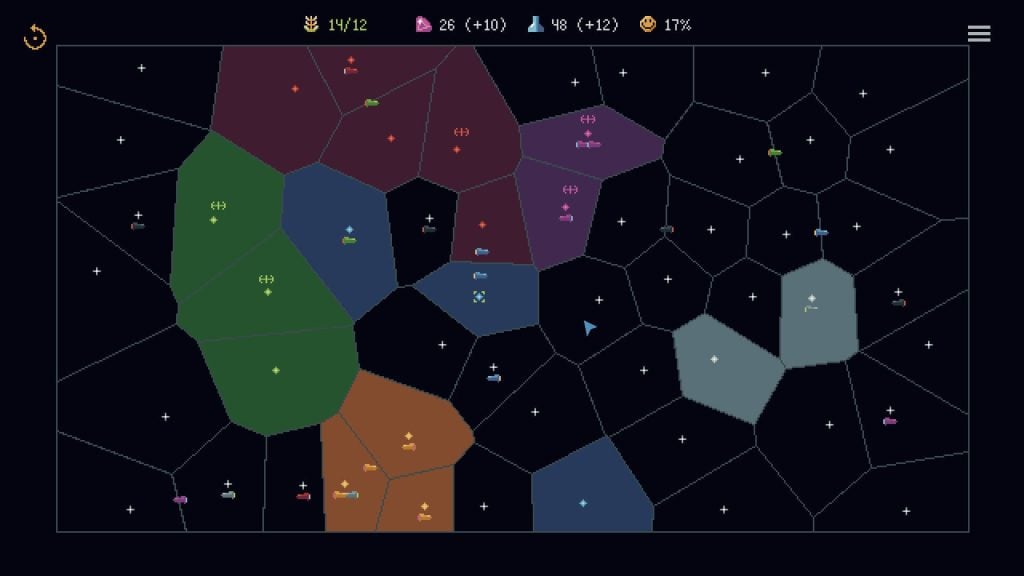
Once the campaign starts, Scout ships can be sent into unexplored systems to reveal planets, potential resources, rival civilizations, and other discoveries. Galaxy generation is designed to produce planets with different sizes, environmental characteristics, production values, and special perks, making some systems considerably more valuable than others.
Recent development updates introduced bonuses such as psionic crystals, which improve research output, and mineral clouds, which increase mineral production.
Other planetary characteristics can influence food, construction, happiness, or the number of structures that can be supported. Establishing a colony is therefore not simply a matter of claiming the nearest planet; players must decide whether a system’s long-term value justifies the ships and resources needed to secure it.
Expansion is handled through several types of vessels and technologies. Colony ships can establish distant settlements, while Colony Shuttles allow additional planets to be claimed within systems where a civilization already has a foothold. Fleets can also be assigned routes in advance, reducing the need to direct every journey one turn at a time.
Exploration may lead to more than empty planets. Current builds include raiders, derelict ships, traveling merchants, and discovery events. One event can place a fleet near an unstable star that is about to destroy its planets, while another allows a merchant to equip a ship with advanced technology. These encounters introduce occasional risks and opportunities outside the usual competition between major civilizations.
Colony Management, Resources, and Happiness
Every settlement contributes to the wider civilization, but colonies must be developed according to their local conditions.
Players can construct and upgrade infrastructure such as farms, mines, shipyards, colony facilities, Arcades, and defensive installations. Build queues and rally points help organize production, while damaged structures can be repaired or recycled.
The economic layer revolves around balancing food, industrial income, research, and happiness. Ships and colonies consume supplies, making rapid expansion difficult to sustain without developing the necessary agricultural base. Producing more than a civilization can comfortably support may damage happiness, while severe shortages can reduce productivity and create wider instability.
The game’s random-event system responds to the condition of the population, and poorly managed civilizations may experience strikes, mutinies, degradation, or outright rebellions. Buildings such as Arcades, along with certain traditions and technologies, can help stabilize the population.
Claiming more worlds may increase production, but every additional colony, ship, and structure also adds demands that must be supported. Building a large empire without the food or happiness needed to maintain it can be just as dangerous as leaving the borders undefended.
A Compact but Consequential Technology Tree
Scientific development takes place through an interconnected research tree. Research can unlock new planetary domes, terraforming, improved soil, Colony Shuttles, advanced engines, defensive force fields, automated infrastructure, and increasingly powerful military vessels.
Other branches lead toward blasters, missiles, orbital bombardment, Starbases, Destroyers, and Battlecruisers.
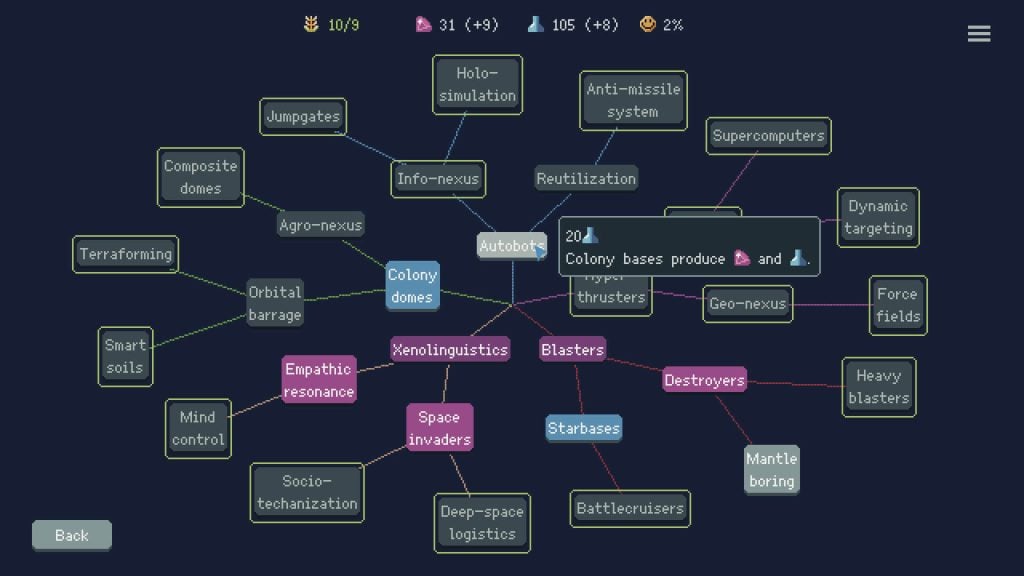
Several technologies also change what players can do strategically; for example, investing in Xenolinguistics supports relations with alien civilizations, advanced propulsion improves fleet movement, and terraforming can turn previously unsuitable planets into useful colonies.
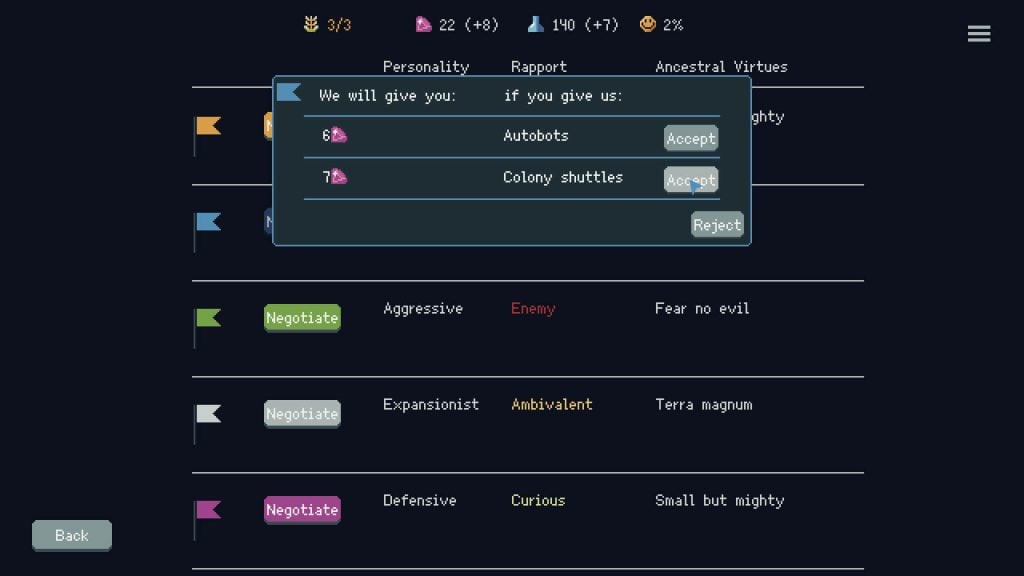
Technologies may also be exchanged during diplomatic negotiations, giving scientific progress value beyond the player’s own borders.
Diplomacy Is Another Form of Expansion
The diplomacy system allows civilizations to negotiate exchanges, trade technologies and resources, establish trade pacts, and sign temporary peace agreements.
Trade pacts provide both participants with recurring economic and scientific benefits, with their rewards increasing as the relationship continues. Peace agreements temporarily prevent normal attacks, although sufficiently hostile actions can still invalidate them. Rival behavior is influenced by diplomatic rapport, previous treaty violations, territorial disputes, and aggressive actions such as occupying contested systems or bombarding colonies.
A player might secure one border with a peace agreement, gain research through a trade partner, and then redirect the fleet toward a more vulnerable rival. Technologies and resources can also be used as bargaining tools, allowing a wealthy or scientifically advanced civilization to gain influence without immediately firing a weapon.
Turn-Based Fleet Battles Can Be Controlled or Automated
When negotiation fails, conflicts are settled through turn-based space combat. Fleets travel between systems on the strategic map and can be ordered to defend territory, attack hostile ships, invade planets, or bombard enemy colonies.
During manual battles, ships are arranged into opposing formations and receive orders across a sequence of combat rounds. Available commands include concentrating fire on selected targets, firing blasters, evading incoming attacks, falling back, or retreating from the engagement.
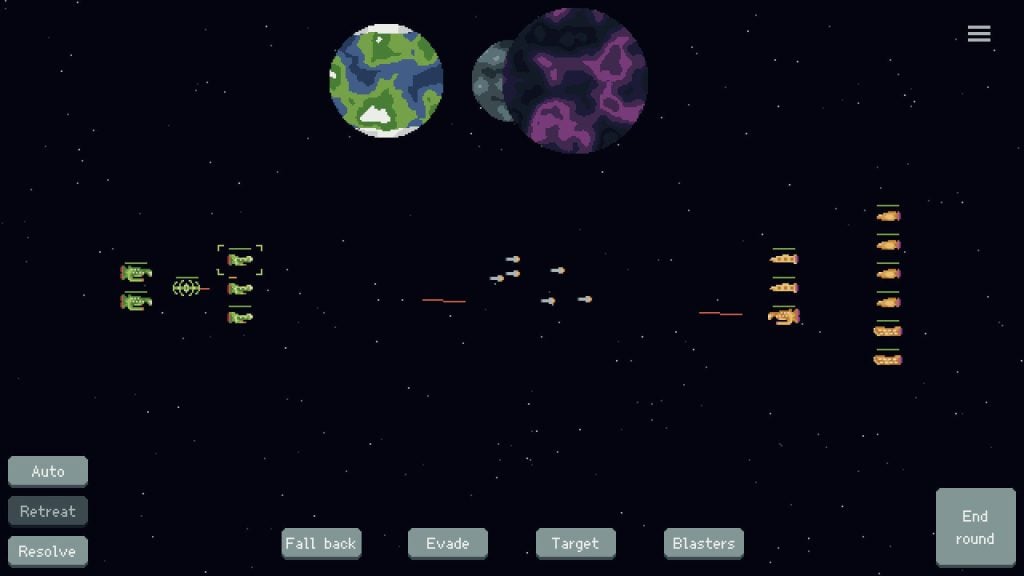
Different vessels bring their own roles and capabilities, including Scouts, Destroyers, Missile Ships, and heavier Battlecruisers, while Starbases and Missile Bases can protect important systems.
Players are not required to personally command every encounter. Battles can be automated or resolved immediately, allowing routine engagements to be completed quickly while leaving control available for strategically important confrontations.
Combat speed can also be adjusted, and successful battles may provide salvage that can be reinvested into the civilization.
Conquest Is Not the Only End Goal
Vega Chronicle supports multiple victory conditions. Development builds have included economic, scientific, cultural, and expansion-based victories, with the expansion route requiring control over a substantial portion of the galaxy.
Optional Aspirations and Monuments provide additional objectives during a campaign. These side goals can encourage players to pursue particular accomplishments even when they are not directly connected to the selected victory condition, adding some variation between civilizations and playthroughs.
Vega Chronicle is scheduled to launch on Steam sometime in 2027, with no exact release date announced. Its browser demo remains in active development and has recently received changes to planet generation, diplomacy, technology progression, combat information, and artificial intelligence. Below is the latest Demo Trailer.
