

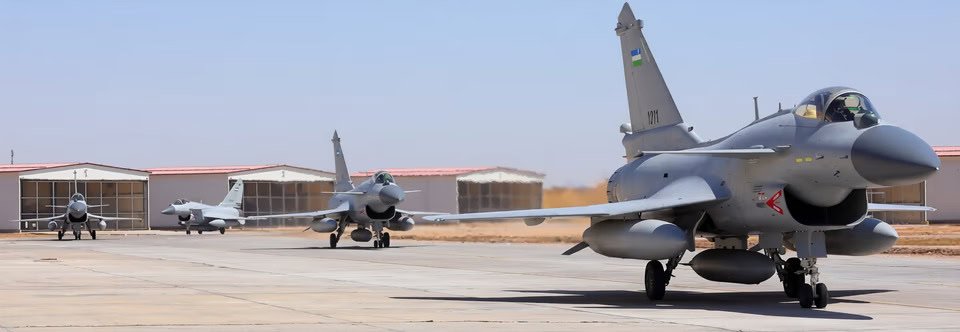
The Chinese-designed J-10 fighter has attracted its second export customer, with the Uzbek Air Force unveiling its newly arrived J-10CE jets in a national broadcast aired on 28 August 2026.
On that occasion, six of the fighters were seen, including images of them taxiing at Karshi-Khanabad Air Base as part of a welcome ceremony. This airfield is located near Karshi in the south of Uzbekistan, close to the Afghan border.
They were expected to fly in the nation’s Independence Day parade on 1 September. However, the first J-10 actually arrived in Uzbekistan in late July, with others arriving in August.
The country’s Ministry of Defence released footage of the six 4++-generation J-10s alongside the slogan “Air borders are protected by modern fighters”.
Uzbekistan follows Pakistan as an export operator of the J-10CE. It is unclear how many J-10s Tashkent ordered, but some reports quote a figure of between 20 and 24. Major General Shukhrat Khalmukhamedov, Uzbekistan’s Minister of Defence, had confirmed the deal in July 2025.
These Chinese-manufactured fighters will likely replace ageing Su-27s and MiG-29s in the Uzbek Air Force fleet. They have been assigned to the 60th Separate Mixed Aviation Brigade at Karshi-Khanabad.
No aerial refuelling probe was evident on the Uzbek aircraft, unsurprising given that the air force does not possess any tankers. Instead, they were seen carrying three external fuel tanks. Nor is anything known about what weapons Uzbekistan may have acquired from China.
Given the republic’s historic connection with the former Soviet Union, and its long tradition of sourcing all its defence equipment from there, it is significant that Uzbekistan has turned to China for its new combat aircraft.
It illustrates how China is making inroads into markets once exclusively held by Russia. Moscow, embroiled in war in Ukraine, is losing ground technologically and strategically to China.

The purchase of fighter jets also ensures that Uzbekistan, a country along the New Silk Road, will more closely fall under China’s orbit. However, China has a poor record in terms of after-market support and the quality of its military products, so Beijing will need to be careful to protect its reputation in Uzbekistan.
This is not the first time that Tashkent has acquired Chinese defence equipment, however. In 2015 it procured HQ-9B, FM-90 and KS-1C surface-to-air missile systems from Beijing.
Further underscoring Uzbekistan’s departure from Russian influence, in recent times it has acquired Airbus H125M and H215M helicopters, four Airbus C295MW transport aircraft and two C-390 transports from Embraer.
Pakistan started receiving its J-10CE fighters in 2022, and they participated in the border war with India last year.
Others have expressed interest in acquiring the J-10 from China, including Indonesia and Bangladesh. Perhaps the latter is closest to inking a deal for this jet built by Chengdu Aircraft Corporation.
by Gordon Arthur
