

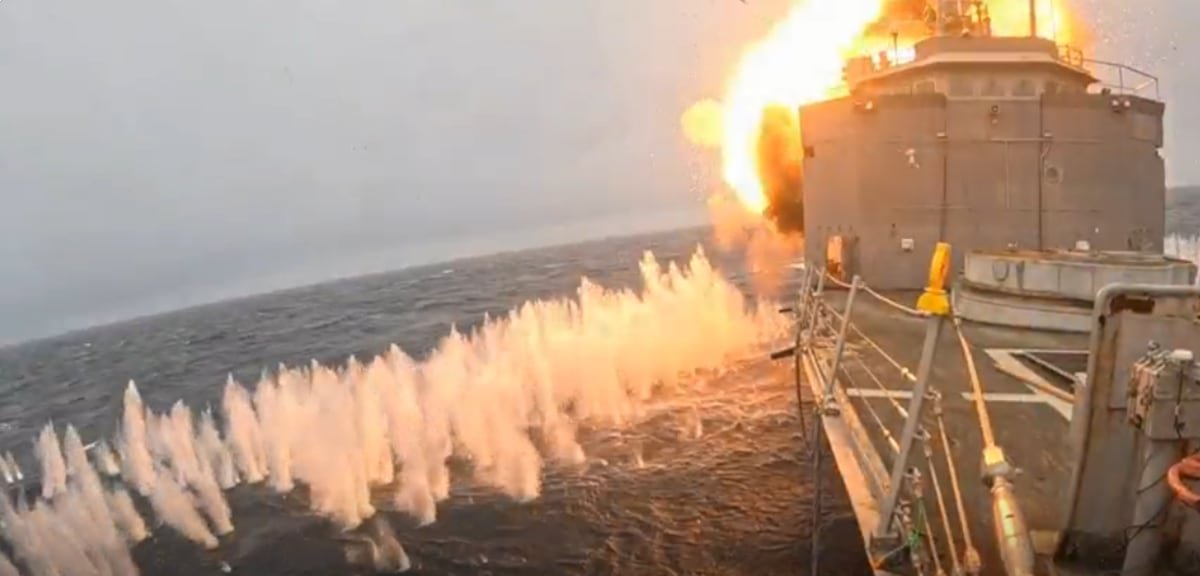
A decommissioned U.S. guided-missile frigate was sent below the seas on Sept. 25 during a joint U.S.-U.K. naval exercise, the U.S. Navy recently announced.
The recent SINKEX blended the firepower of U.S. Task Force 65, Task Force 67, Task Force 68, Task Force 69 and Task Force 1060 alongside the Royal Navy and the U.S. Air Force.
The USS Klakring, an Oliver Hazard Perry-class frigate — laid up in Philadelphia, Pennsylvania, since its decommissioning on March 22, 2013 — served as the target of the exercise.
Named for Rear Adm. Thomas B. Klakring, who was awarded three Navy Crosses as the commander of the submarine USS Guardfish during World War II, the USS Klakring entered the sea service on Aug. 20, 1983, and supported Operation Earnest Will to protect Kuwaiti oil tankers from Iranian attacks during the Iran-Iraq War.
The final blow to the USS Klakring on Sept. 25 came from the newly commissioned submarine USS Massachusetts, a nuclear-powered, Block IV Virginia-class fast-attack boat, which successfully struck and sank the decommissioned frigate with a Mk 48 Advanced Capability Torpedo.
“Atlantic Thunder demonstrates the unmatched lethality and interoperability of the United States and United Kingdom,” Capt. Kelechi Ndukwe, commander of U.S. Task Force 65, said in a release. “This sinking exercise not only validated the power behind U.S.-UK offensive weapons but delivers a clear message to adversaries that the U.S. Navy and Royal Navy remain a ready allied force.”
Led by the U.S. 6th Fleet in the North Atlantic, Exercise Atlantic Thunder 2026 came just days after the Royal Navy successfully launched a U.S. Navy Mk 48 Heavyweight Torpedo from a British Excalibur uncrewed underwater vehicle, or UUV, marking a significant step toward allied operational fleets of uncrewed vehicles.
The exercise highlighted capabilities within both the U.S. and U.K. fleets, with the guided-missile destroyer USS Paul Ignatius successfully inflicting maximum damage and range capability of an anti-surface variant of the Standard Missile 6 (SM 6), while the Royal Navy utilized its newest ship-busting missiles, the Naval Strike Missile and Sea Venom, per the release.
Claire Barrett is an editor and military history correspondent for Military Times. She holds a master’s degree in military history from King’s College, London, and is also a World War II researcher with an unparalleled affinity for Sir Winston Churchill and Michigan football.
