

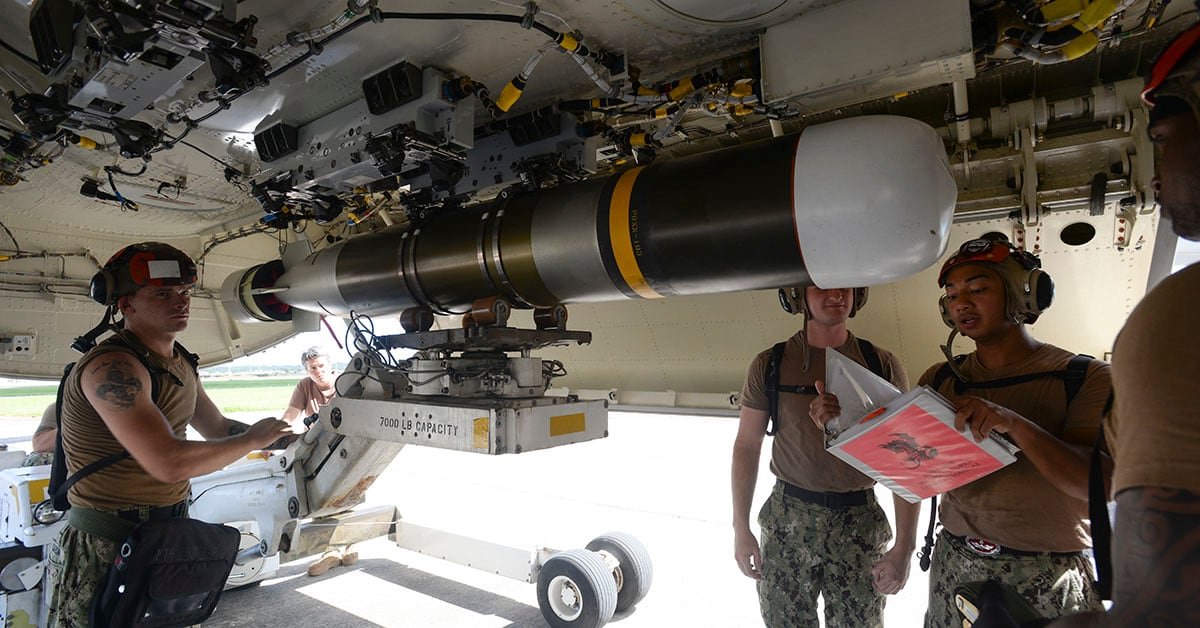
The Navy is exploring two options for its Silent Anvil Air-Launched Torpedo and is seeking contractors that fit the bill.
The first is a new torpedo launched from an aircraft or drone that glides into the water and acoustically homes in on the target.
The other is a glide kit affixed to an existing torpedo.
The concept seems similar to the Navy’s existing High Altitude Anti-Submarine Warfare Weapon Capability system, which added a glide kit to regular Mark 54 torpedoes that can be launched from P-8 Poseidon patrol planes flying as high as 30,000 feet. Or, the Air Force’s highly successful Joint Attack Direct Munition, which added fins and GPS to turn iron bombs into cheap guided munitions.
Silent Anvil would extend the concept to a wider “range of manned and unmanned aircraft platforms capable of executing ASW missions,” according to the Navy Request for Information. The deadline is Sept. 29.
The Navy seeks a weapon that can be carried internally or externally, and is compatible with a standard BRU-61/A bomb rack. The torpedo should have “compact, lightweight form factor similar to the GBU-39 Small Diameter Bomb (SDB) to maximize aircraft carriage options across multiple manned and unmanned platforms.”
This means a weight of no more than 268 pounds, a length of no more than 70 inches and a diameter of up to 7.5 inches. The RFI does not specify the range of Silent Anvil (the Mark 54 has a range of about 5.7 miles).
“The Government is seeking industry input on the maximum standoff glide range achievable,” the Navy said.
The RFI included launch speed and altitude bands: Mach 0.25, 0.50, and 0.85, at altitudes from 10 feet up to 60,000 feet. This is far higher than the P-8’s maximum altitude, and closer to the ceiling of an MQ-4C Triton high-altitude drone.
“SAA-LT shall maximize aerial flight endurance while minimizing aquatic immersion time, restricting water residence strictly to the minimum duration required for successful mission execution,” the Navy said. For the glide-kit version, the torpedo must enter the water at an angle of 45 to 90 degrees and at a velocity of 40-120 feet per second.
The SAA-LT timeline calls for a prototype within 18 months after an agreement award. This would be followed by 180 all-up-round prototypes within three years after a successful demonstration.
SAA-LT comes as China expands both the size and sophistication of its submarine fleet, including large, long-range robot subs. For its part, the U.S. Navy is also developing the Long Range Antisubmarine Warfare weapon, which will extend the reach of rocket-launched ASW torpedoes fired from vertical launch tubes on surface ships.
Michael Peck is a correspondent for Defense News and a columnist for the Center for European Policy Analysis. He holds an M.A. in political science from Rutgers University. Find him at theuncommondefense.com. His email is mikedefense1@gmail.com.
