

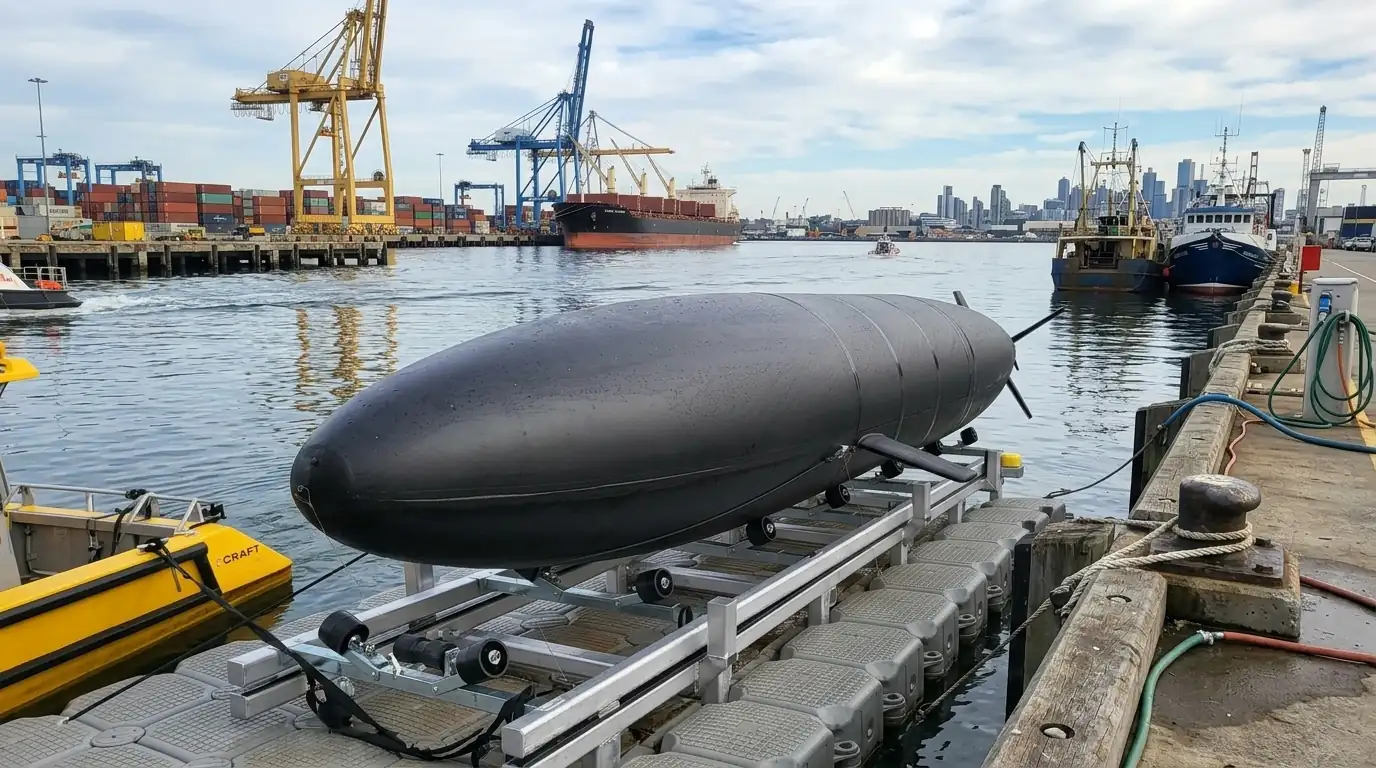
Defense Feeds, Washington — The United States is advancing autonomous undersea warfare as the US Navy Speartooth underwater drone expands autonomous strike capability following the delivery of the first Australian-developed Speartooth large unmanned underwater vehicle.
The platform represents a growing shift toward autonomous systems capable of conducting long-range underwater missions with limited human involvement. As naval competition intensifies, unmanned underwater technology is becoming increasingly important for future maritime operations.
The Speartooth LUUV has been developed to support a range of missions including underwater surveillance, intelligence gathering and autonomous strike operations. Unlike smaller unmanned underwater systems focused mainly on reconnaissance, large unmanned underwater vehicles are designed for extended endurance and more complex operational roles. This gives navies additional flexibility in contested maritime environments.
The delivery also highlights expanding defense cooperation between the United States and Australia. As both countries deepen strategic alignment in the Indo-Pacific, collaborative development of advanced military technologies has become a growing priority. The Speartooth program reflects this broader trend in allied defense integration.
Autonomous Underwater Strike Capability Expands
The Speartooth LUUV is designed to operate independently over long distances and extended periods beneath the surface. Its autonomous capabilities allow it to conduct missions in areas where crewed submarines may face higher risks or operational limitations. This makes it particularly valuable in contested underwater environments.
Large unmanned underwater vehicles are becoming increasingly important because they combine stealth with operational persistence. Unlike surface drones, underwater systems are naturally harder to detect and track. This provides strategic advantages for reconnaissance and strike missions.
The platform is also expected to support intelligence and surveillance operations. Equipped with advanced sensors, the Speartooth can collect underwater data and monitor maritime activity in critical regions. Persistent underwater awareness is becoming a key element of modern naval strategy.
In addition, autonomous strike capability could significantly expand operational flexibility. Unmanned underwater systems may eventually support precision engagement missions without placing crews directly in danger. This reflects a broader shift toward distributed and autonomous warfare concepts.

US-Australia Defense Cooperation Deepens
The delivery of the Speartooth drone to the US Navy underscores growing defense cooperation between Australia and the United States. Both countries are increasing collaboration in areas such as undersea warfare, autonomous systems and advanced defense technologies. The Indo-Pacific security environment is driving much of this partnership.
Australia has become an increasingly important contributor to allied defense innovation. Developing advanced unmanned systems domestically allows Canberra to strengthen its own military capabilities while supporting broader regional security objectives. Cooperation with the US also enhances interoperability between allied forces.
The Speartooth project aligns with wider strategic initiatives aimed at improving collective deterrence in the Indo-Pacific. Undersea warfare is expected to play a major role in future regional security competition, particularly as naval activity expands across strategic maritime routes.
Joint development and technology sharing also provide industrial benefits. Collaborative programs help accelerate innovation while distributing development costs and expertise. This strengthens long-term defense capability for both countries.
Future of Underwater Warfare Becomes Increasingly Autonomous
The introduction of the Speartooth LUUV reflects a broader transformation in naval warfare. Autonomous underwater systems are expected to become a central component of future maritime operations, particularly in intelligence gathering, mine warfare and strike missions. Their ability to operate with minimal human involvement provides major operational advantages.
Underwater drones can remain deployed for extended periods while conducting surveillance or monitoring activities in sensitive areas. This persistence allows navies to maintain awareness without constantly deploying crewed submarines or ships. Such capabilities are increasingly valuable in strategic competition.
The rise of autonomous underwater systems is also reshaping naval doctrine. Future fleets are likely to combine crewed submarines with networks of unmanned platforms operating together. This distributed approach enhances flexibility while reducing operational risk.
At the same time, integrating autonomous strike systems raises important technical and strategic questions. Reliable communication, navigation and command systems are essential for safe and effective operations. Ensuring these technologies function in contested underwater environments remains a significant challenge.
The US Navy’s receipt of the first Speartooth drone marks an important milestone in this evolving field. As undersea competition intensifies, autonomous systems are expected to play a larger role in future maritime security strategies. The program demonstrates how allied nations are preparing for a more technologically advanced underwater battlespace.
