

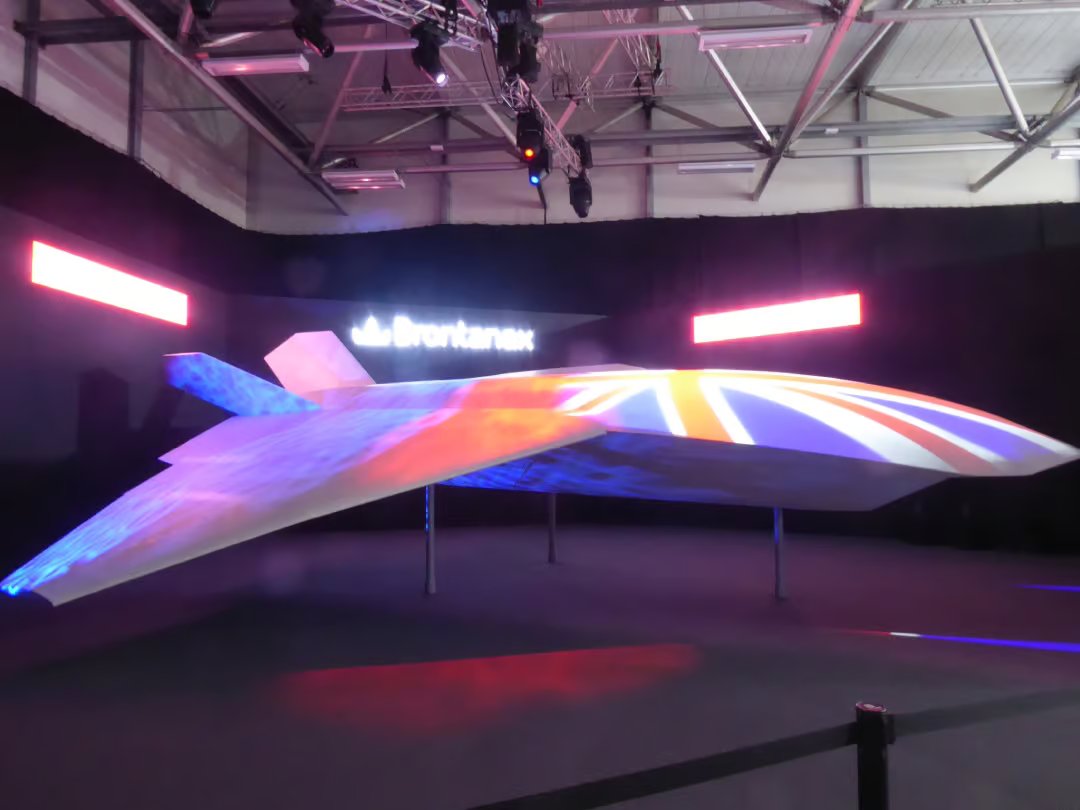

On the day when the new Defence Secretary, Wes Streeting, announced at Farnborough 2026 that £298 billion would be allocated to defence spending over the next four years, including £15 billion more than the previous settlement, BAE Systems revealed Brontanax, the UK’s first autonomous collaborative combat aircraft (CCA). Named after the Ancient Greek words for “thunder” and “king,” the uncrewed jet Brontanax is about the size of a Hawk trainer and is designed to operate alongside RAF Typhoons, F-35s, and the future sixth-generation fighter, Tempest, providing electronic warfare and precision-strike capabilities.
A demonstrator has been secretly developed by FalconWorks, BAE Systems’ advanced projects division at Warton, with its first flight scheduled for 2027 and initial RAF deployment by 2030. Weighing around five tonnes, the Brontanax demonstrator will be powered by a US Williams International jet engine, but BAE Systems intends to use one of the emerging powerplants from Rolls-Royce or an Orpheus family of low-cost turbofans in the future.
The programme is part of the UK’s £300 million StormFighter initiative for sovereign autonomous combat aircraft, as outlined in the recent UK Defence Investment Plan. That plan states that between 2030 and 2035, the UK aims to invest at least £70 billion in new capabilities for the air domain to realise the vision set out in the 2025 SDR. The UK’s Combat Air Force is expected to expand and operate fourth and fifth-generation fighters alongside autonomous air systems, including CCAs. These will improve sensor coverage, carry additional missiles, and significantly outperform the crewed air component, thereby enhancing survivability and lethality. The CCAs will utilise a sovereign, world-leading propulsion system. Continued investment in the UK’s CCA programme will deliver autonomous capabilities to every RAF combat air squadron within the next decade. The RAF must maintain the ability to penetrate contested airspace, which is vital to outpacing adversaries’ growing capabilities and conducting strikes, as well as intelligence, surveillance, and reconnaissance (ISR) missions.

The StormFighter programme is viewed as a UK and European response to reduce dependence on the United States and its perceived leadership in the emerging CCA sector, as emphasised by Britain’s new defence minister. Meanwhile, Germany is opening bids for a CCA after indicating last month that it would choose Boeing’s MQ-29 Ghost Bat, and StormFighter could be a contender.
by David Oliver
