

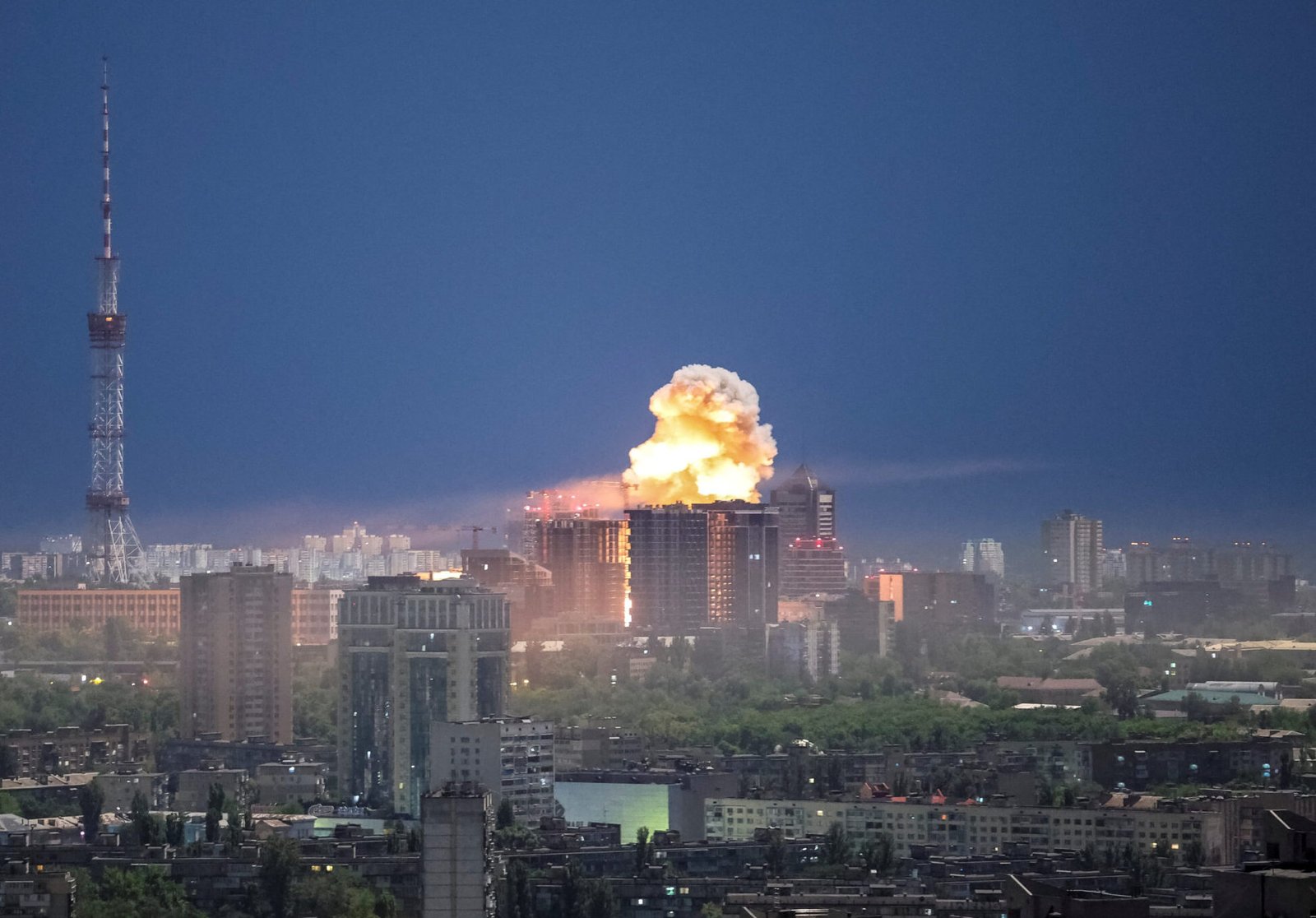
Russia has reportedly begun deploying a new generation of jet-powered strike drones against Ukrainian targets as the Kremlin seeks to counter the growing effectiveness of Ukraine’s interceptor drones. This latest development underlines the relentless race to innovate that has defined the Russia-Ukraine War, with neither side able to retain a clear technological advantage for long.
Russia has been using jet-powered drones in its air offensive against Ukraine for some time. However, the latest model is believed to combine a significantly expanded range of up to one thousand kilometers along with a substantially larger warhead. Open source analysts claim Russia is expanding launch infrastructure for these weapons systems in the Oryol region around two hundred kilometers north of Ukraine, suggesting preparations are now underway for large-scale deployment.
Speaking in early June, Ukraine’s top military commander Oleksandr Syrskyi warned that Russia aims to increase the share of jet-powered drones in its bombing campaign up to 50 percent. “The enemy is constantly changing tactics, increasing the number of drones and improving their quality,” he commented.
Stay updated
As the world watches the Russian invasion of Ukraine unfold, UkraineAlert delivers the best Atlantic Council expert insight and analysis on Ukraine twice a week directly to your inbox.
News of Russia’s latest drone upgrade comes as Ukraine’s interceptor capabilities appear to have given the country a temporary edge in the drone war. Ukrainian Defense Minister Mykhailo Fedorov recently stated that Ukraine’s interception rate of Russian strike drones doubled during the first four months of the current year. Ukrainian interceptor technologies have also made international headlines during spring 2026 as part of the response to Iranian drone strikes across the Middle East.
Enhanced jet-powered drones could help Russia regain the initiative in the drone war following a period of Ukrainian gains that have seen Kyiv improve defensive capabilities while also expanding mid-range strikes on Russian logistics behind the front lines and increasing attacks inside Russia itself. Drones are a key element of the Kremlin bombing campaign targeting Ukrainian cities and civilian infrastructure. With the Russian army struggling to achieve a breakthrough on the battlefield, Moscow is placing increasing emphasis on long-range airstrikes in a bid to weaken Ukraine’s wartime economy, undermine the morale of the civilian population, and force Kyiv to capitulate.
In order to enable its aerial offensive, Russia has focused on increasing the domestic production of strike drones. Moscow initially sourced these weapons from Iran but soon established large-scale manufacturing capabilities inside Russia. This has made it possible to dramatically expand the scale of bombing raids. Whereas overnight attacks in 2023 and 2024 typically featured dozens of drones, it is now common for hundreds of strike drones to be launched at targets across Ukraine in a single day. This trend has stretched Ukraine’s limited air defenses.
Over the past year, Ukrainian defense tech companies have responded to this heightened threat by developing a number of cheap but effective interceptor drones. This has made it possible to counter the far larger quantities of Russian strike drones being launched at Ukraine’s cities in a cost-effective and sustainable manner. The increasing use of jet-powered drones will now require further innovations from the Ukrainian side.
Eurasia Center events

Recent Russian upgrades extend beyond the new jet-powered drones currently entering service. According to Ukrainian analysts, Russia is also now deploying technologies that enable multiple drones to communicate in order to map out and bypass Ukrainian air defenses. Meanwhile, Ukrainian Air Force officials report that Russia is increasingly able to maintain direct operator control over drones during large-scale attacks by utilizing mobile networks.
These developments highlight the rapidly changing technological realities of the war. Since the start of Russia’s full-scale invasion more than four years ago, drone warfare has undergone a dramatic evolution that is redefining how modern military conflicts are fought.
Moscow and Kyiv have adopted drone strategies that reflect their broader war aims. While Russia intensifies the bombardment of Ukraine’s cities and civilian infrastructure as part of efforts to break Ukrainian resistance, Kyiv has prioritized mid-range attacks behind the front lines in order to disrupt Russian logistics, together with deep strikes inside Russia to weaken Putin’s war machine and starve the Kremlin of funding.
The development of drone warfare by both Russia and Ukraine since 2022 offers important lessons for the rest of the world. There is certainly much to learn. While Ukraine now routinely contends with nightly attacks involving five hundred drones or more, air defenses in neighboring countries have struggled to cope with far smaller numbers of drones. In late May, a single Russian drone was able to penetrate Romanian airspace and hit a residential building, injuring two. Similar incidents have caused alarm in Poland, Finland, and the Baltic states. Awareness of the drone threat is now growing, but the countries most at risk have yet to address the issue with a sense of urgency.
David Kirichenko is an associate research fellow at the Henry Jackson Society.
Further reading
The views expressed in UkraineAlert are solely those of the authors and do not necessarily reflect the views of the Atlantic Council, its staff, or its supporters.

The Eurasia Center’s mission is to enhance transatlantic cooperation in promoting stability, democratic values, and prosperity in Eurasia, from Eastern Europe and Turkey in the West to the Caucasus, Russia, and Central Asia in the East.
Follow us on social media
and support our work
Image: An explosion lights up an area during a Russian missile and drone strike, amid Russia’s attack on Ukraine, in Kyiv, Ukraine. June 2, 2026. (REUTERS/Gleb Garanich)
