

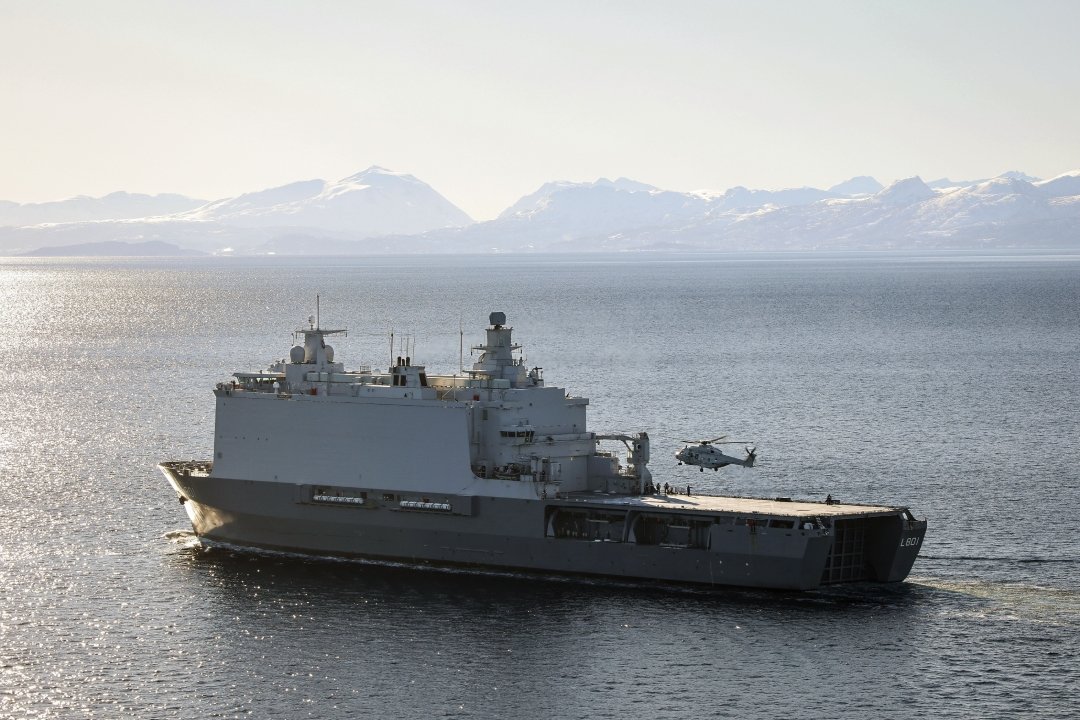

The UK and the Netherlands have announced a bilateral maritime partnership aimed at strengthening core capabilities that significantly boost their naval outputs in national, bilateral, and NATO contexts.
Headlines of the agreement, announced after a bilateral meeting between the two countries’ prime ministers on the sidelines of NATO’s Ankara Summit, include enhancing co-operation on developing maritime uncrewed systems (MUS) and establishing a common class of amphibious ship.
With the UK now set to join the Netherlands’ Amphibious Transport Ship (ATS) programme, the two nations will develop a combined fleet of eight ships, with four assigned to each. As part of the GBP2.4 billion deal, the ships will be built in UK yards to a Dutch design: the 15,000-tonne, 160-metre vessels will transport troops, vehicles, and equipment.
Reflecting both navies’ consistent shift towards developing ‘hybrid’, crewed and uncrewed force structures, a UK government statement noted that the ships’ flight decks will be designed to operate current and future long-range drones and autonomous systems.
The UK and Netherlands’ marine forces have long been increasing their cooperation in strategic, operational, and tactical areas. Developing a shared platform to support their national and bilateral operations is an obvious next step to further unify the two forces.
The respective amphibious units of the two nations – the UK’s Royal Marines Commandos and the Netherlands’ Korps Mariniers – are among NATO’s most advanced military forces. Since most of NATO’s operational zones are maritime, amphibious capability and capacity are crucial for strengthening NATO’s deterrence and defence, allowing the deployment of forces when and where they are needed, including in key regions across the North Atlantic and High North.
The decision to develop a common platform demonstrates the ambition of the two forces to train, deploy, and operate more effectively together. This, the UK statement said, would improve NATO’s ability to respond quickly to crises.
In the statement, UK Defence Secretary Dan Jarvis said, “We are building an even stronger amphibious force with the Netherlands, strengthening our defence and deterrence as close NATO allies and JEF partners.”
JEF – the Joint Expeditionary Force – is a UK-led alliance of ten northern European nations, with the Netherlands playing a key role. JEF aims to create deterrence below the level of open conflict, meaning an amphibious force can be used to establish a presence at a specific time and place to reinforce deterrence. Having two highly capable marine forces that are well integrated and, eventually, able to deploy on a common platform enhances the deterrent effect.
by Dr. Lee Willett
